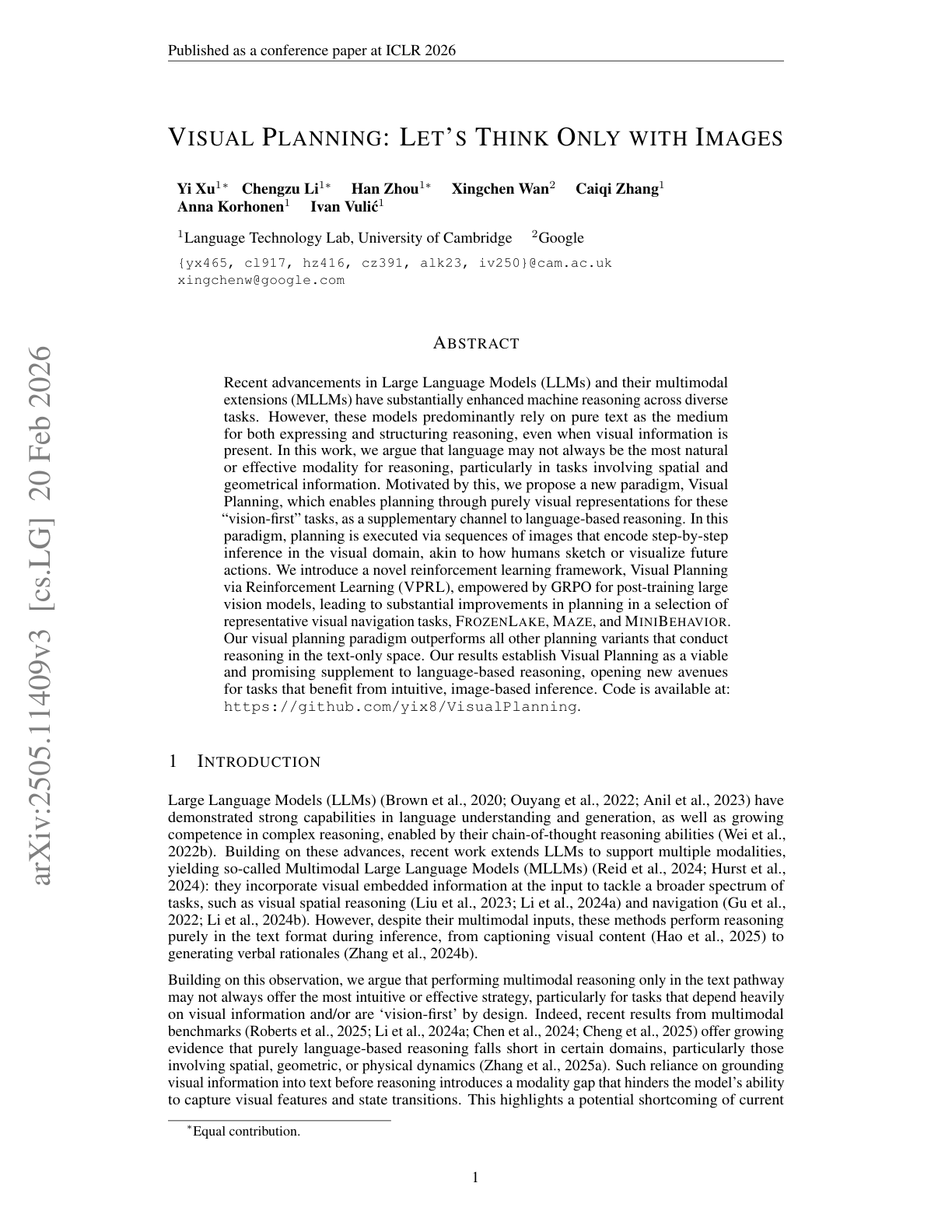
Visual Planning
Proposes a novel reasoning paradigm that replaces language-based planning with image-based reasoning. The authors argue that language is not always the optimal medium for tasks involving spatial or physical reasoning. They introduce Visual Planning, where reasoning is executed as a sequence of visual states (images) without any text mediation, allowing models to “think” directly in images. This is realized through a reinforcement learning framework called VPRL (Visual Planning via Reinforcement Learning), which trains a vision-only model (LVM-3B) to plan using images. Key contributions and findings:
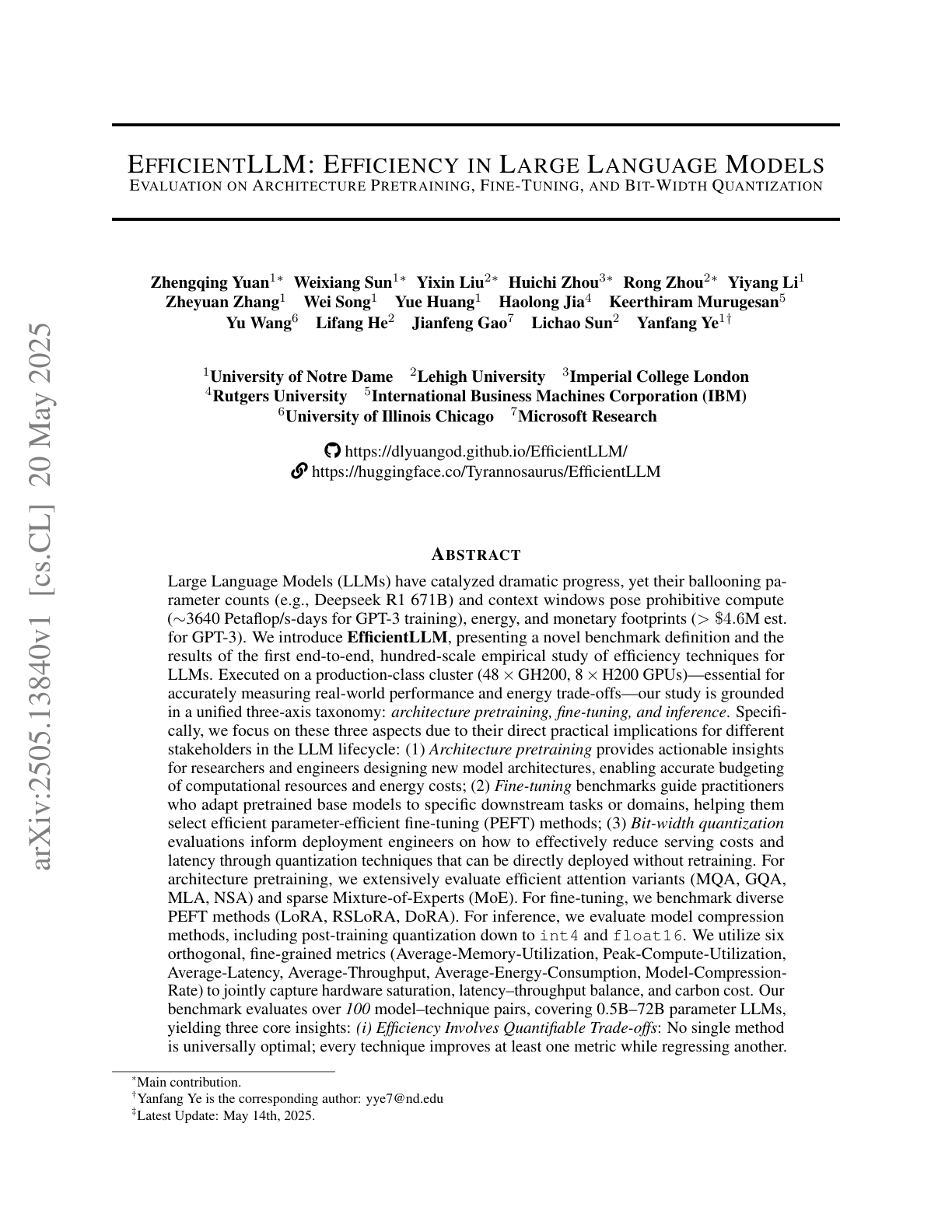
EfficientLLM
Introduces the first large-scale, empirical benchmark for evaluating efficiency trade-offs in LLMs across architecture, fine-tuning, and inference. Conducted on a high-performance cluster (48×GH200, 8×H200 GPUs), the study evaluates over 100 model–technique pairs spanning 0.5B–72B parameters, using six metrics: memory utilization, compute utilization, latency, throughput, energy consumption, and compression rate. Key insights include:
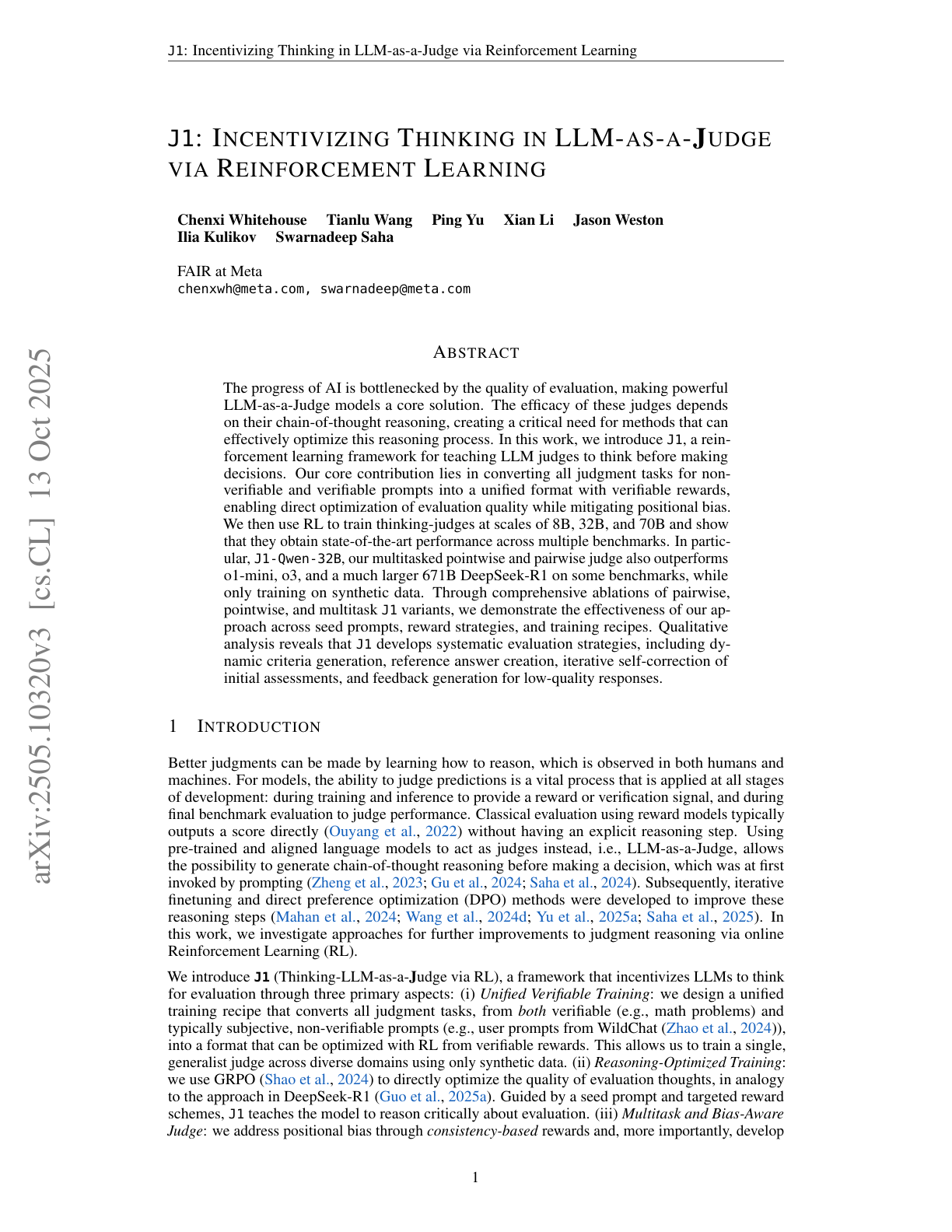
J1
Introduces a novel training approach for LLMs to act as evaluators (LLM-as-a-Judge) by explicitly incentivizing thoughtful reasoning during judgment. Instead of relying solely on prompting or preference fine-tuning, J1 employs online reinforcement learning with verifiable rewards to teach models to think through evaluations systematically. Key insights:
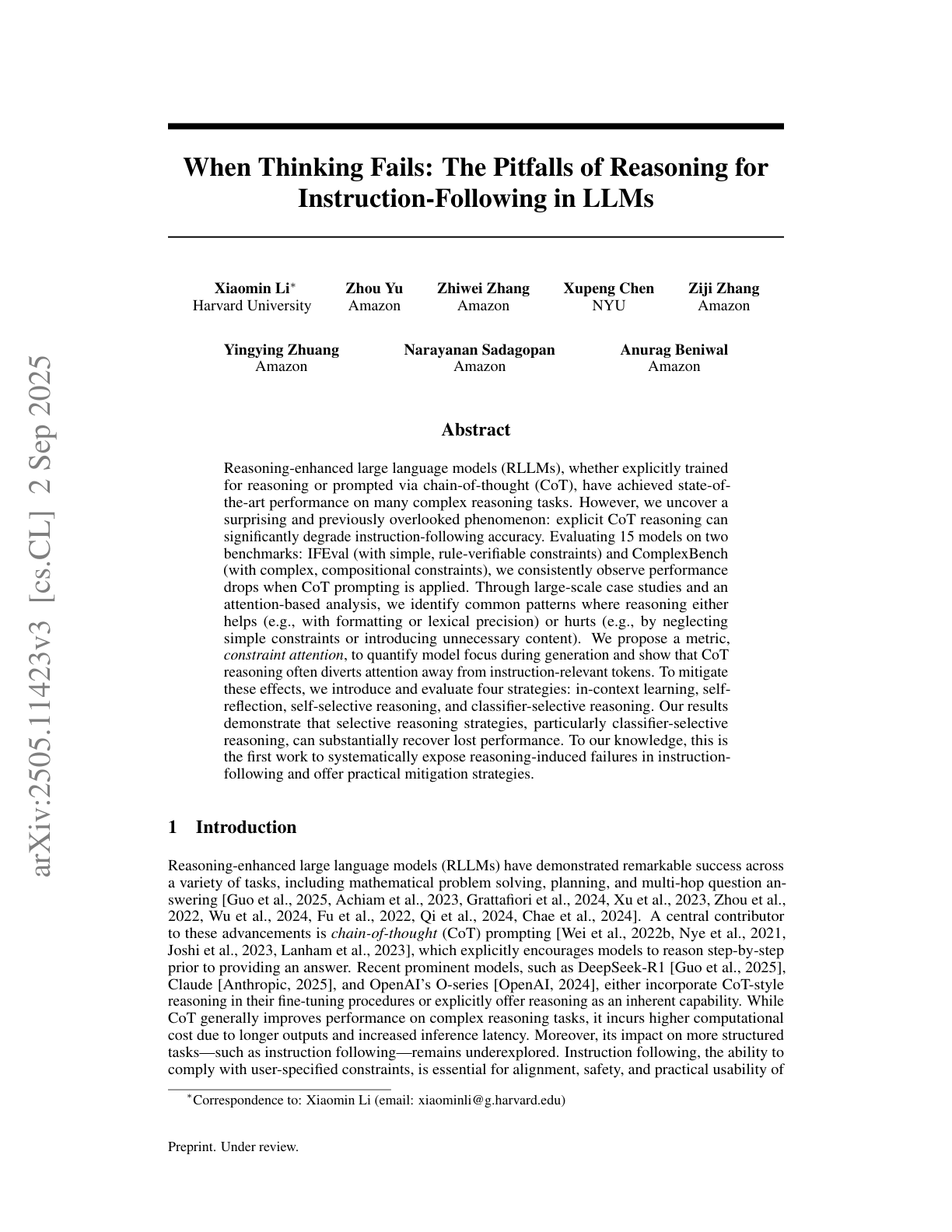
The Pitfalls of Reasoning for Instruction- Following in LLMs
Explores an unexpected flaw in reasoning-augmented large language models (RLLMs): while chain-of-thought (CoT) prompting often boosts performance on complex reasoning tasks, it can degrade instruction-following accuracy. The authors evaluate 15 models (e.g., GPT, Claude, LLaMA, DeepSeek) on two instruction-following benchmarks and find that CoT prompting consistently reduces performance across nearly all models and datasets. Key findings:

Generalizable AI Predicts Immunotherapy Outcomes Across Cancers and Treatments
Introduces COMPASS, a concept bottleneck-based foundation model that predicts patient response to immune checkpoint inhibitors (ICIs) using tumor transcriptomic data. Unlike prior biomarkers (TMB, PD-L1, or fixed gene signatures), COMPASS generalizes across cancer types, ICI regimens, and clinical contexts with strong interpretability and performance. Key contributions:
Towards a Deeper Understanding of Reasoning in LLMs
This paper investigates whether LLMs can adapt and reason in dynamic environments, moving beyond static benchmarks. Using the SmartPlay benchmark—a suite of four interactive games that require diverse cognitive skills—the authors evaluate three prompting strategies: self-reflection, heuristic mutation (via an Oracle), and planning. They test these methods across models of varying size (Llama3-8B to Llama3.3-70B) and draw several conclusions on how model scale and prompting interact with task complexity. Key findings:
AdaptThink
This paper introduces AdaptThink, an RL framework designed to help reasoning models decide when to use detailed chain-of-thought reasoning (“Thinking”) versus directly producing an answer (“NoThinking”), based on task difficulty. This approach challenges the prevailing assumption that deep reasoning should be applied uniformly across all problems, showing that skipping the “thinking” step often yields better efficiency and even higher accuracy on simpler tasks. Key insights:
MedBrowseComp
MedBrowseComp is a new benchmark designed to evaluate LLM agents’ ability to perform complex, multi-hop medical fact-finding by browsing real-world, domain-specific web resources. Testing over 1,000 clinically grounded questions, the benchmark reveals major capability gaps in current models, with top systems achieving only 50% accuracy and GUI-based agents performing even worse.
ARC-AGI-2
ARC-AGI-2 is a new benchmark designed to push the boundaries of AI reasoning beyond the original ARC-AGI. It introduces harder, more unique tasks emphasizing compositional generalization and human-like fluid intelligence, with baseline AI models performing below 5% accuracy despite strong ARC-AGI-1 results.
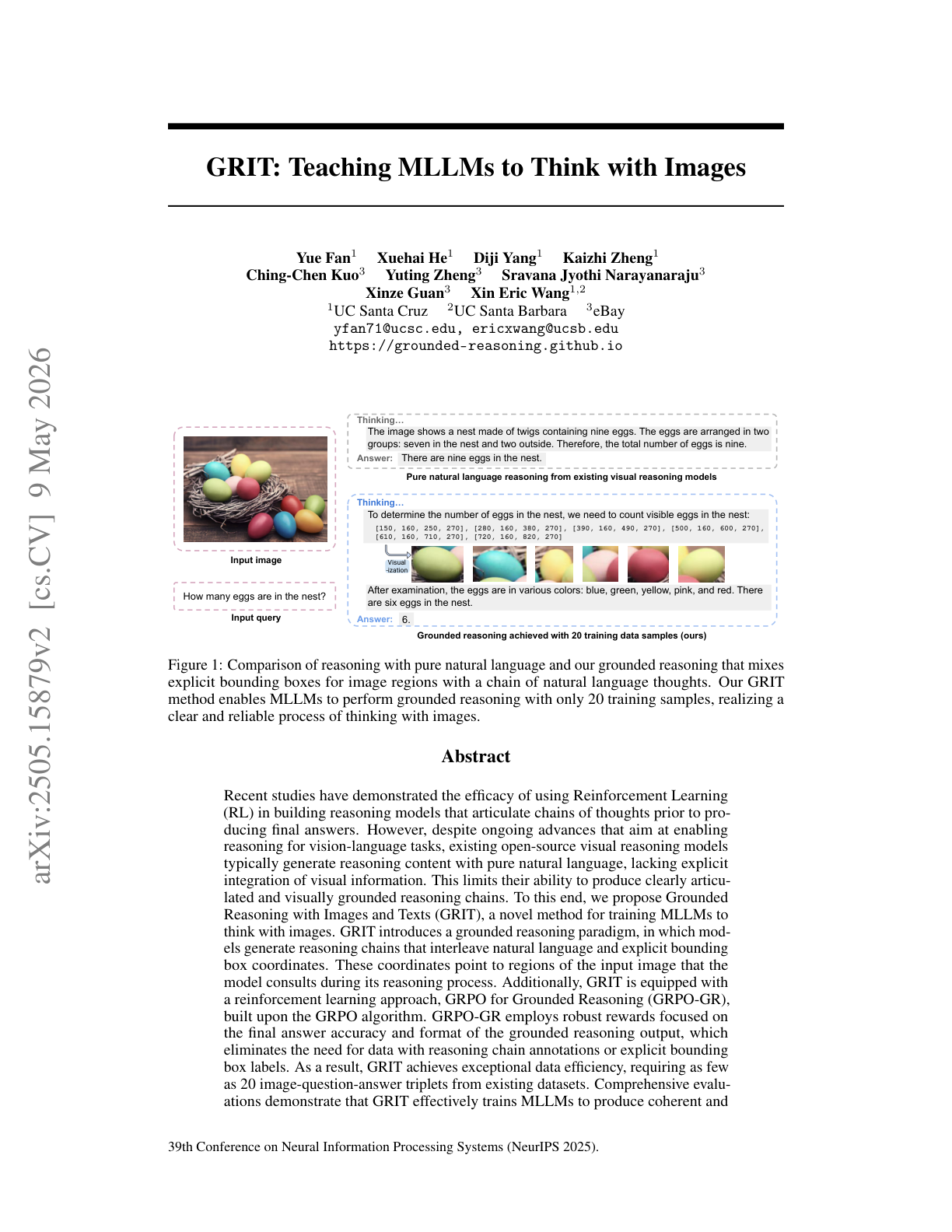
Teaching MLLMs to Think with Images
GRIT is a new method that enables MLLMs to perform grounded visual reasoning by interleaving natural language with bounding box references. Using a reinforcement learning approach (GRPO-GR), GRIT achieves strong reasoning and grounding performance with as few as 20 image-question-answer triplets, outperforming baselines in both accuracy and visual coherence.