Agent Lumos
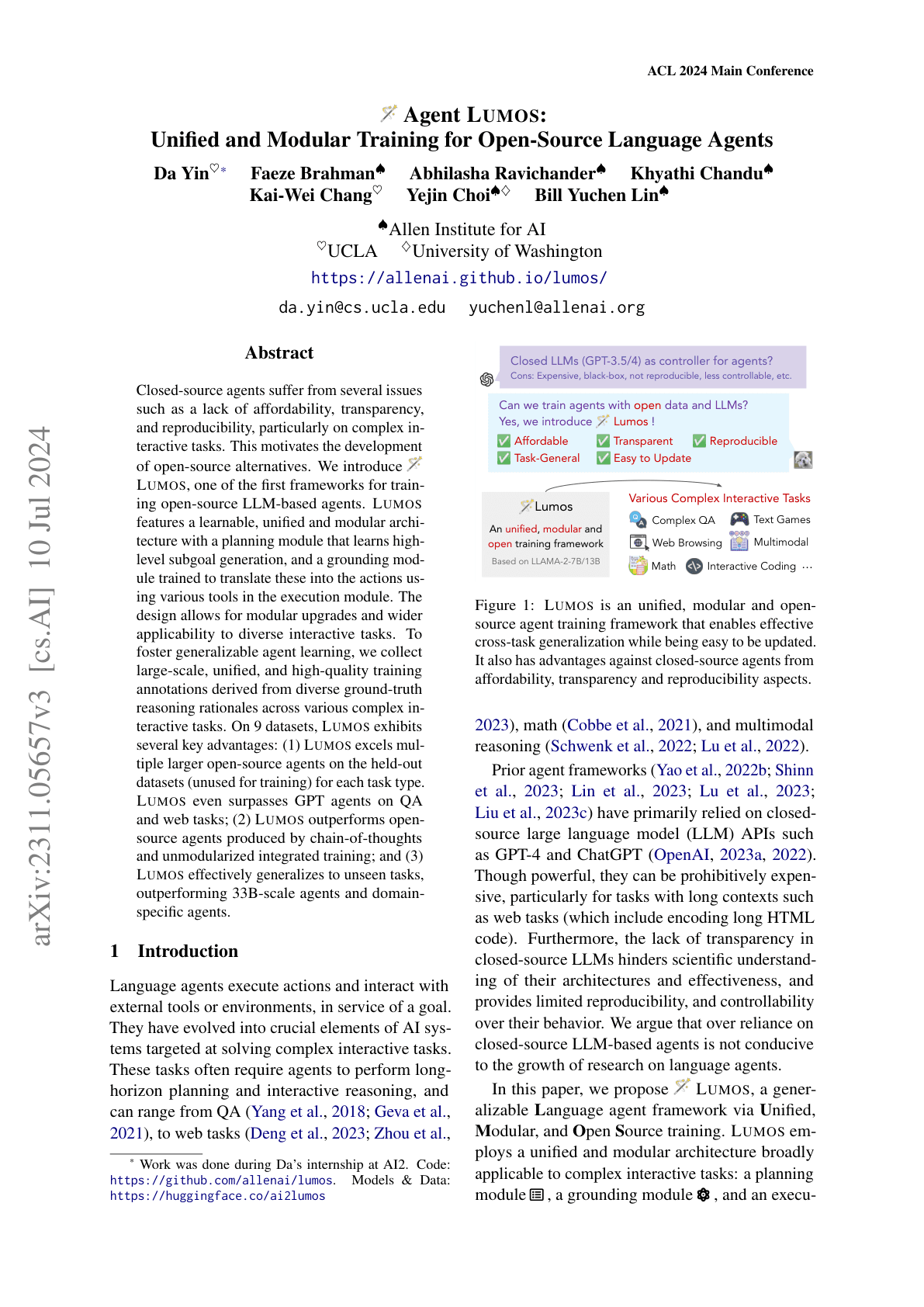
Lumos is a unified recipe for training open-source LLM agents that separates high-level planning from low-level grounding so each module can be supervised and improved independently.
Ask this paper
Modular architecture: One module learns to decompose complex tasks into subgoals (planning), while a second module translates those subgoals into concrete tool calls and actions (grounding).
Training data: The authors compile large-scale agent annotations by re-formatting reasoning rationales from math, web, and QA tasks into the Lumos planner/grounder format.
Nine-dataset evaluation: Across complex QA, web tasks, and math tasks, Lumos beats larger open agents and even surpasses GPT-3.5/GPT-4-based agents on QA and web domains.
Takeaway: Explicit modularization gives open-source agents a reproducible way to catch up to closed-source systems without needing frontier-scale base models.
Abstract
Closed-source agents suffer from several issues such as a lack of affordability, transparency, and reproducibility, particularly on complex interactive tasks. This motivates the development of open-source alternatives. We introduce LUMOS, one of the first frameworks for training open-source LLM-based agents. LUMOS features a learnable, unified, and modular architecture with a planning module that learns high-level subgoal generation, and a grounding module trained to translate these into actions using various tools in the execution module. The design allows for modular upgrades and wider applicability to diverse interactive tasks. To foster generalizable agent learning, we collect large-scale, unified, and high-quality training annotations derived from diverse ground-truth reasoning rationales across various complex interactive tasks. On 9 datasets, LUMOS exhibits several key advantages: (1) LUMOS excels multiple larger open-source agents on the held-out datasets (unused for training) for each task type. LUMOS even surpasses GPT agents on QA and web tasks; (2) LUMOS outperforms open-source agents produced by chain-of-thoughts and unmodularized integrated training; and (3) LUMOS effectively generalizes to unseen tasks, outperforming 33B-scale agents and domain-specific agents.