Agent S3
The paper introduces Behavior Best-of-N (bBoN): run many full CUAs in parallel, convert each rollout into a compact behavior narrative, then do comparative selection to pick the best trajectory. With a stronger base agent (Agent S3), this sets the state of the art on OSWorld and generalizes to Windows and Android.
Ask this paper
Behavior Best-of-N: sample multiple complete rollouts, summarize each with before/after deltas and pointer crops, and select the winner via a one-shot MCQ judge.
Agent S3 baseline: a flatter loop with an integrated coding sub-agent increases success and cuts LLM calls and wall time compared to Agent S2.
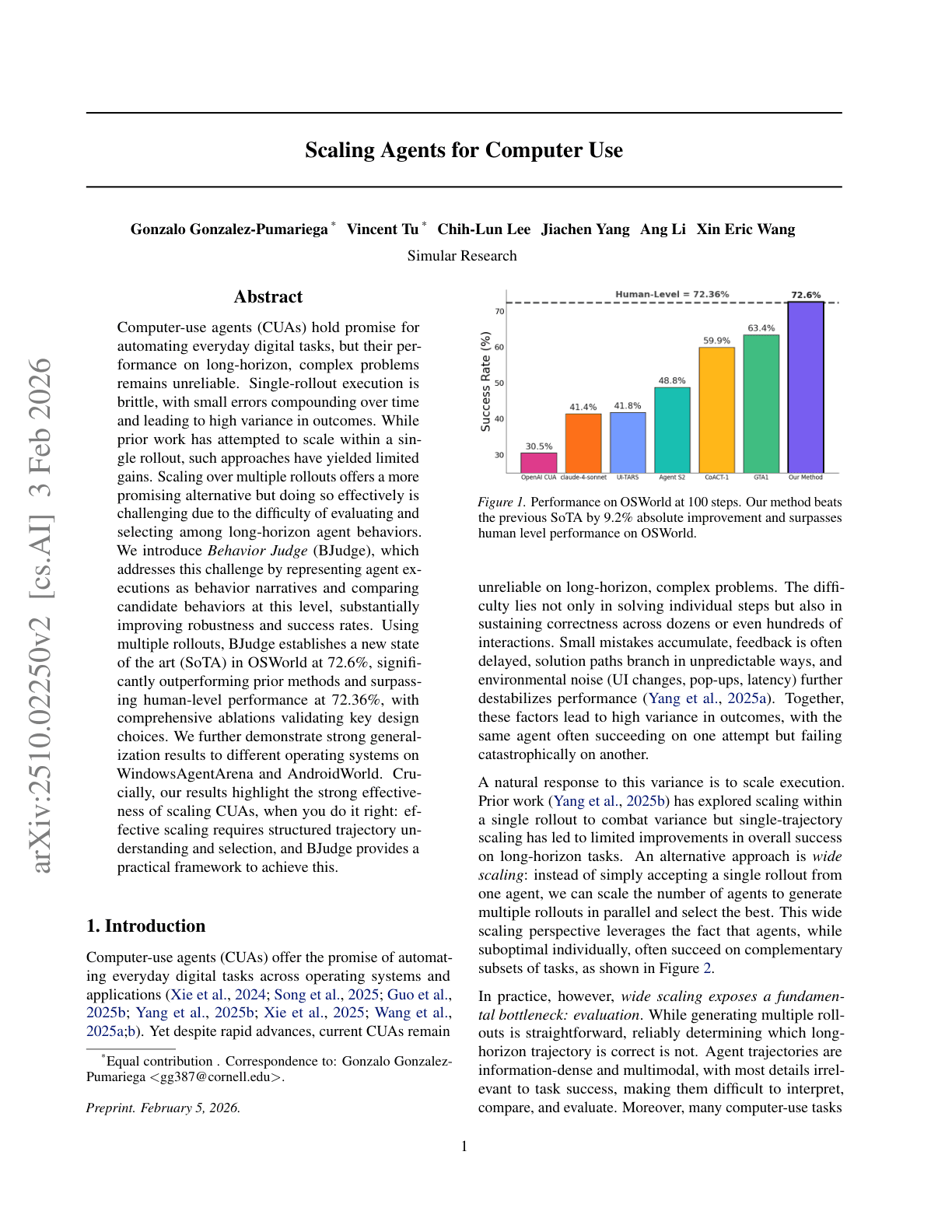
Results: new SoTA on OSWorld at 100 steps, with strong gains in efficiency, and the approach transfers to Windows and Android setups.
Scaling: accuracy rises as N grows, model diversity improves Pass@N, and single-round comparative selection matches or beats pairwise tournaments at lower cost.
Practical takeaways: spin up parallel VMs from the same snapshot, instrument steps to emit verifiable deltas, start with N around 4 to 10, and add diverse strong models if budget allows.
Limitation: assumes independent parallel runs; shared real-desktop side effects can leak across attempts.
Abstract
Computer-use agents (CUAs) hold promise for automating everyday digital tasks, but their performance on long-horizon, complex problems remains unreliable. Single-rollout execution is brittle, with small errors compounding over time and leading to high variance in outcomes. While prior work has attempted to scale within a single rollout, such approaches have yielded limited gains. Scaling over multiple rollouts offers a more promising alternative but doing so effectively is challenging due to the difficulty of evaluating and selecting among long-horizon agent behaviors. We introduce Behavior Judge (BJudge), which addresses this challenge by representing agent executions as behavior narratives and comparing candidate behaviors at this level, substantially improving robustness and success rates. Using multiple rollouts, BJudge establishes a new state of the art (SoTA) in OSWorld at 72.6%, significantly outperforming prior methods and surpassing human-level performance at 72.36%, with comprehensive ablations validating key design choices. We further demonstrate strong generalization results to different operating systems on WindowsAgentArena and AndroidWorld. Crucially, our results highlight the strong effectiveness of scaling CUAs, when you do it right: effective scaling requires structured trajectory understanding and selection, and BJudge provides a practical framework to achieve this.