The Era of Real-World Human Interaction
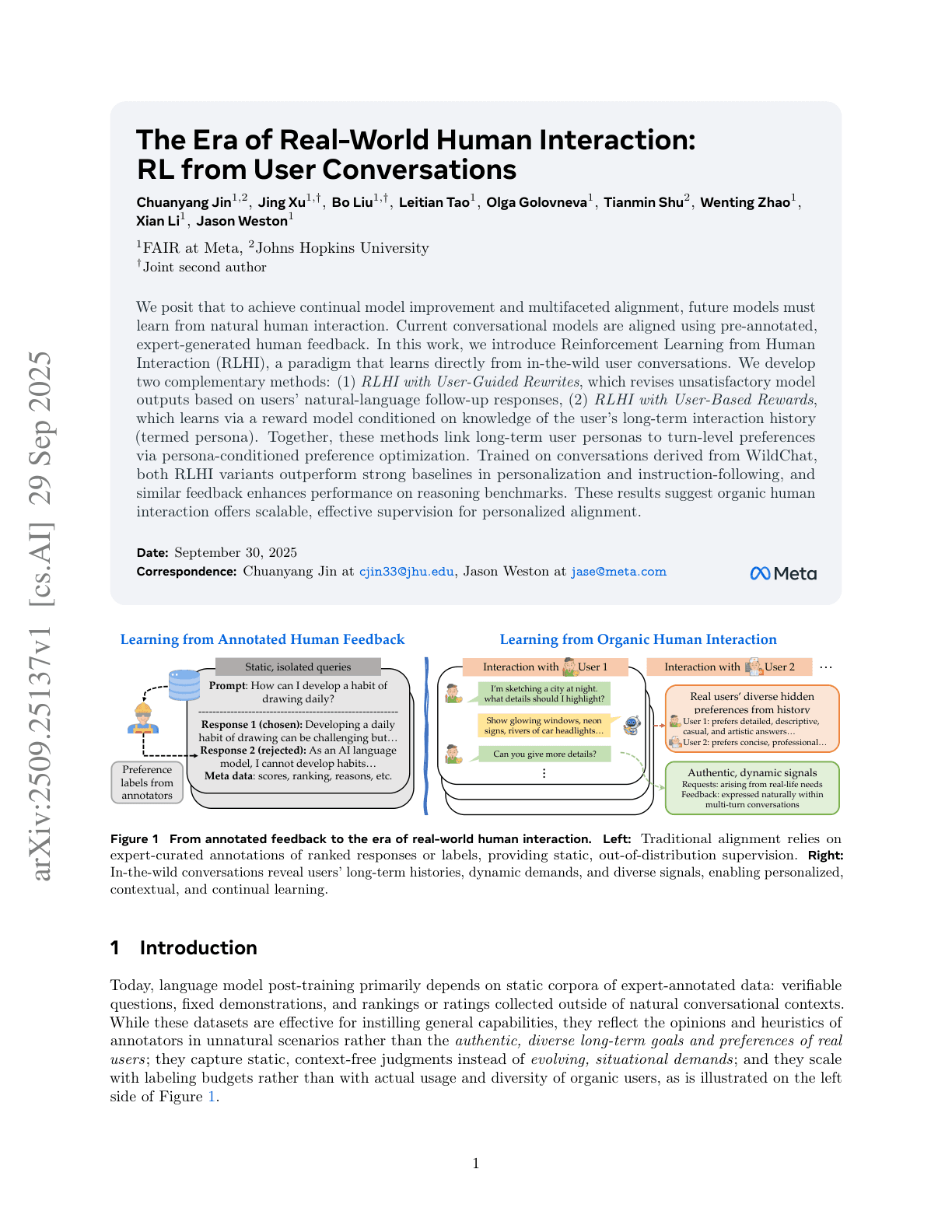
This work presents a post-training recipe that learns directly from real user conversations instead of static annotator labels. RLHI combines user-guided rewrites (using follow-ups as corrections) with persona-based rewards (ranking sampled candidates via a persona-conditioned reward model). Trained on WildChat conversations, it shows strong improvements in personalization, instruction following, and even transfers to reasoning tasks.
Ask this paper
Personas are distilled from long-term user histories and prepended at inference; training uses persona-conditioned DPO on rewrites and reward-ranked pairs.
Real chats contain rich correction signals, especially in later turns, providing dense supervision.
On WildChat-based evaluation, rewrites improve personalization and preference, while persona-based rewards lead in instruction following.
Benchmarks show strong results: 77.9% win rate on AlpacaEval 2.0, competitive on Arena-Hard, and reasoning accuracy rising from 26.5 to 31.8 across math/science datasets.
Key ablations: RL > SFT for interaction data, strong quality filters are essential, and user diversity matters more than depth per user.
Next steps include online continual learning, safer reward modeling, and privacy-preserving personalization.
Abstract
We posit that to achieve continual model improvement and multifaceted alignment, future models must learn from natural human interaction. Current conversational models are aligned using pre-annotated, expert-generated human feedback. In this work, we introduce Reinforcement Learning from Human Interaction (RLHI), a paradigm that learns directly from in-the-wild user conversations. We develop two complementary methods: (1) RLHI with User-Guided Rewrites, which revises unsatisfactory model outputs based on users' natural-language follow-up responses, (2) RLHI with User-Based Rewards, which learns via a reward model conditioned on knowledge of the user's long-term interaction history (termed persona). Together, these methods link long-term user personas to turn-level preferences via persona-conditioned preference optimization. Trained on conversations derived from WildChat, both RLHI variants outperform strong baselines in personalization and instruction-following, and similar feedback enhances performance on reasoning benchmarks. These results suggest organic human interaction offers scalable, effective supervision for personalized alignment.