Agentic Context Engineering (ACE)
Presents a modular context-engineering framework that grows and refines an LLM’s working context like a playbook, not a terse prompt. ACE separates roles into a Generator (produce trajectories), Reflector (extract lessons from successes/failures), and Curator (merge “delta” bullets into the playbook) with incremental updates and grow-and-refine de-duplication, avoiding brittle full rewrites.
Ask this paper
Why it’s needed: Prior prompt optimizers tend to compress into short generic instructions (brevity bias) and can suffer context collapse when an LLM rewrites a long context end-to-end. In AppWorld, a context of 18,282 tokens with 66.7% accuracy collapsed to 122 tokens with 57.1% at the next step.
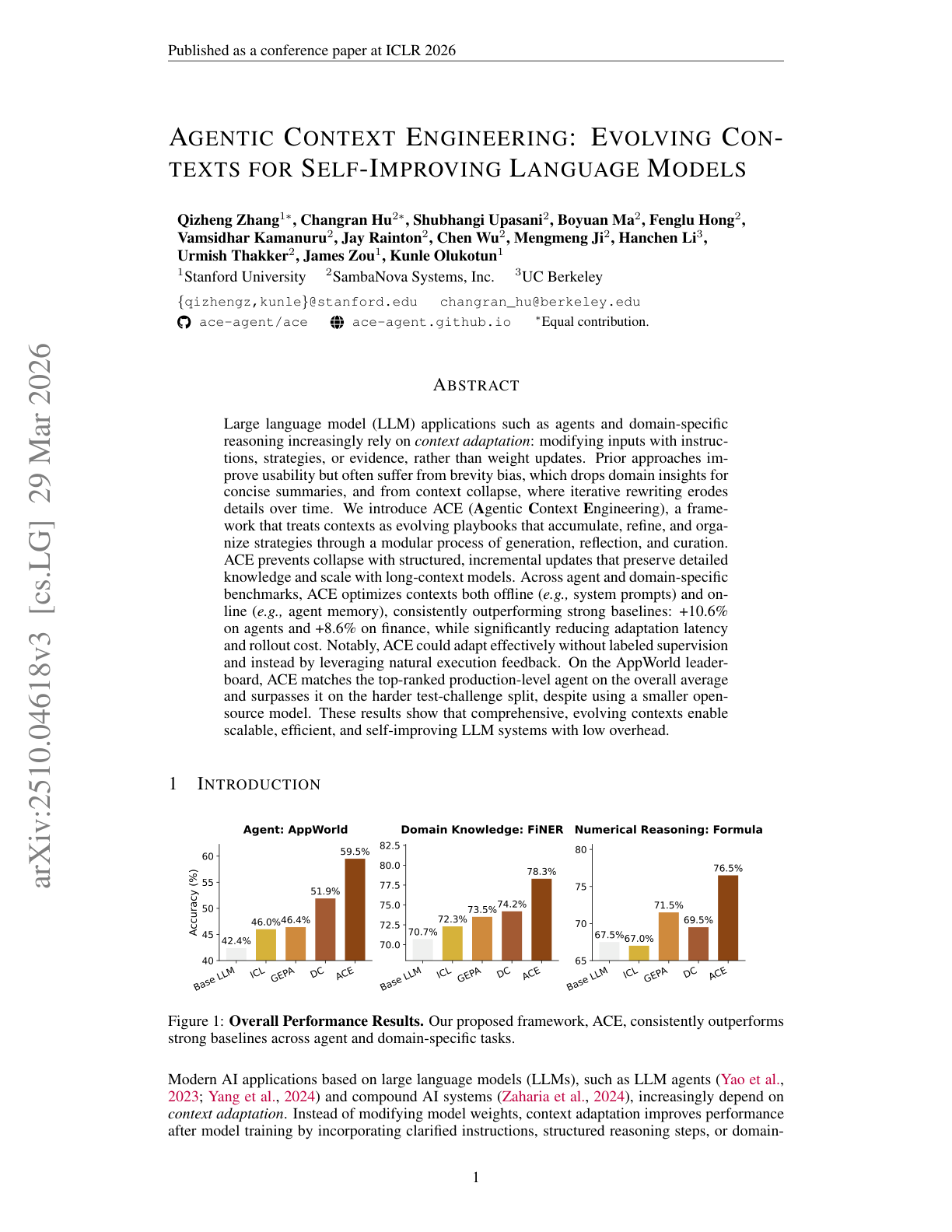
Results (agents): On AppWorld, ACE consistently beats strong baselines in both offline and online adaptation. Example: ReAct+ACE (offline) lifts average score to 59.4% vs 46.0–46.4% for ICL/GEPA. Online, ReAct+ACE reaches 59.5% vs 51.9% for Dynamic Cheatsheet. ACE matches the leaderboard’s top production agent on average and surpasses it on the challenge split using a smaller open model (DeepSeek-V3.1).
Results (domain reasoning): On finance benchmarks FiNER and Formula, ACE adds +8.6% average over strong optimizers in offline adaptation, and also leads in online settings when reliable feedback exists.
Cost and latency: Because ACE applies localized delta merges with non-LLM logic, adaptation is far cheaper and faster. Examples: −82.3% latency and −75.1% rollouts vs GEPA for AppWorld offline, and −91.5% latency and −83.6% token cost vs DC on FiNER online.
For builders: Treat your system prompts and agent memory as a living playbook. Log trajectories, reflect to extract actionable bullets (strategies, tool schemas, failure modes), then merge as append-only deltas with periodic semantic de-dupe. Use execution signals and unit tests as supervision. Start offline to warm up a seed playbook, then continue online to self-improve. Limitations: quality depends on the Reflector signal; in low-signal settings, both ACE and other adaptive methods can degrade.