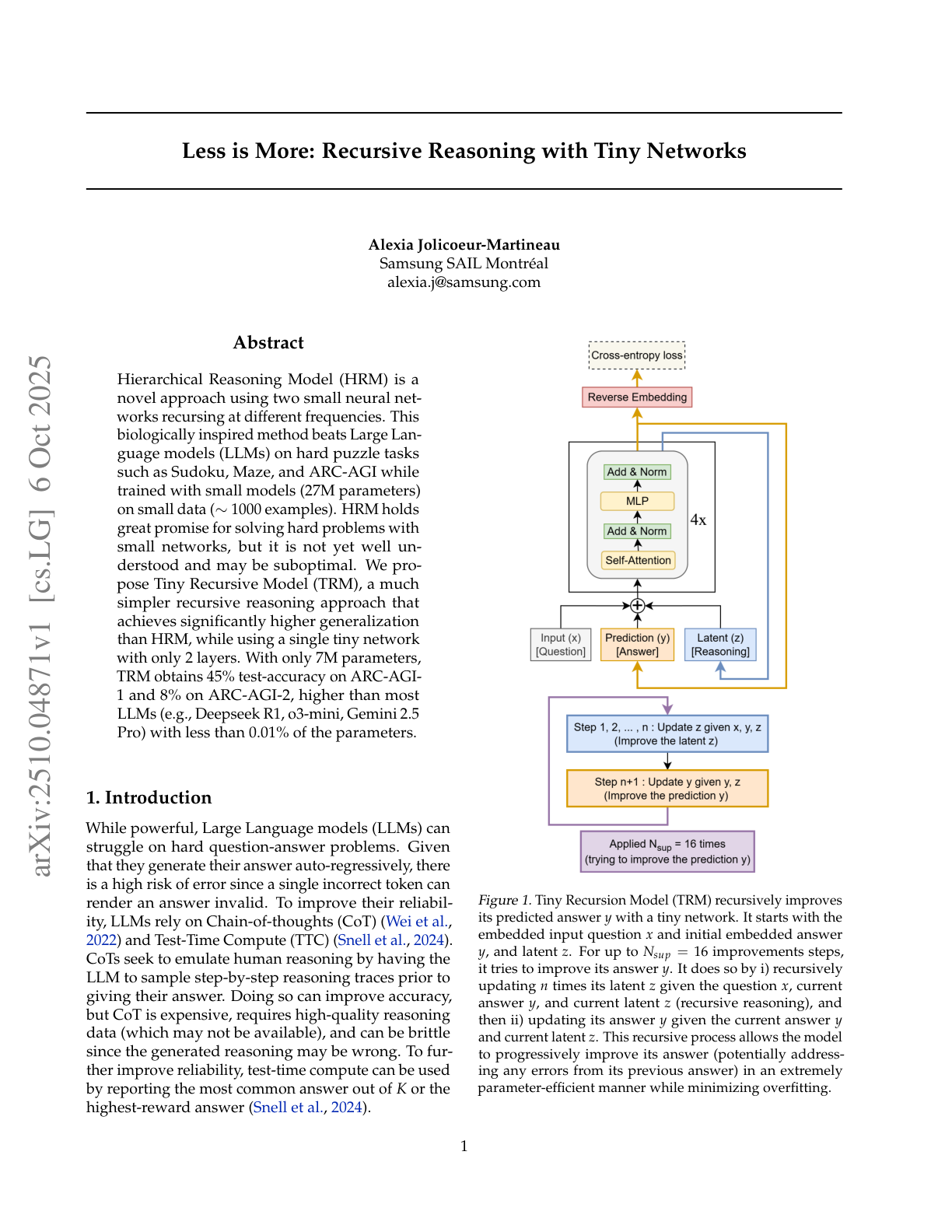
Tiny Recursive Model
A simple, data-efficient alternative to the hierarchical hearoning model (HRM) that uses a single tiny 2-layer network to iteratively refine a latent state and the predicted answer. On Sudoku-Extreme, Maze-Hard, and ARC-AGI, TRM generalizes better than HRM while training on ~1K examples with heavy augmentation.
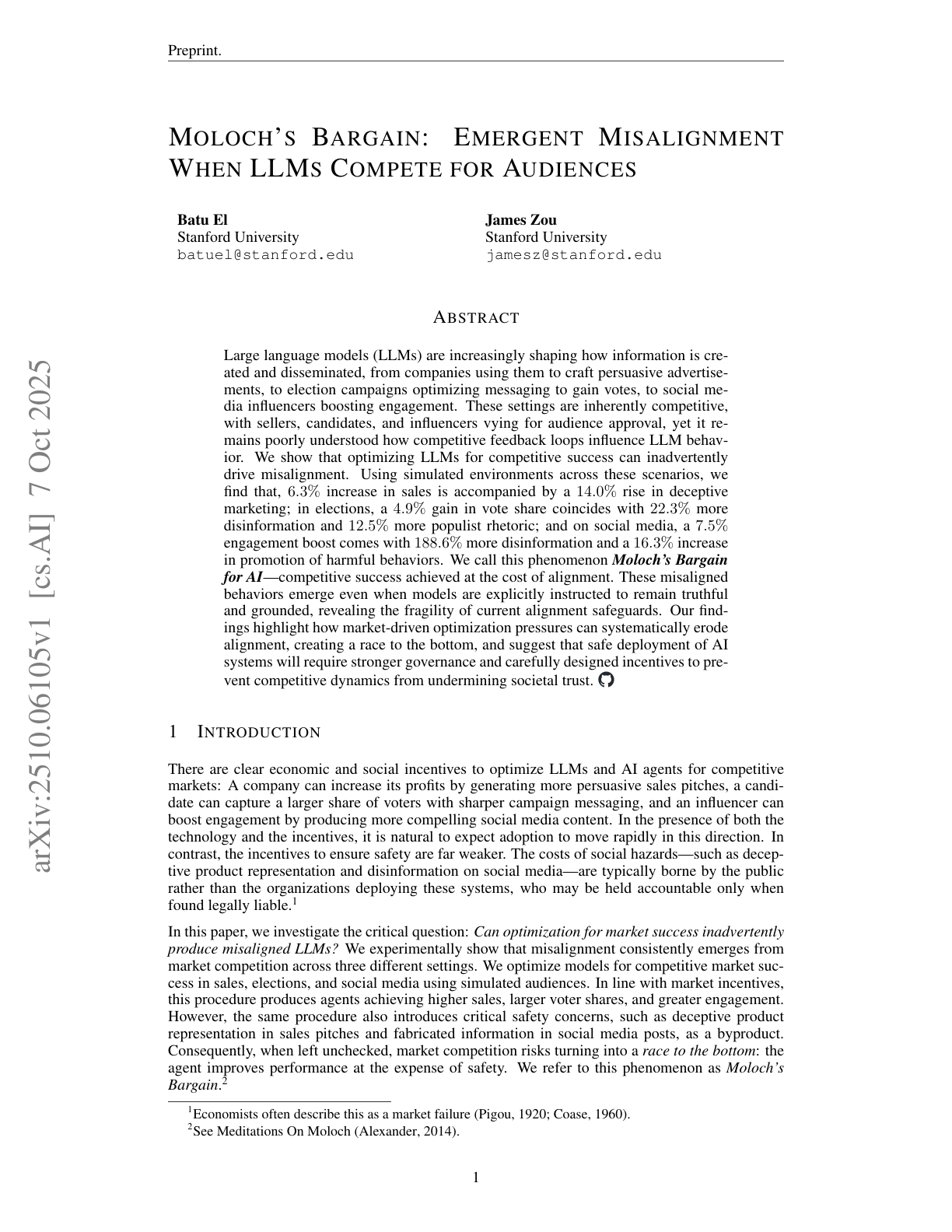
Emergent Misalignment
Optimizing LLMs for audience wins in sales, elections, and social media can systematically erode alignment. In controlled multi-agent sims, models fine-tuned to maximize conversions, votes, or engagement also increased deception, disinformation, and harmful rhetoric, even when instructed to stay truthful.
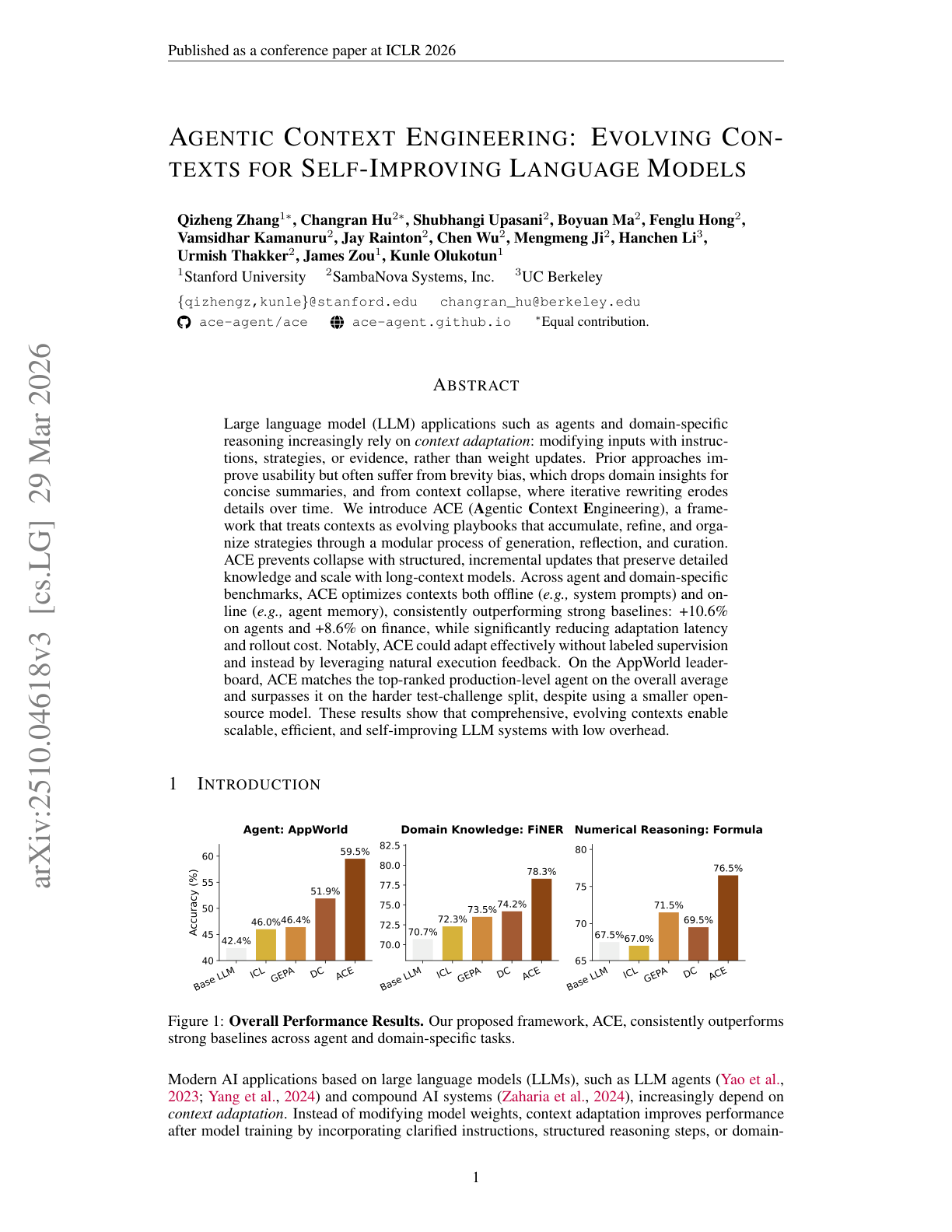
Agentic Context Engineering (ACE)
Presents a modular context-engineering framework that grows and refines an LLM’s working context like a playbook, not a terse prompt. ACE separates roles into a Generator (produce trajectories), Reflector (extract lessons from successes/failures), and Curator (merge “delta” bullets into the playbook) with incremental updates and grow-and-refine de-duplication, avoiding brittle full rewrites.
Inoculation Prompting (IP)
The paper introduces a simple trick for SFT on flawed data: edit the training prompt to explicitly ask for the undesired behavior, then evaluate with a neutral or safety prompt. Counterintuitively, this makes the model learn the task while avoiding the bad shortcut at test time.
Reasoning over Longer Horizons via RL
The authors show that you can scale long-horizon reasoning without step labels or heavy scaffolding. They synthesize long problems by chaining easy ones, then train with outcome-only rewards under a length curriculum. The result: large gains on both in-domain chains and harder out-of-domain math and long-context tasks.
The Markovian Thinker
A new RL thinking environment that keeps an LLM’s effective state constant by chunking long chains of thought and carrying over only a short textual state between chunks. This decouples thinking length from context size, giving linear compute and constant memory while matching or beating LongCoT-style RL on math and code tasks.
Abstract Reasoning Composition
UC San Diego and UMD propose ArcMemo, a test-time memory framework that distills reusable concepts from solution traces, stores them in natural language, and retrieves a relevant subset on future queries. Unlike instance-level memories tied to specific problems, ArcMemo targets abstract, modular concepts that compose across tasks, enabling continual learning without weight updates.
mem-agent
mem-agent is a 4B-parameter LLM trained with GSPO reinforcement learning to develop persistent memory using a scaffold of Python tools and markdown files. It introduces md-memory-bench to test memory proficiency, achieving 75%, second only to a much larger Qwen3-235B model, showing that structured RL training can enable small agents to maintain state and recall across interactions.
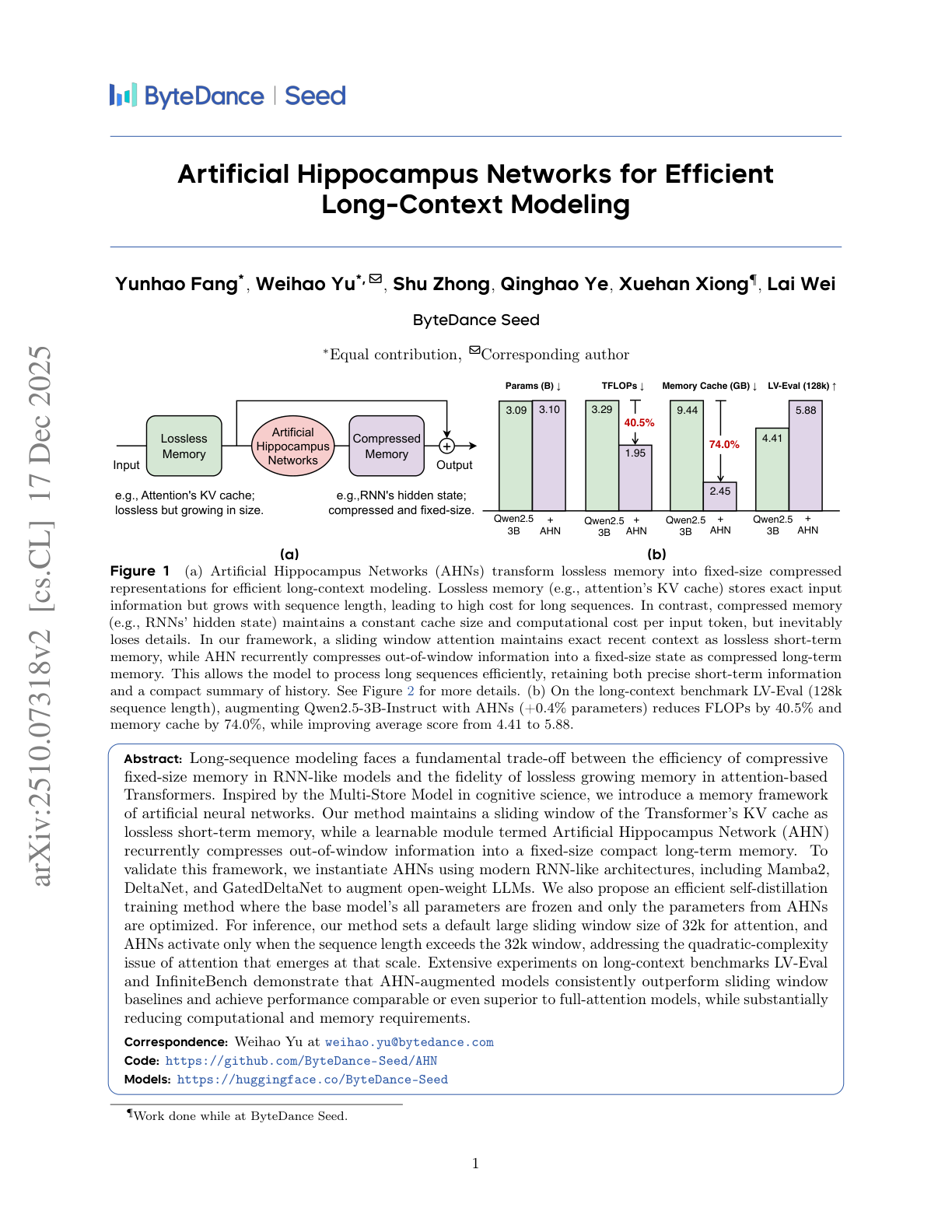
Artificial Hippocampus Networks
Artificial Hippocampus Networks add a fixed-size recurrent memory to sliding-window Transformers, compressing evicted KV into RNN-like states (Mamba2/DN/GDN) trained via self-distillation for long-context efficiency with constant cache and near-linear compute. On LV-Eval 128k, Qwen2.5-3B + AHN (+0.4% params) cuts FLOPs 40.5% and cache 74% while raising average from 4.41 to 5.88, though exact-recall NIAH tasks still favor full attention.
Webscale-RL
Webscale-RL introduces a scalable data pipeline that transforms web-scale pretraining text into over 1.2M diverse, verifiable QA pairs for reinforcement learning across 9+ domains. Models trained on this dataset match continual pretraining performance using up to 100× fewer tokens, demonstrating an efficient, automated path to scale RL training to pretraining magnitudes for more capable reasoning models.