Reasoning over Longer Horizons via RL
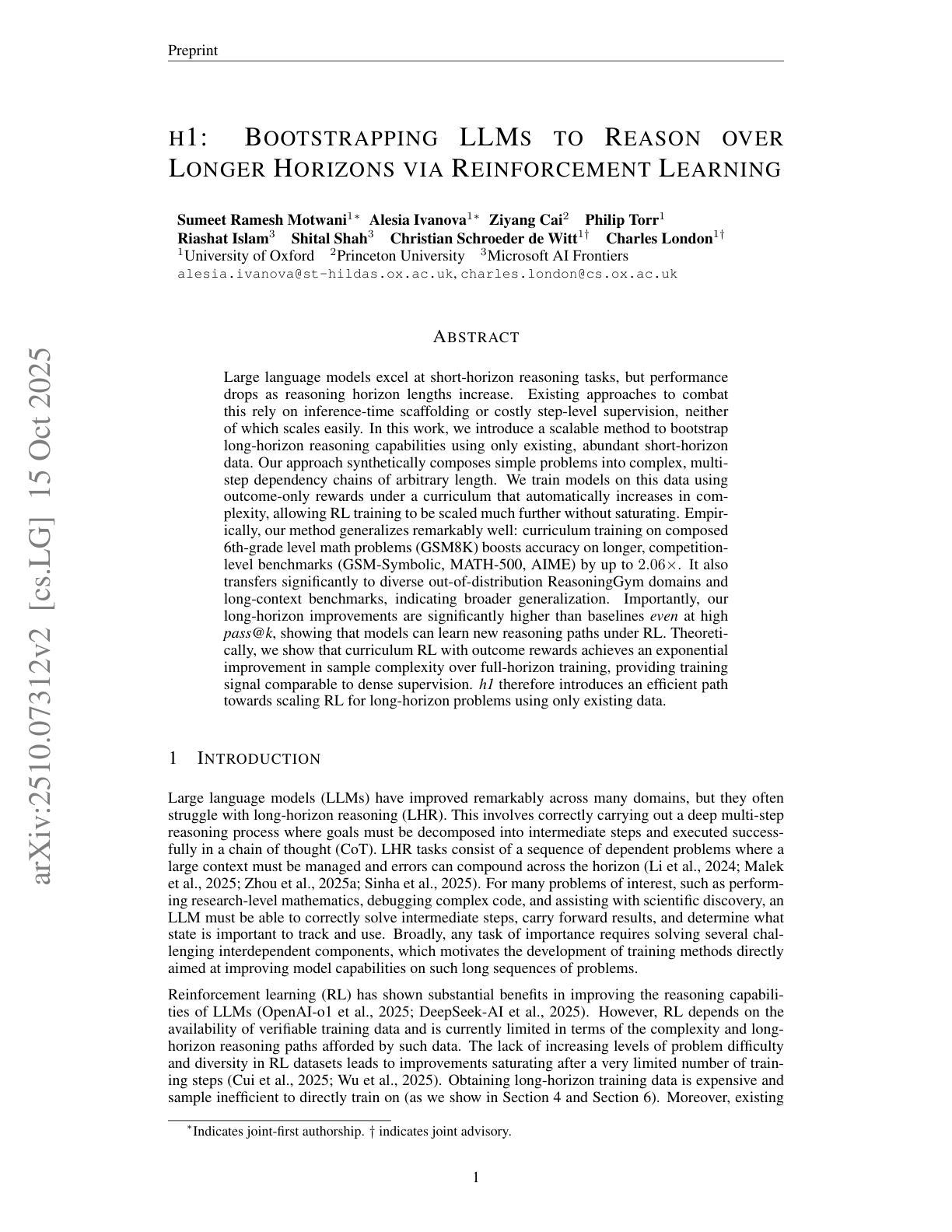
The authors show that you can scale long-horizon reasoning without step labels or heavy scaffolding. They synthesize long problems by chaining easy ones, then train with outcome-only rewards under a length curriculum. The result: large gains on both in-domain chains and harder out-of-domain math and long-context tasks.
Ask this paper
Method in one line: compose h-step problem chains from atomic tasks (e.g., GSM8K items) via lightweight adapters, then run stage-wise GRPO on horizon h=1→H so models first master short skills and then reliably reuse them at longer depths.
Why it works: they argue LHR needs more than per-step accuracy p; it also needs horizon skills σ_j (state tracking, reusing intermediate values). Curriculum increases the signal at each depth, avoiding vanishing reward at long horizons. The theory section proves that curriculum or dense rewards cut sample complexity from exponential in H to polynomial.
Core results: on composed GSM8K chains, curriculum RL boosts accuracy by up to 2.9× at longer horizons vs. instruct and standard RL baselines. Crucially, gains persist even at high pass@k (up to 128) on unseen lengths, indicating genuinely new reasoning paths rather than better sampling of the base model.
Generalization: training only on composed GSM8K transfers to harder benchmarks: AIME 2024 improves from 5.10 to 10.52 (2.06×), GSM-Symbolic P2 rises from 43.08 to 52.00, and long-context tasks improve on LongBench-v2 and Hash-hop.
Practical recipe: use an instruct base (they use Qwen-2.5-3B), synthesize horizon-h chains with deterministic adapters, verify only the final answer, and run Dr.GRPO in stages with an expanding max output length. They also show you can skew datasets toward cheaper short examples and recover performance by spending more training compute.