Agentic-R1
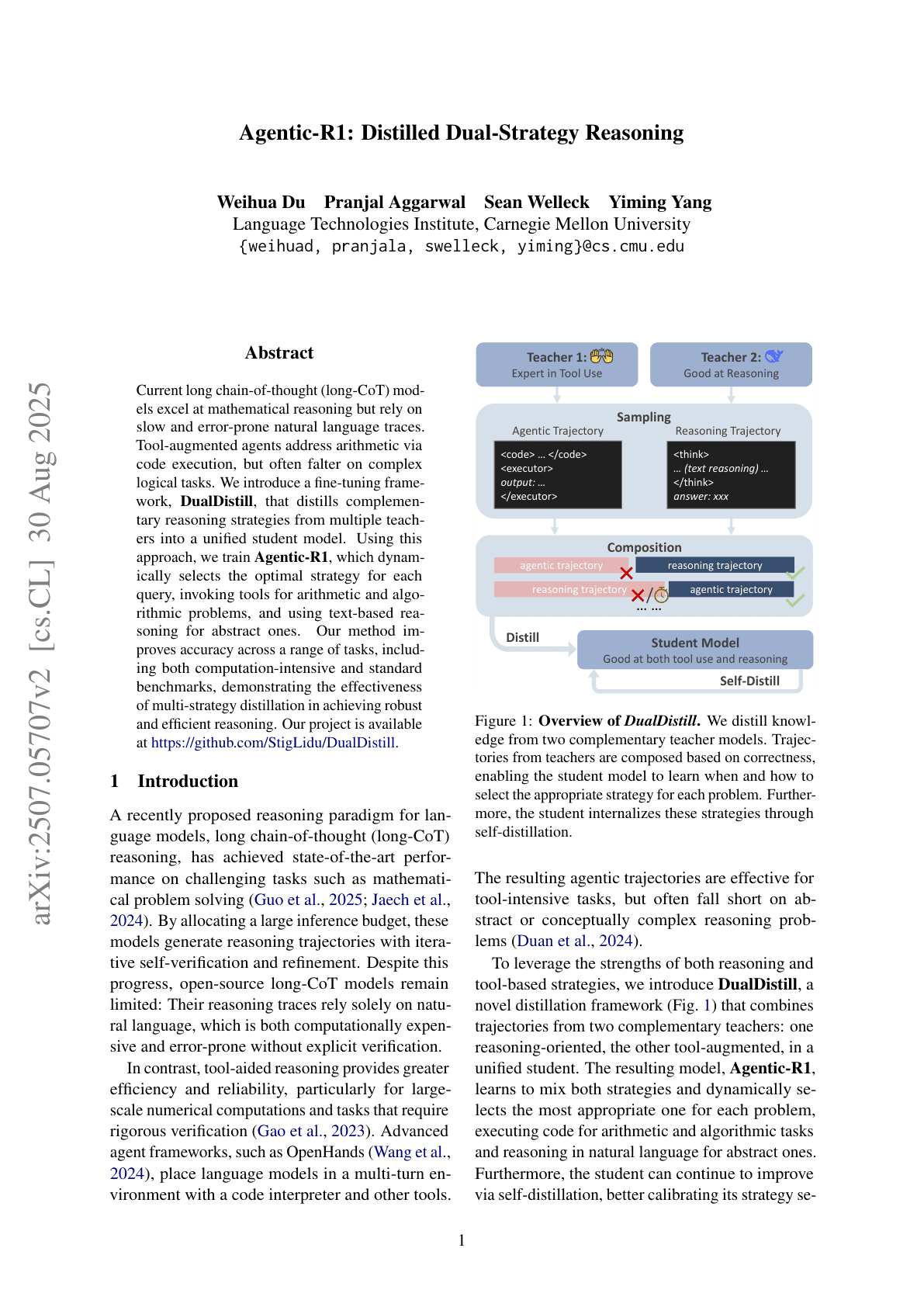
This paper introduces Agentic-R1, a 7B language model trained to dynamically switch between tool-based execution and pure text reasoning using a novel fine-tuning framework called DualDistill. Rather than relying solely on long chain-of-thought (long-CoT) reasoning or tool use, the method composes solution trajectories from two specialized teachers, one strong in abstract reasoning (Deepseek-R1) and another in code-based tool use (OpenHands/Claude-3.5). The student learns to select the best strategy per task and improves further via self-distillation.
Ask this paper
DualDistill composes mixed trajectories by combining teacher outputs based on correctness, with explicit transitions that allow the student to learn adaptive reasoning strategies from both paradigms.
The model performs well on a wide range of mathematical tasks. On tool-heavy benchmarks like DeepMath-L and Combinatorics300, Agentic-R1 outperforms both single-strategy baselines and even its agentic teacher. Notably, tool usage was invoked in 79.2% of Combinatorics300 problems but only 52% in simpler AMC tasks, showing strategic selectivity.
Self-distillation improves performance further: the final version, Agentic-R1-SD, achieves the best results across most benchmarks (e.g., 65.3% on DeepMath-L under a large token budget vs. 56.3% for Deepseek-R1-Distill).
An ablation confirms that trajectory composition is critical: removing it results in substantial performance drops (e.g., 40.0% → 59.3% on DeepMath-L).
Qualitative examples show the model switching strategies mid-problem: abandoning failed tool executions to fall back on text reasoning, or moving from slow symbolic reasoning to efficient code-based calculation.
Abstract
Current long chain-of-thought (long-CoT) models excel at mathematical reasoning but rely on slow and error-prone natural language traces. Tool-augmented agents address arithmetic via code execution, but often falter on complex logical tasks. We introduce a fine-tuning framework, DualDistill, that distills complementary reasoning strategies from multiple teachers into a unified student model. Using this approach, we train Agentic-R1, which dynamically selects the optimal strategy for each query, invoking tools for arithmetic and algorithmic problems, and using text-based reasoning for abstract ones. Our method improves accuracy across a range of tasks, including both computation-intensive and standard benchmarks, demonstrating the effectiveness of multi-strategy distillation in achieving robust and efficient reasoning. Our project is available at https://github.com/StigLidu/DualDistill