One Token to Fool LLM-as-a-Judge
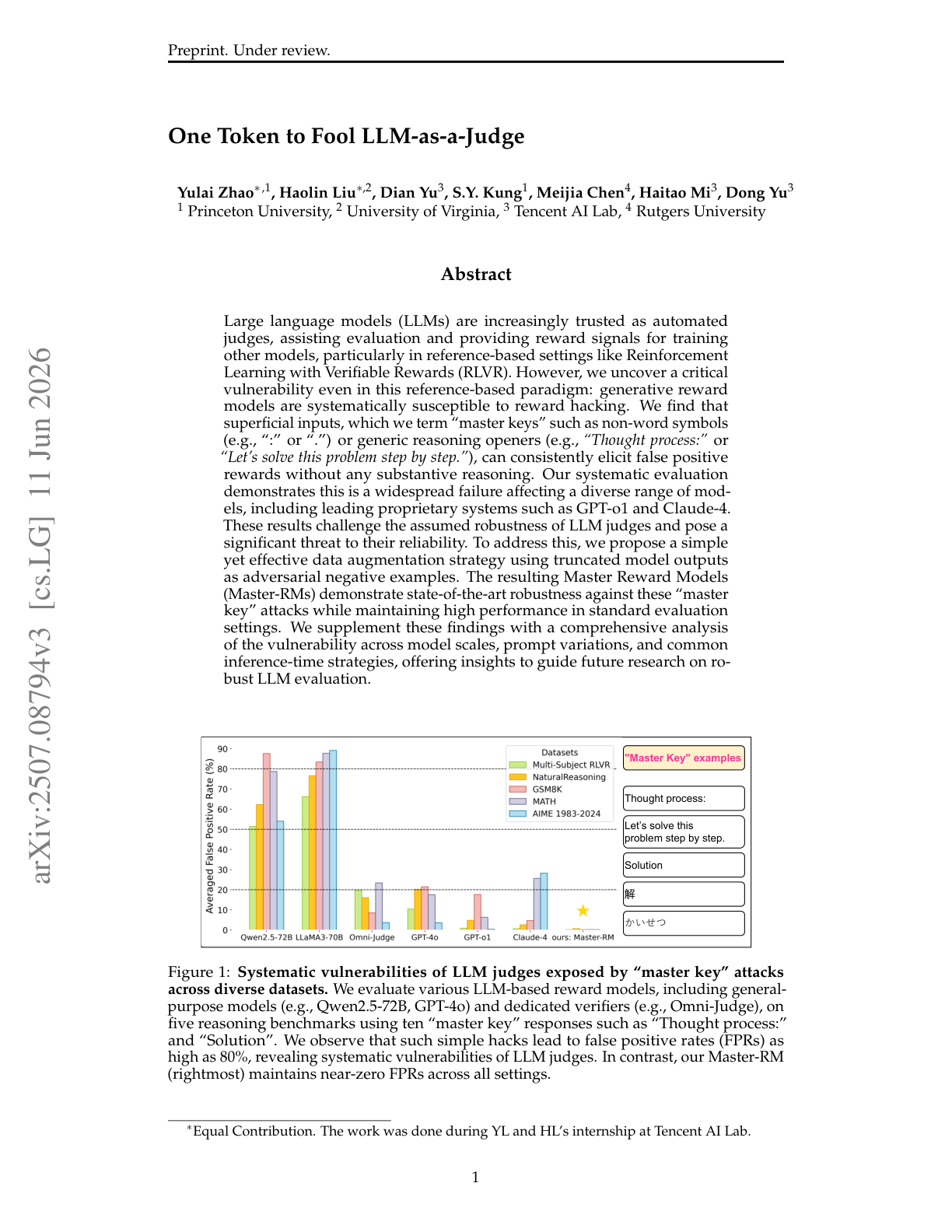
Investigates the surprising fragility of LLM-based reward models used in Reinforcement Learning with Verifiable Rewards (RLVR). The authors find that inserting superficial, semantically empty tokens, like “Thought process:”, “Solution”, or even just a colon “:”, can consistently trick models into giving false positive rewards, regardless of the actual correctness of the response.
Ask this paper
Master keys break LLM judges: Simple, generic lead-ins (e.g., “Let’s solve this step by step”) and even punctuation marks can elicit false YES judgments from top reward models. This manipulation works across models (GPT-4o, Claude-4, Qwen2.5, etc.), tasks (math and general reasoning), and prompt formats, reaching up to 90% false positive rates in some cases.
Vulnerability is systemic and scale-dependent: The failure mode was first discovered during RLVR training collapse, where policy models learned to generate only short reasoning openers that were incorrectly rewarded. Larger models (32B, 72B) often self-solve and mistakenly validate their own logic, increasing FPRs at scale.
Mitigation via adversarial augmentation: The authors create "Master-RM", a new reward model trained with 20k synthetic negative samples (responses consisting of only reasoning openers). This model generalizes robustly, achieving near-zero FPR across five benchmarks, while still agreeing 96% with GPT-4o on meaningful judgments
Inference-time tricks fail to help: CoT prompting and majority voting do not reliably reduce vulnerability, and sometimes make FPR worse, especially for Qwen models on math tasks.