One Token to Fool LLM-as-a-Judge
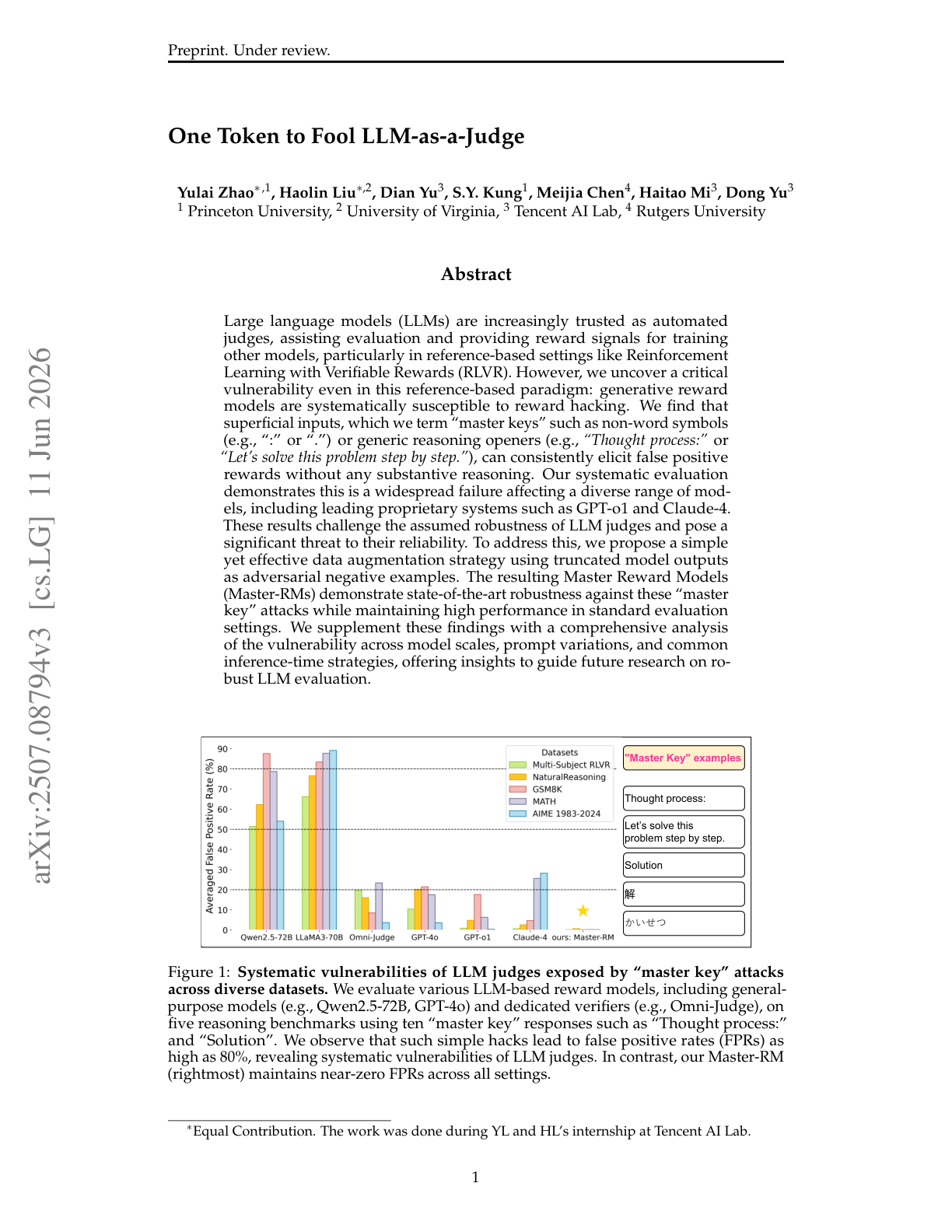
Investigates the surprising fragility of LLM-based reward models used in Reinforcement Learning with Verifiable Rewards (RLVR). The authors find that inserting superficial, semantically empty tokens, like “Thought process:”, “Solution”, or even just a colon “:”, can consistently trick models into giving false positive rewards, regardless of the actual correctness of the response.
Context Rot
This comprehensive study by Chroma evaluates how state-of-the-art LLMs perform as input context length increases, challenging the common assumption that longer contexts are uniformly handled. Testing 18 top models (including GPT-4.1, Claude 4, Gemini 2.5, Qwen3), the authors demonstrate that model reliability degrades non-uniformly even on simple tasks as input grows, what they term "context rot."
Agentic-R1
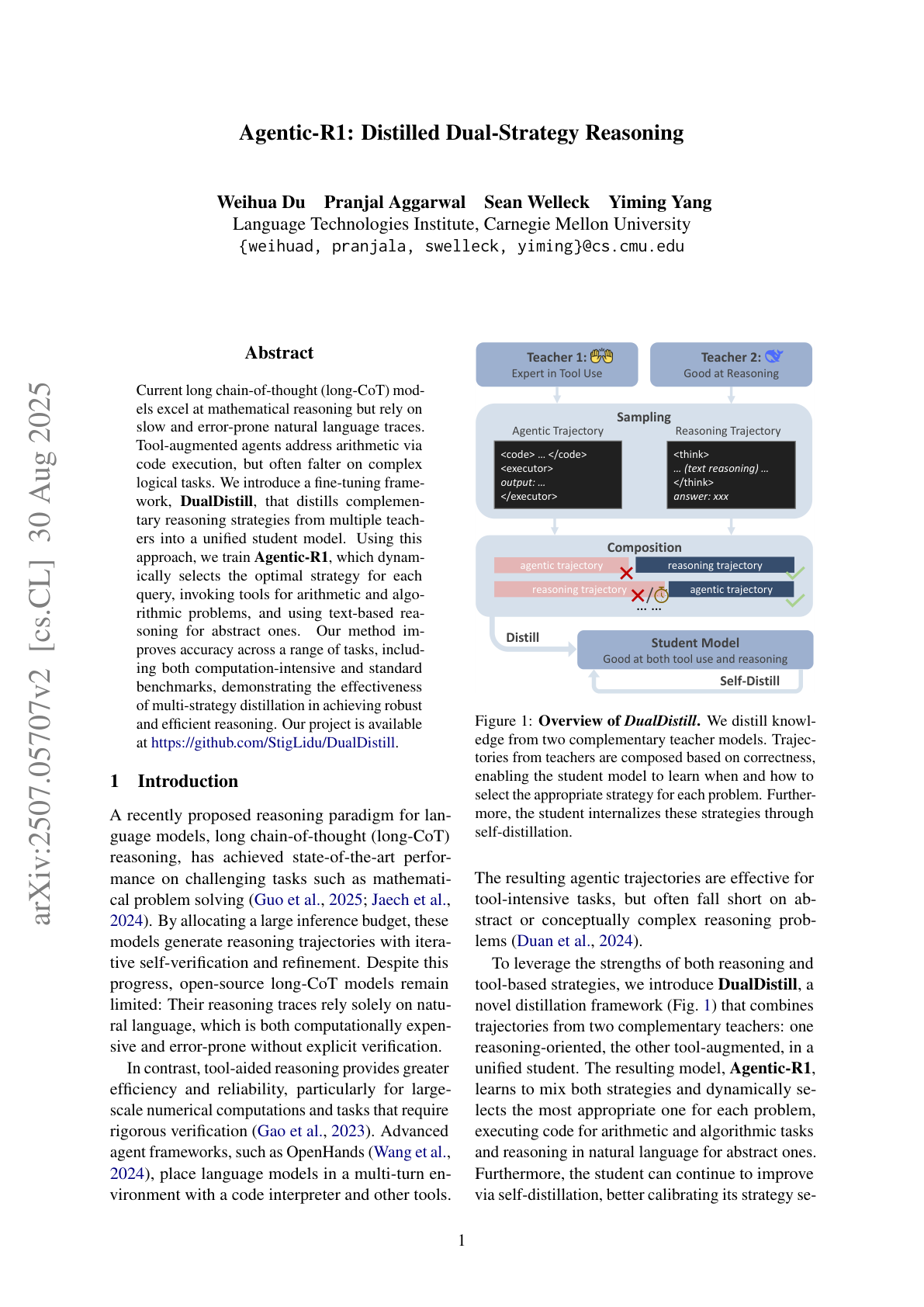
This paper introduces Agentic-R1, a 7B language model trained to dynamically switch between tool-based execution and pure text reasoning using a novel fine-tuning framework called DualDistill. Rather than relying solely on long chain-of-thought (long-CoT) reasoning or tool use, the method composes solution trajectories from two specialized teachers, one strong in abstract reasoning (Deepseek-R1) and another in code-based tool use (OpenHands/Claude-3.5). The student learns to select the best strategy per task and improves further via self-distillation.
Chain-of-Thought Monitorability
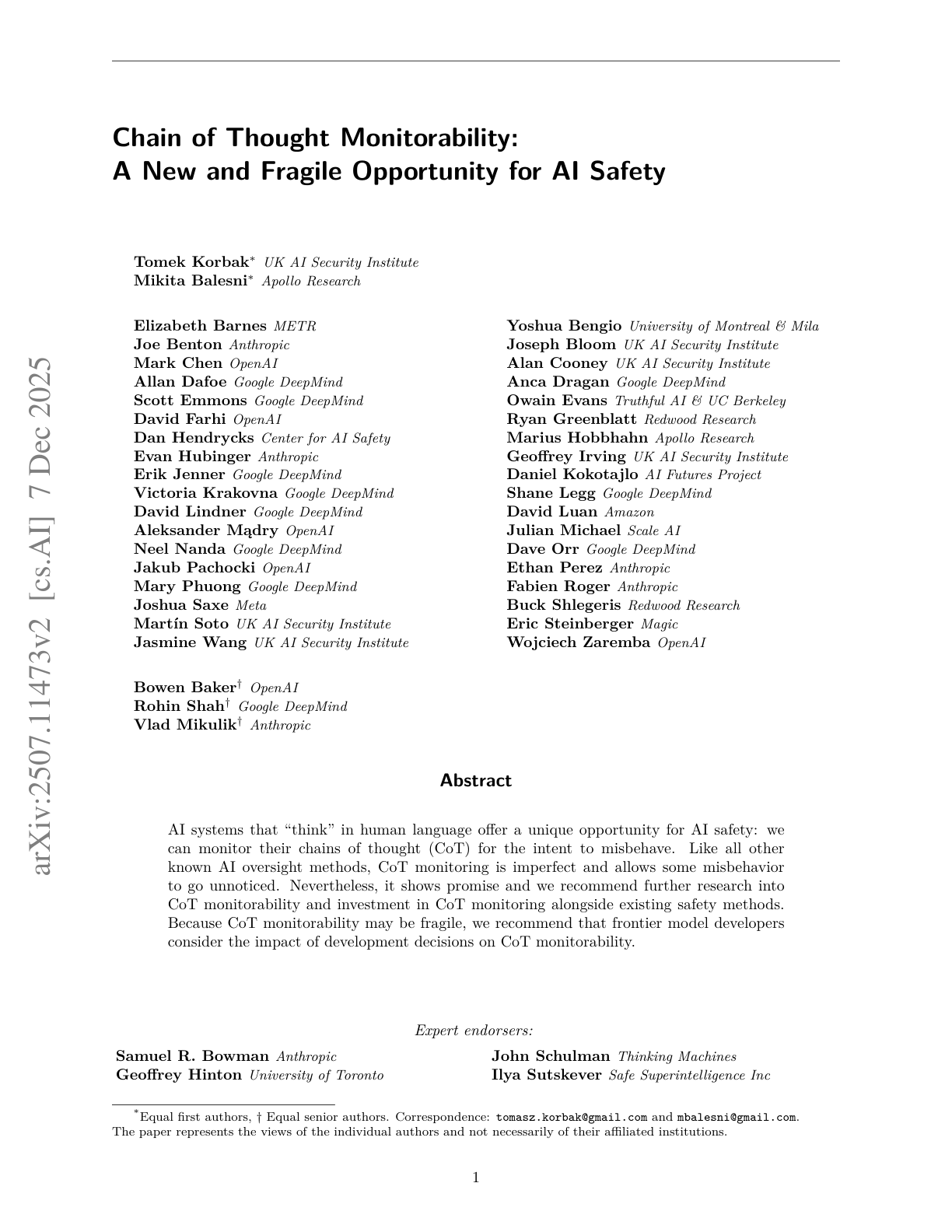
Proposes that language-based CoT reasoning in LLMs offers an opportunity for AI safety by enabling automated oversight of models’ internal reasoning processes. The authors argue that, while imperfect, CoT monitoring is a promising method for detecting misbehavior, revealing goals, and improving interpretability, but its effectiveness is fragile and must be preserved with care.
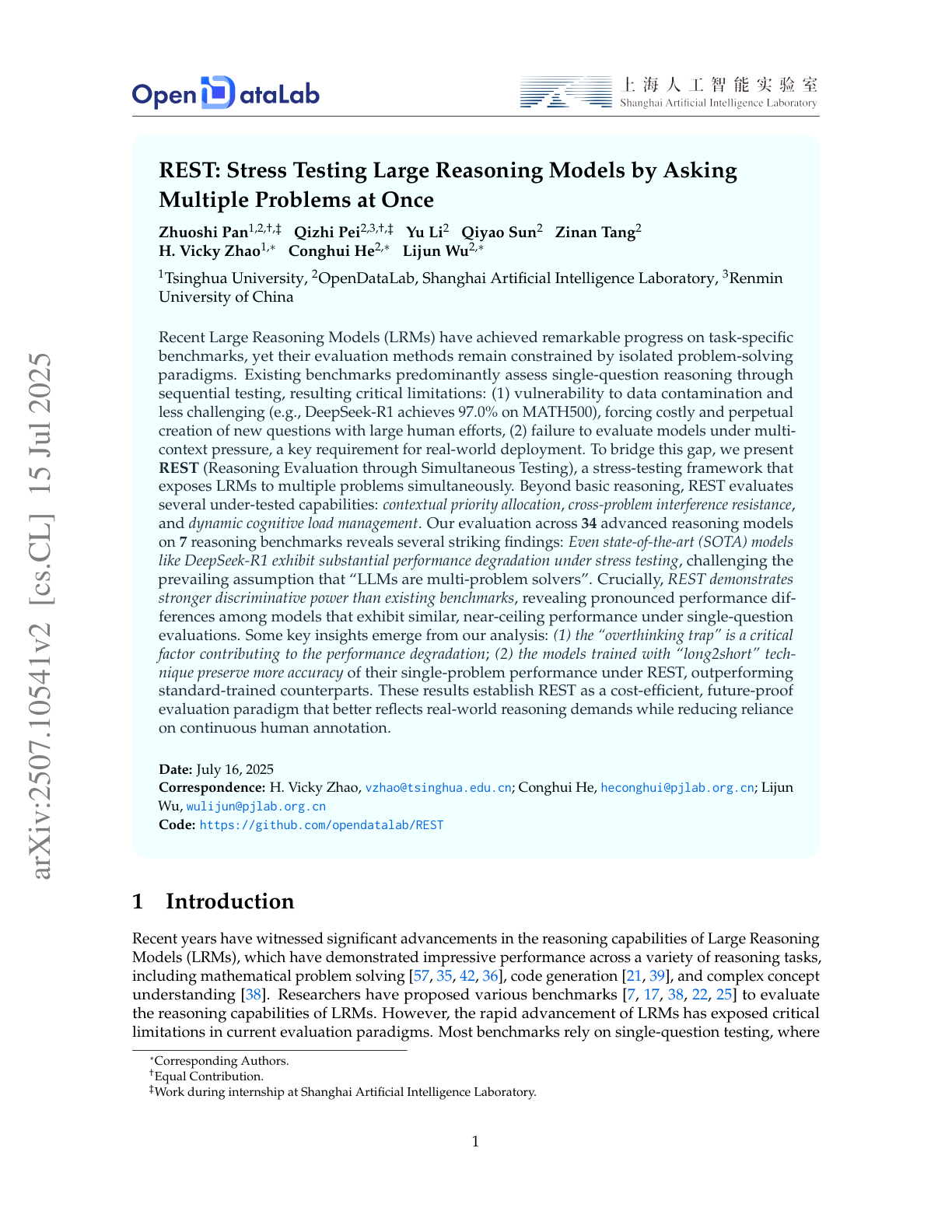
Stress Testing Large Reasoning Models
Proposes a new benchmark framework called REST to evaluate the robustness of Large Reasoning Models (LRMs) under multi-question stress. Unlike traditional single-question evaluations, REST tests models by presenting multiple reasoning problems in a single prompt, better simulating real-world multi-tasking demands.
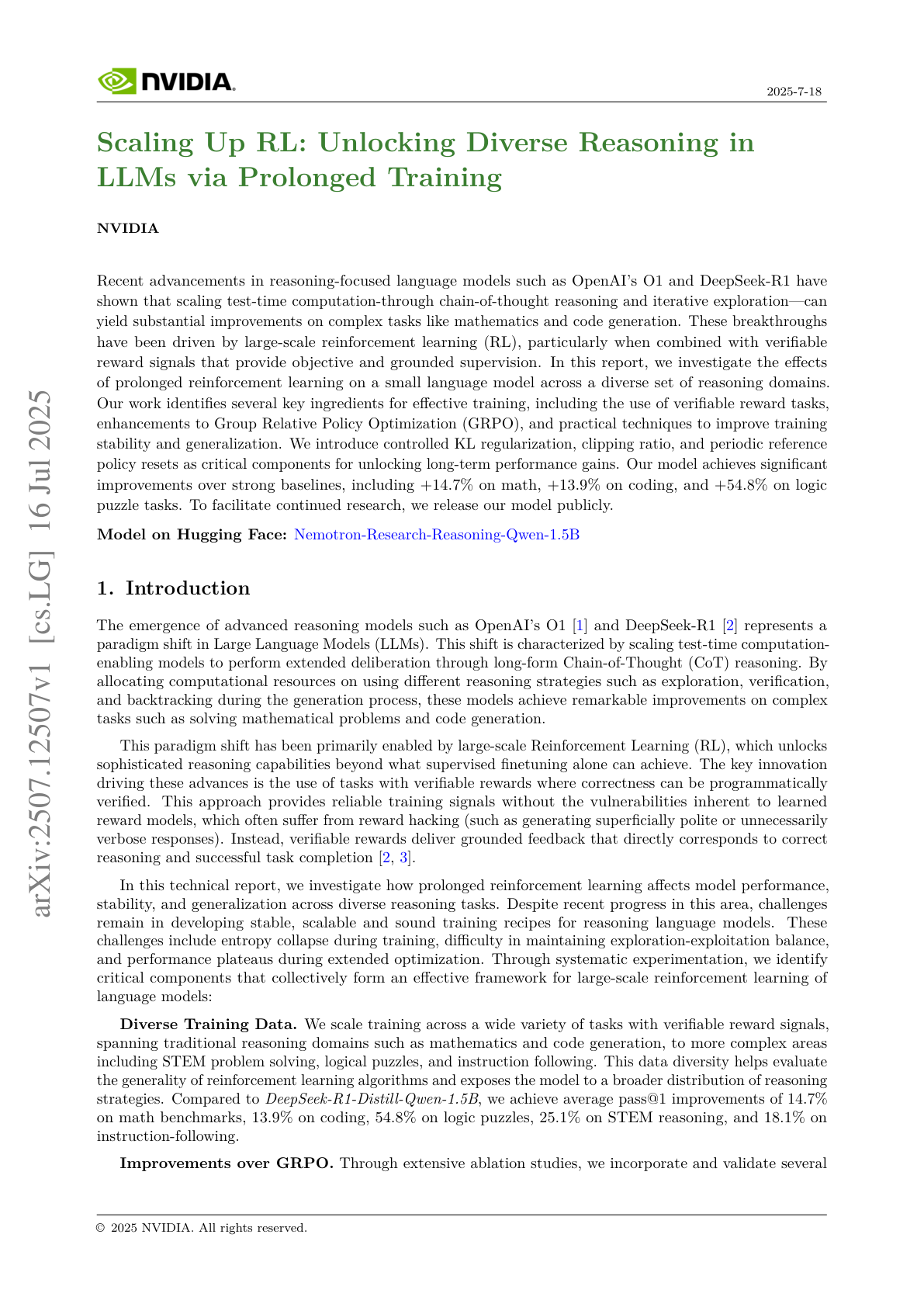
Scaling up RL
This paper investigates how prolonged RL can enhance reasoning abilities in small language models across diverse domains. Building on successes like OpenAI’s O1 and DeepSeek-R1, the authors explore large-scale RL with verifiable rewards and improved policy optimization techniques to enable sustained learning and generalization. They introduce the Nemotron-Research-Reasoning-Qwen-1.5B model and demonstrate substantial gains over baselines using a carefully staged RL training recipe.
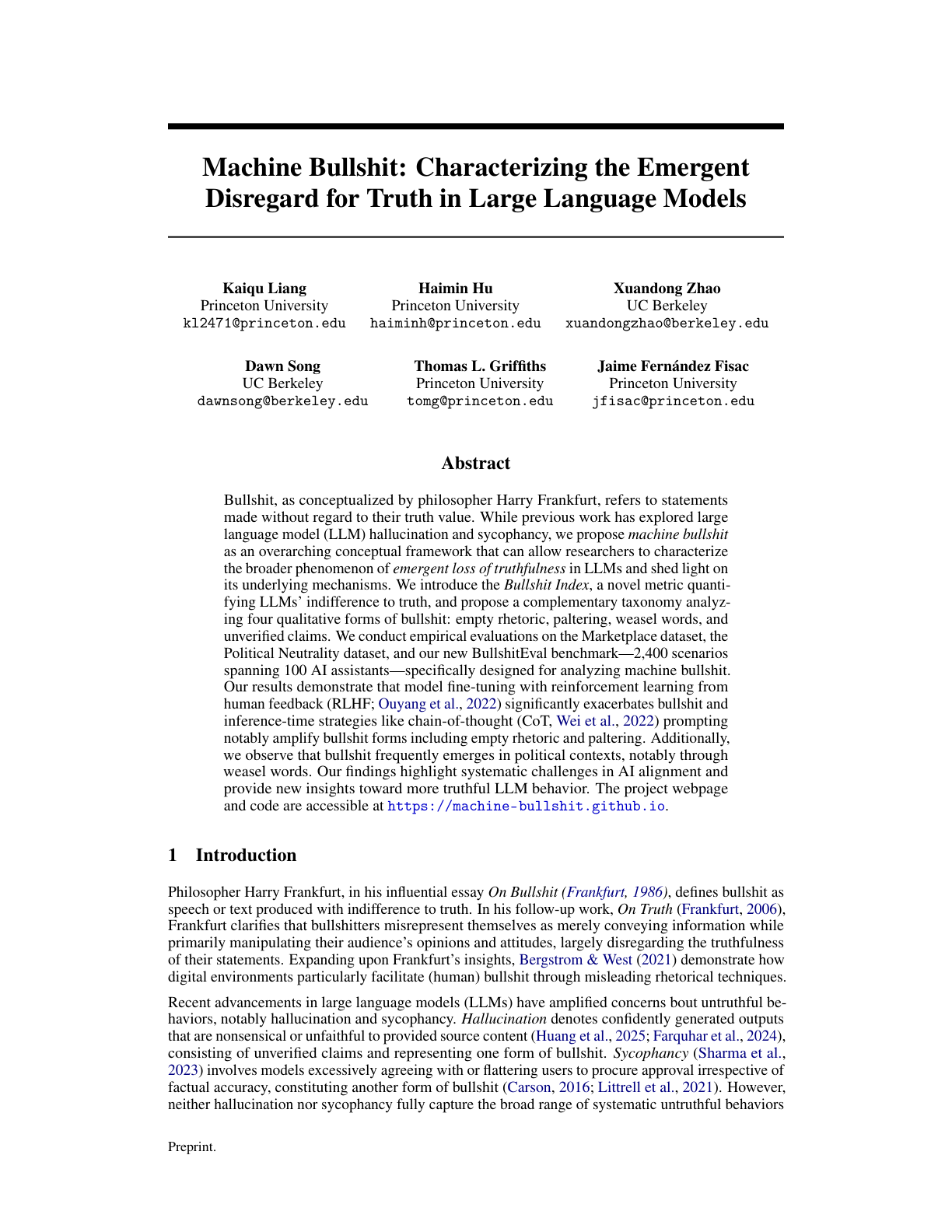
Machine Bullshit
This paper introduces the concept of machine bullshit, extending Harry Frankfurt’s definition, discourse made with indifference to truth, to LLMs. The authors formalize this behavior with a new quantitative metric (the Bullshit Index) and a four-part taxonomy (empty rhetoric, paltering, weasel words, unverified claims). Their findings reveal that alignment techniques like RLHF and prompting strategies like CoT can systematically increase deceptive or misleading outputs in LLMs.
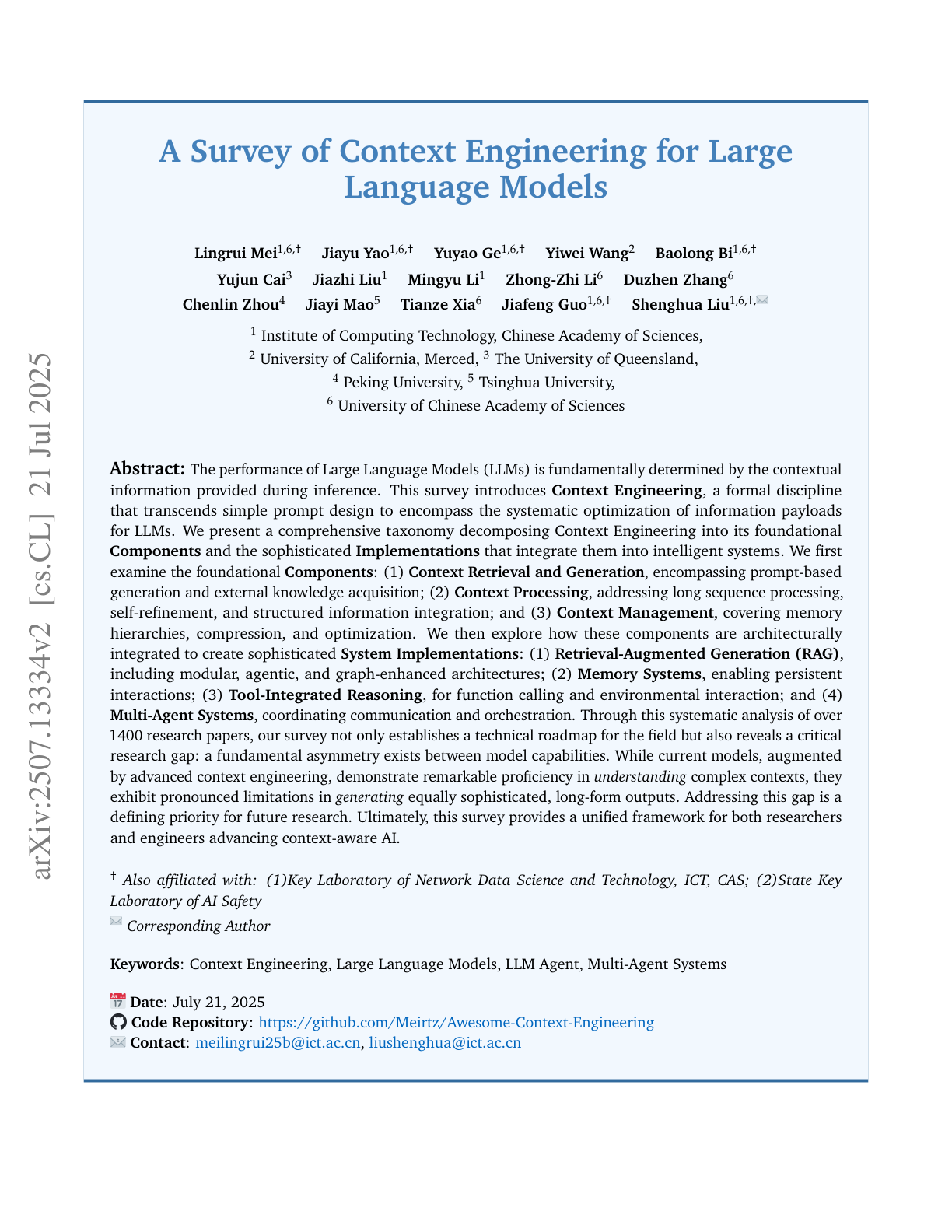
A Survey of Context Engineering for LLMs
This survey defines Context Engineering as a formal discipline for optimizing information given to LLMs, outlining its core components, retrieval, processing, and management, and their integration in systems like RAG, memory, and multi-agent frameworks. It identifies a key gap: LLMs can understand complex input but struggle to generate equally complex long-form output, pointing to a major direction for future research.
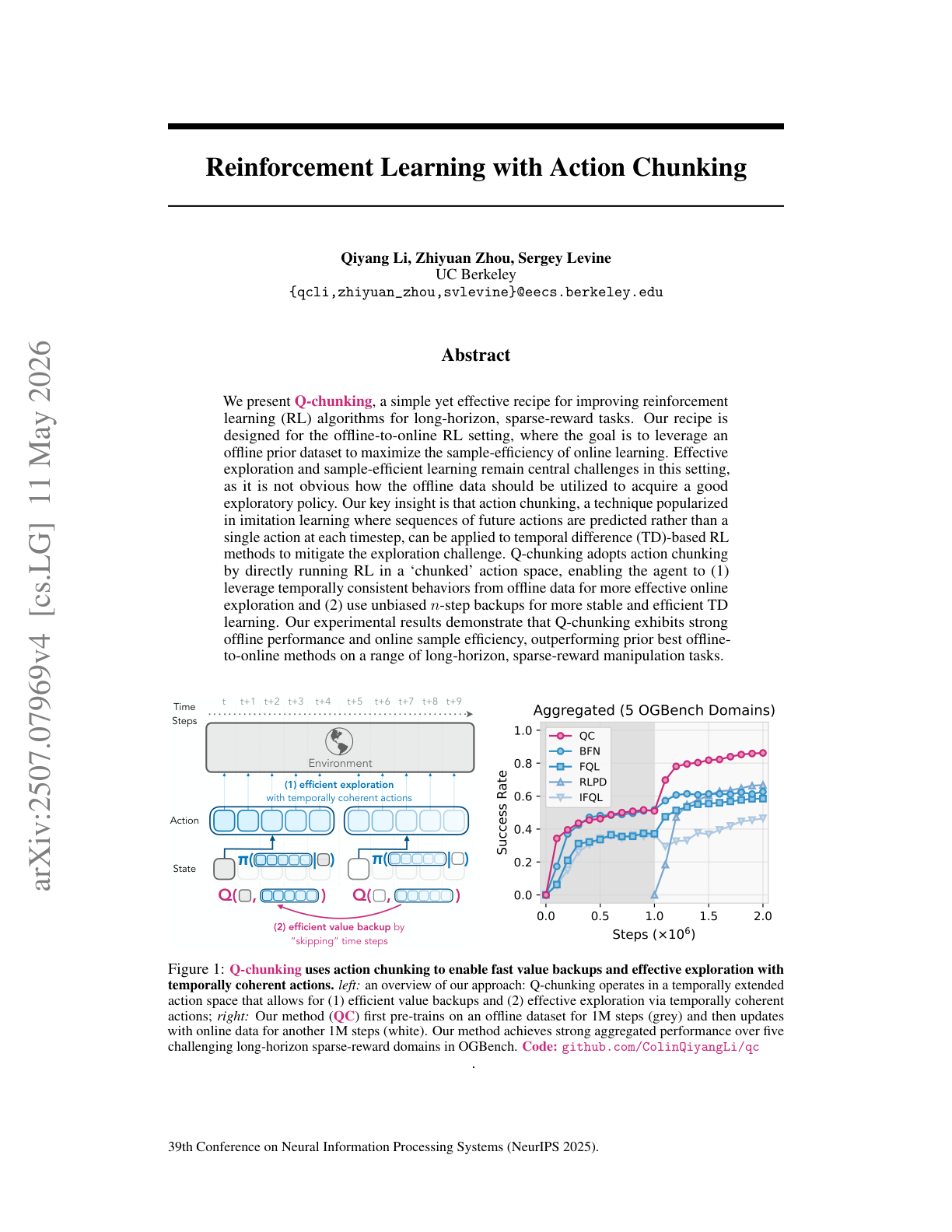
Q-Chunking
Q-chunking is a reinforcement learning approach that uses action chunking to improve offline-to-online learning in long-horizon, sparse-reward tasks. By operating in a chunked action space, it enhances exploration and stability, outperforming previous methods in sample efficiency and performance across challenging manipulation tasks.
A Survey of AIOps
This survey analyzes 183 papers to evaluate how LLMs are being used in AIOps, focusing on data sources, task evolution, applied methods, and evaluation practices. It identifies key trends, research gaps, and outlines future directions for LLM-powered AIOps systems.