Agentopia
Agentopia is one of the most ambitious agent-society testbeds yet, a 79-page release that drops 100 LLM agents into a persistent world and lets them live, form relationships, and pursue goals over 10 simulated years, a horizon orders of magnitude longer than prior day-level work. Beyond observing emergent social behavior, the authors use the simulation as a training signal, optimizing models toward a life reward that reflects human well-being via rejection sampling.
Ask this paper
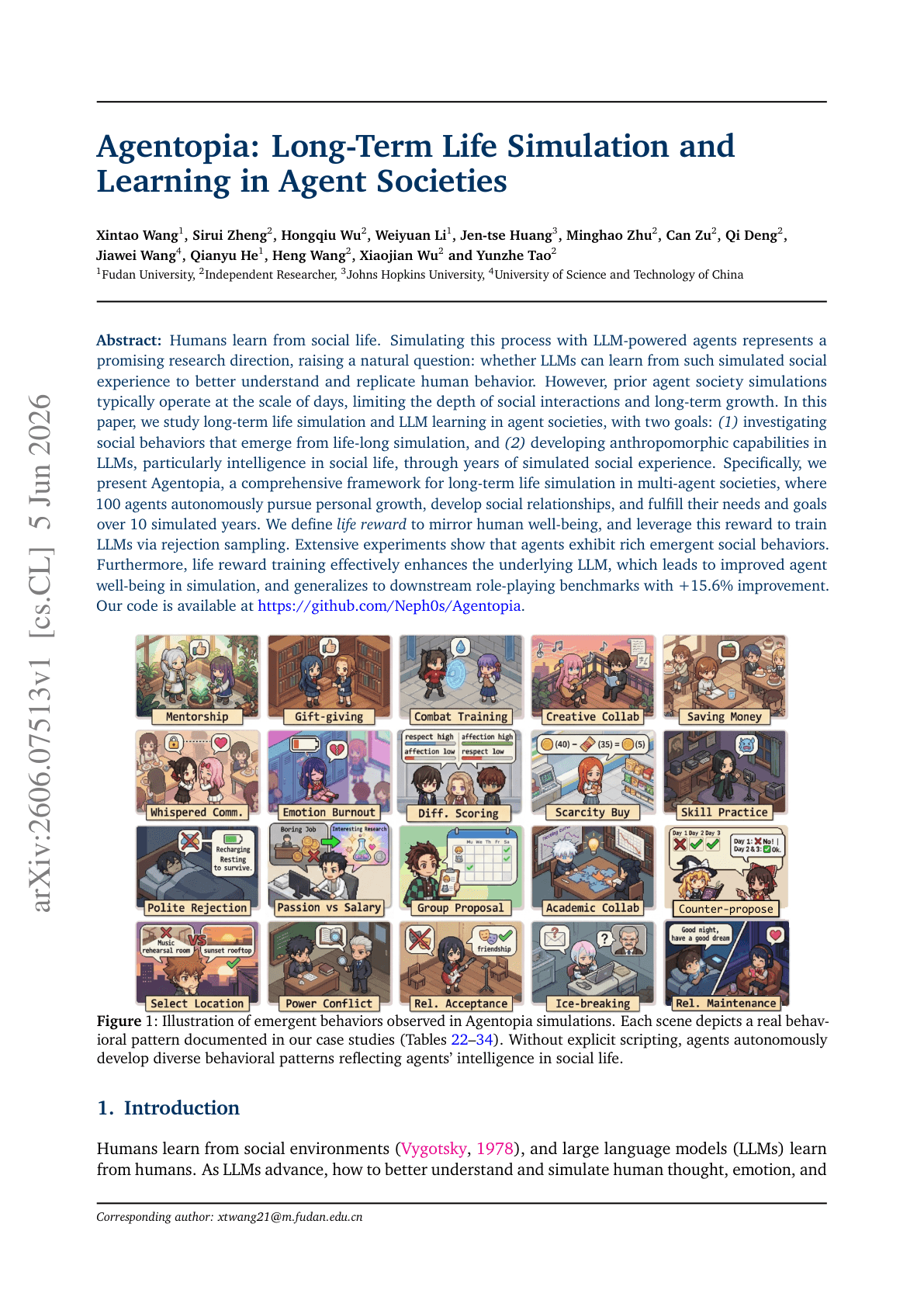
Long-horizon by design: Where earlier agent societies ran at the granularity of days, Agentopia simulates a decade of life per world, surfacing unscripted social strategies and interpersonal dynamics that only appear over long timescales.
Simulation as a training signal: The life-reward metric is used to fine-tune more anthropomorphic models, and the improvements transfer beyond the simulation to downstream role-playing benchmarks rather than staying trapped in the sandbox.
Measured gains: Trained agents improve overall CoSER Test performance by 15.6%, with the biggest jumps in Anthropomorphism at 23.7% and Character Fidelity at 16.4%, and they are respected by 24.2% more peers and liked by 15.9% more.
Why it matters: A single 10-year, 100-agent run consumes 13.7 billion tokens across 567,000 LLM calls. That scale is a statement about where agent research is heading: living, learning populations as both an object of study and a source of training data.
Abstract
Humans learn from social life. Simulating this process with LLM-powered agents represents a promising research direction, raising a natural question: whether LLMs can learn from such simulated social experience to better understand and replicate human behavior. However, prior agent society simulations typically operate at the scale of days, limiting the depth of social interactions and long-term growth. In this paper, we study long-term life simulation and LLM learning in agent societies, with two goals: (1) investigating social behaviors that emerge from life-long simulation, and (2) developing anthropomorphic capabilities in LLMs, particularly intelligence in social life, through years of simulated social experience. Specifically, we present Agentopia, a comprehensive framework for long-term life simulation in multi-agent societies, where 100 agents autonomously pursue personal growth, develop social relationships, and fulfill their needs and goals over 10 simulated years. We define life reward to mirror human well-being, and leverage this reward to train LLMs via rejection sampling. Extensive experiments show that agents exhibit rich emergent social behaviors. Furthermore, life reward training effectively enhances the underlying LLM, which leads to improved agent well-being in simulation, and generalizes to downstream role-playing benchmarks with +15.6% improvement.