MiniMax Sparse Attention
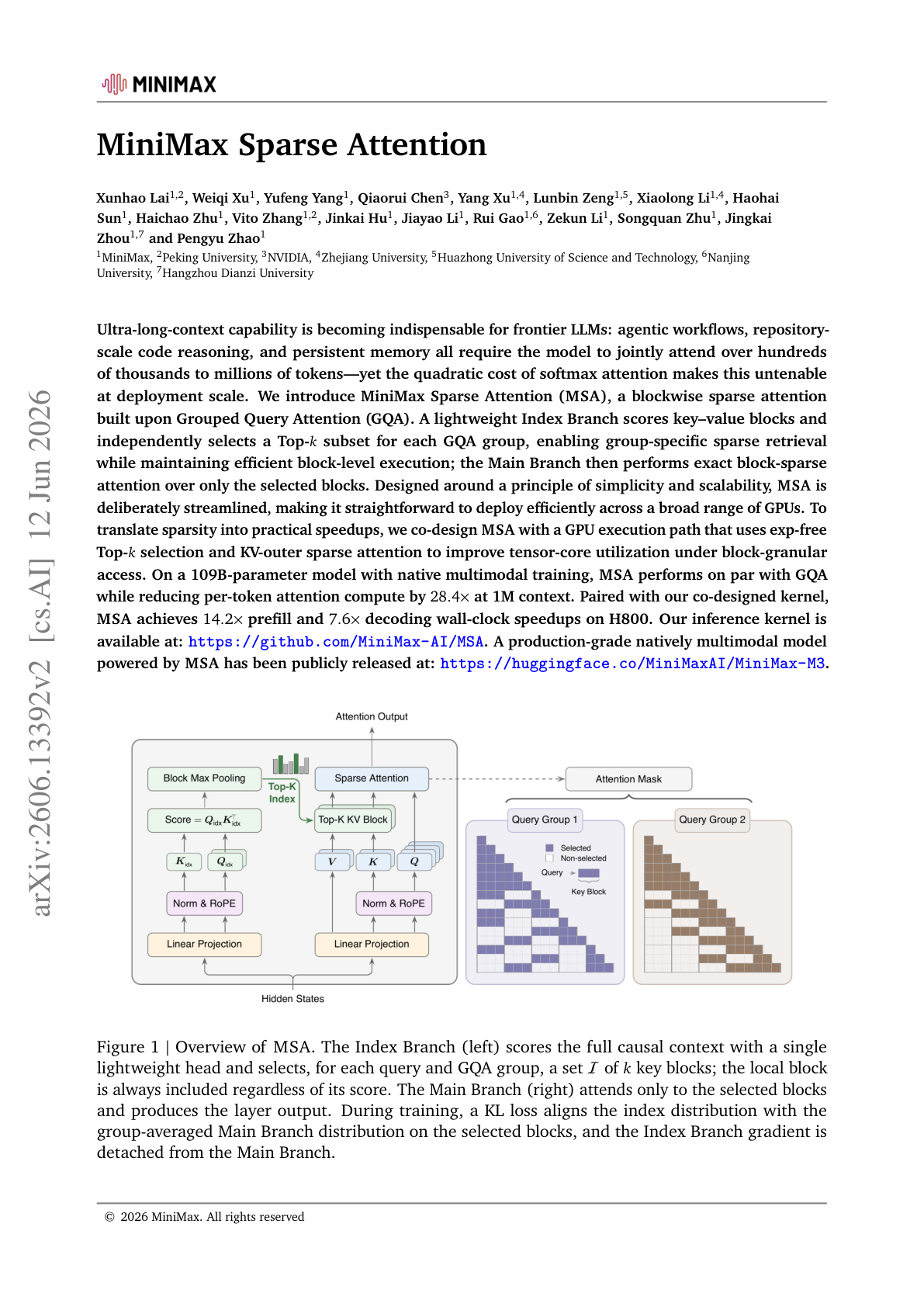
Ultra-long context is now a core requirement for agents, codebase-scale reasoning, multimodal workflows, and persistent memory, but dense softmax attention still makes million-token deployment expensive. MiniMax Sparse Attention (MSA) tackles this by adding blockwise sparsity on top of Grouped Query Attention, with a lightweight routing branch that chooses which key-value blocks each query group should actually attend to.
Ask this paper
Two-branch attention design: The Index Branch scores the full causal context and selects Top-k key-value blocks independently for each GQA group, while the Main Branch performs exact sparse attention only over those selected blocks.
Hardware-aware implementation: The paper co-designs the sparse pattern with GPU kernels, using exp-free Top-k selection and KV-outer sparse attention to improve tensor-core utilization under block-granular access.
Large speedups at scale: On a 109B-parameter natively multimodal model, MSA matches GQA performance while reducing per-token attention compute by 28.4x at 1M context. The paired kernel reaches 14.2x prefill and 7.6x decoding wall-clock speedups on H800.
Why it matters: Long context is only useful if it can be served cheaply. MSA is compelling because it keeps the mechanism simple, trains it directly into a production-scale model, open-sources the inference kernel, and powers the released MiniMax-M3 model.