How AI Agents Reshape Knowledge Work
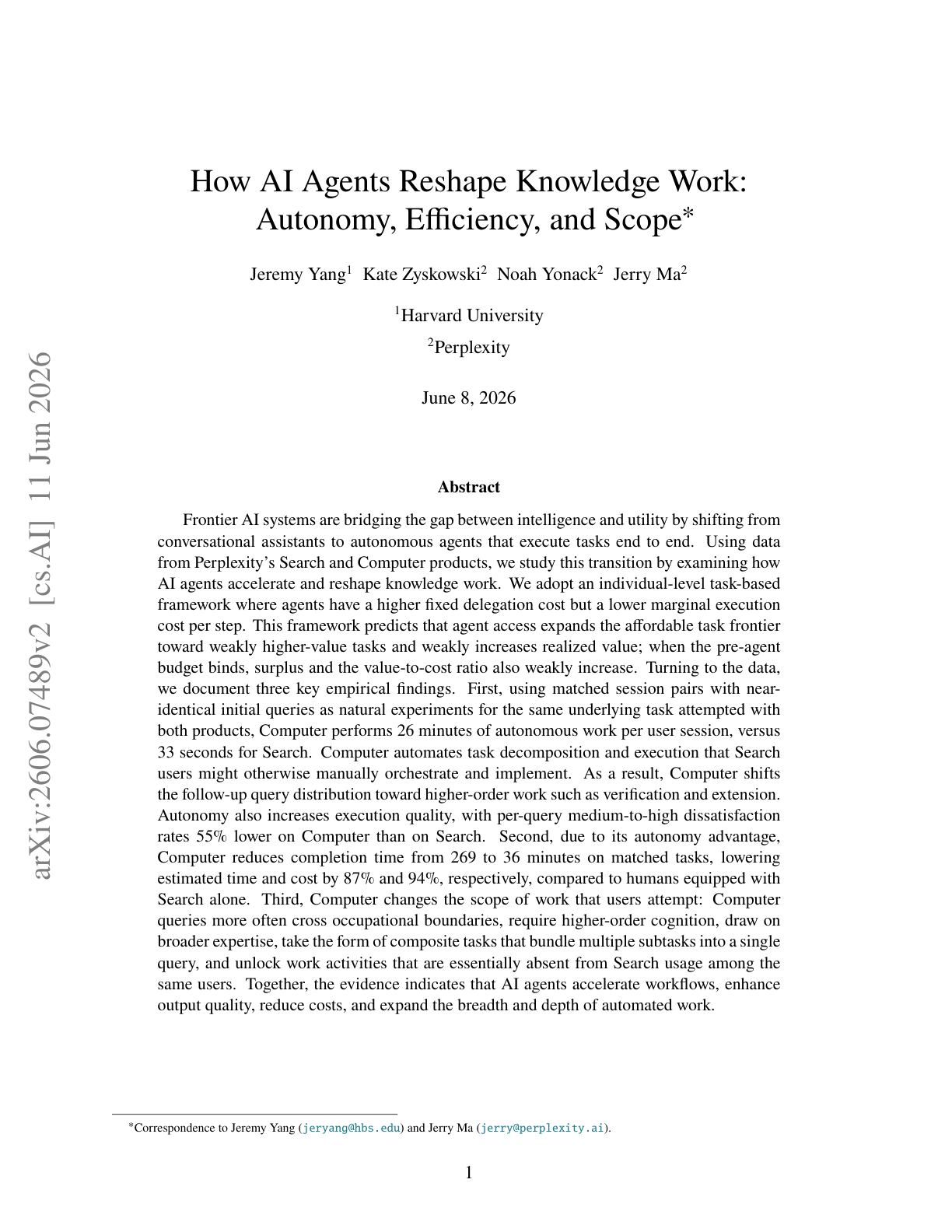
This economics paper, drawing on large-scale production data from Perplexity, studies how the shift from conversational assistants to autonomous agents is reshaping knowledge work. It compares Search, a conversational assistant, with Computer, a general-purpose agent system, along three dimensions: autonomy, efficiency, and the scope of tasks people take on. The framing is a cost-structure model in which agents carry higher fixed and delegation costs but lower per-step marginal costs, so they win once tasks are complex enough.
Ask this paper
Autonomy looks different in practice: Computer performs around 26 minutes of autonomous machine work per session versus roughly 33 seconds for Search, and per-query dissatisfaction is 55% lower on the agent, 1.3% against 2.9%.
Large efficiency gains: On matched tasks, Computer cuts completion time from 269 to 36 minutes, an 87% reduction in time and about a 94% reduction in cost relative to humans working with Search alone.
Scope shifts upward: Agent queries are more cognitively complex, 71% abstract or non-routine versus 53%, with twice as much create-level work, and they bundle interdependent subtasks that cross occupational boundaries.
Why it matters: The data supports a clean prediction. As the fixed costs of delegation fall, agents move the affordable value frontier toward higher-value, multi-step knowledge work, which is exactly where adoption grew fastest, reaching 84 times its first-week volume over the study.