AutoMem
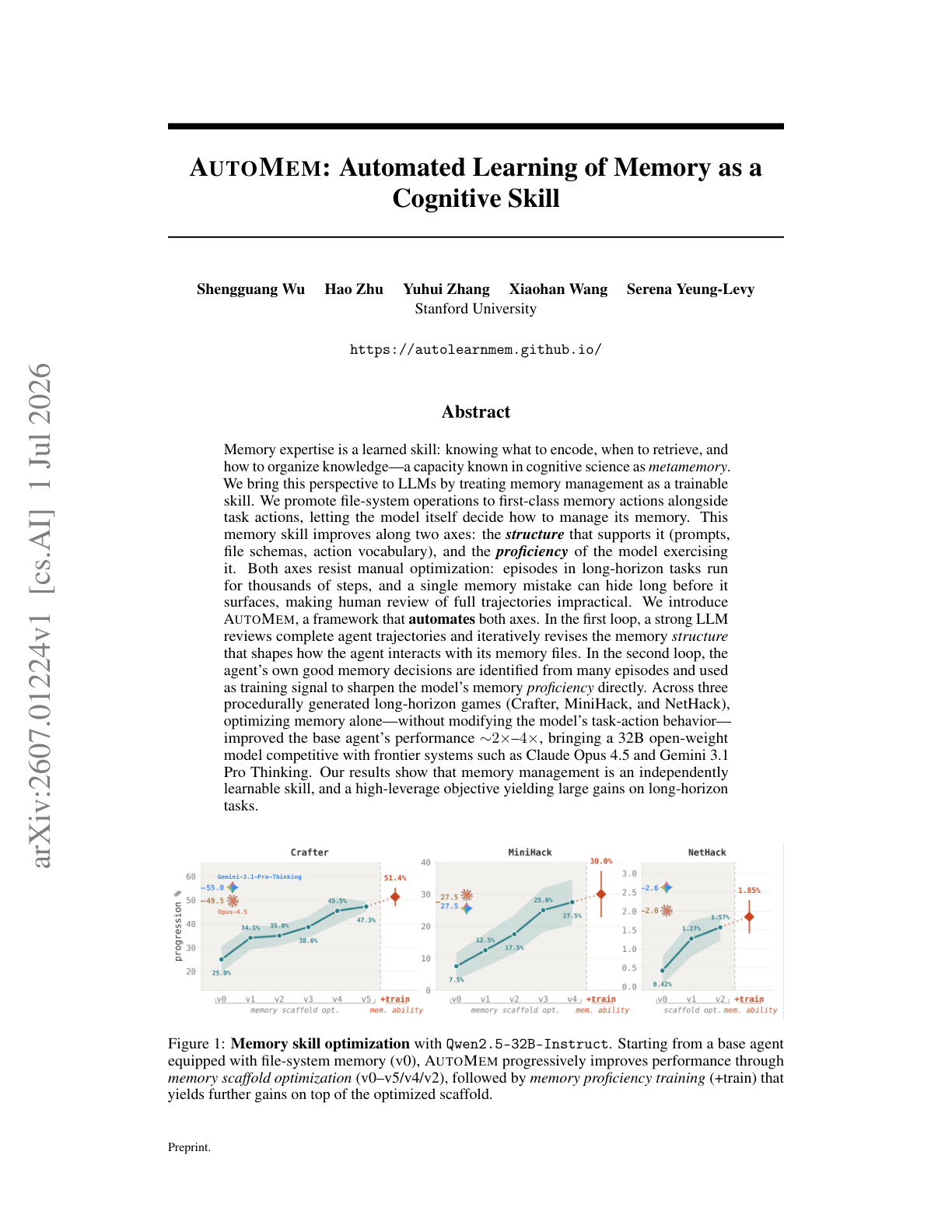
Memory for LLM agents is usually a fixed module bolted onto the model, but knowing what to encode, when to retrieve, and how to organize notes is itself a skill. AutoMem, from Stanford, treats memory management as a trainable cognitive ability, a capacity cognitive science calls metamemory. ---
Ask this paper
Memory ops in the action space: Read, write, search, and append live in the same action space as task actions, so the model itself decides what to store and when to pull it back rather than following a hand-designed policy.
Two meta-learning loops: One loop optimizes the agent scaffold, the memory structure, while a second trains a dedicated memory specialist from the agent’s own traces, separating memory structure from memory proficiency.
Large gains without touching task behavior: Optimizing memory alone yields roughly 2x to 4x progression gains and lifts an open-weight 32B model to frontier-level performance on long-horizon tasks like Crafter, MiniHack, and NetHack.
Why it matters: Framing memory as a learned skill instead of a frozen component gives agents a path to keep getting better at managing their own knowledge, which is exactly what long-horizon autonomy demands.