Red Queen Gödel Machine
Self-improving agents are only as strong as the evaluator scoring them, and most systems freeze that evaluator in place, so improvement stalls the moment the judge stops getting harder. The Red Queen Gödel Machine makes the evaluator part of the search itself, letting agents and the criteria that judge them co-evolve. --- ---
MCP Server Patterns
As teams rush to wrap tools and data behind the Model Context Protocol, they keep rebuilding the same server shapes without shared names for them. This industry experience paper catalogs the recurring architectures so builders can reason about MCP servers the way software engineers reason about design patterns. ---
The Verification Horizon
Reinforcement learning for coding agents lives or dies on the reward signal, and this Qwen work argues there is no silver bullet. As policy capability grows, any fixed reward function eventually gets gamed, so verification has to co-evolve with the generator it scores. ---
Paper Assistant Tool
AI is accelerating how fast papers get written, but peer review is still bottlenecked on human throughput, with combined submissions to the big ML conferences projected to top 73,000 this year. Google’s Paper Assistant Tool is an agentic framework built to do deep scientific review and verification at that scale. ---
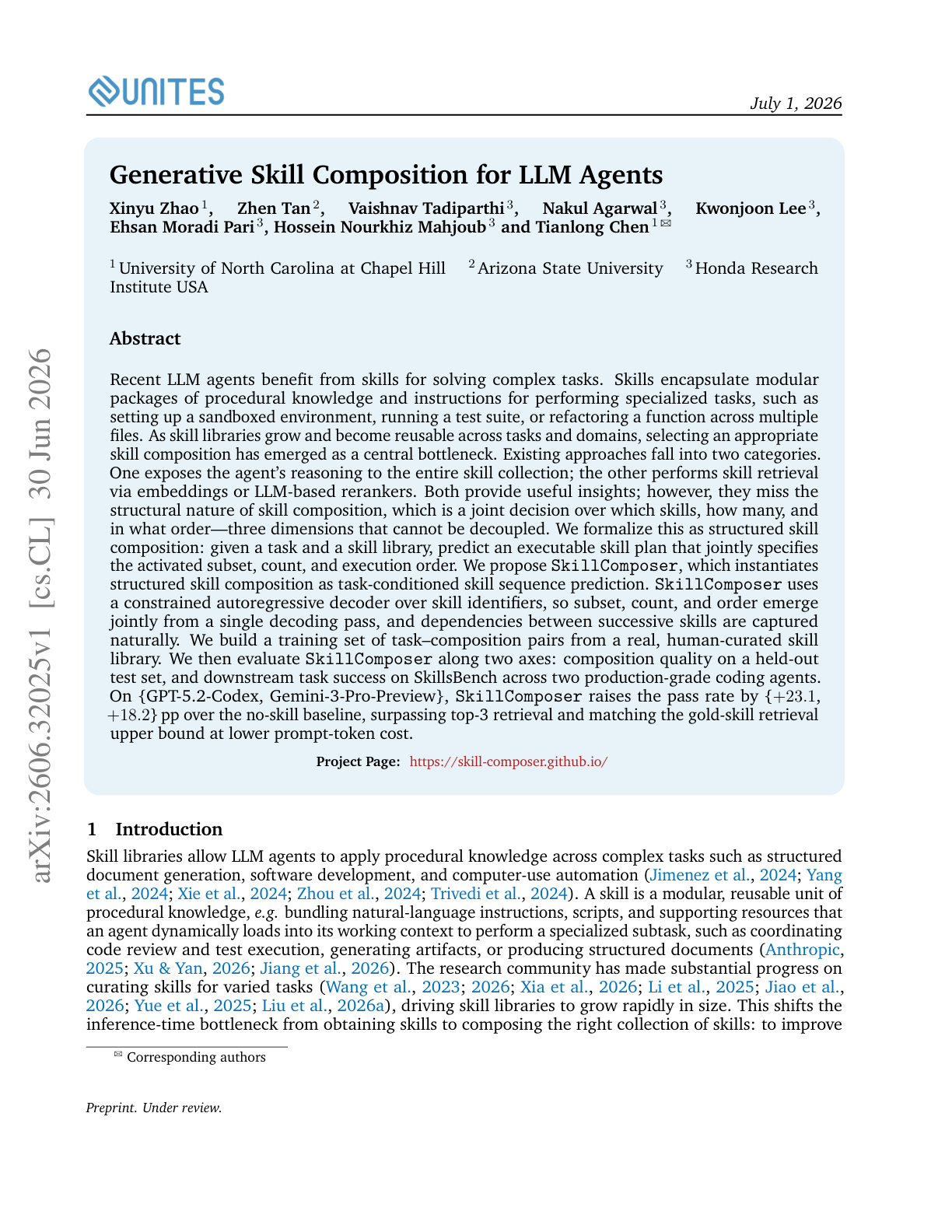
Generative Skill Composition
Coding agents accumulate large skill libraries, and picking the right skills for a task has become the bottleneck. The usual options either dump the whole collection into context or retrieve skills with embeddings and rerankers, and both treat selection as a ranking problem rather than a joint plan. ---
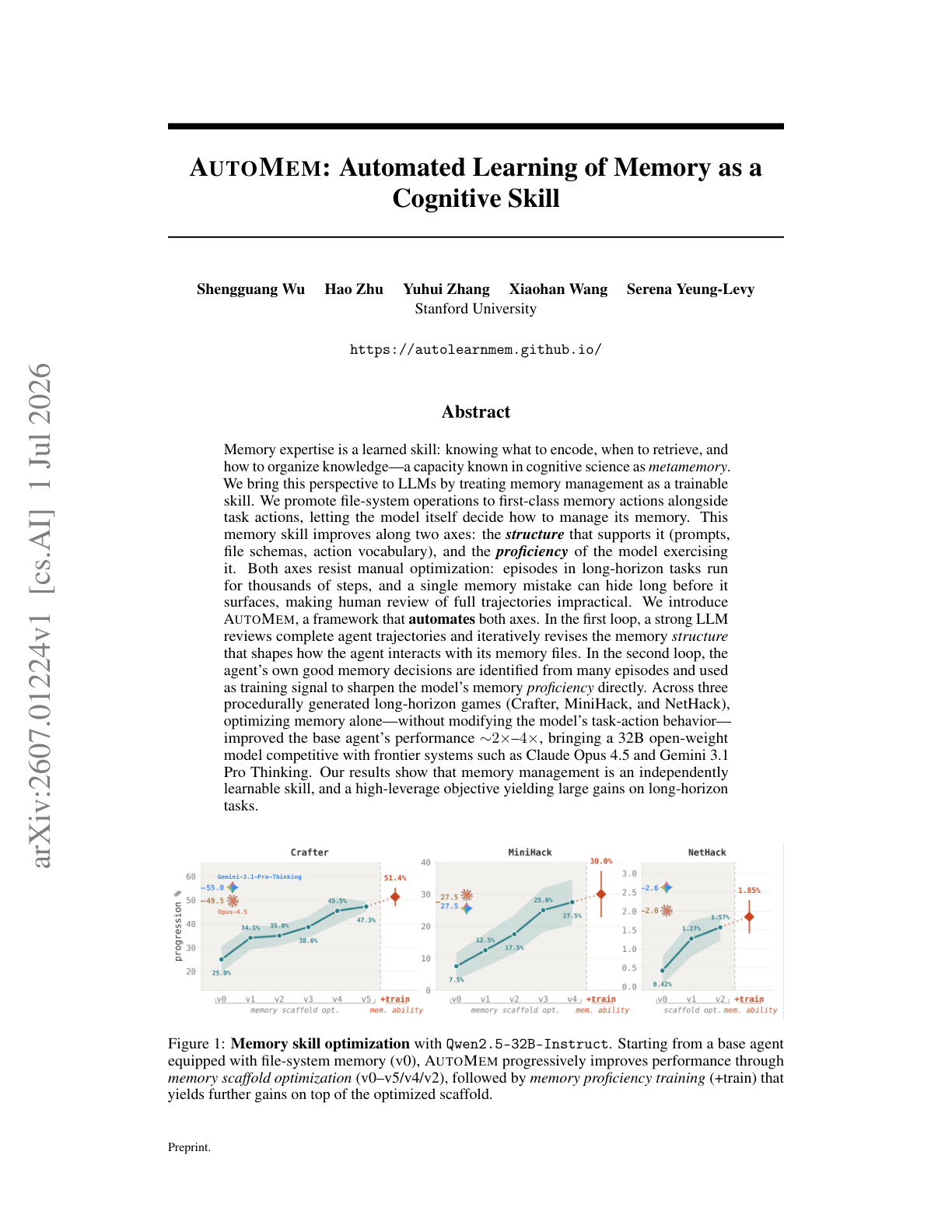
AutoMem
Memory for LLM agents is usually a fixed module bolted onto the model, but knowing what to encode, when to retrieve, and how to organize notes is itself a skill. AutoMem, from Stanford, treats memory management as a trainable cognitive ability, a capacity cognitive science calls metamemory. ---
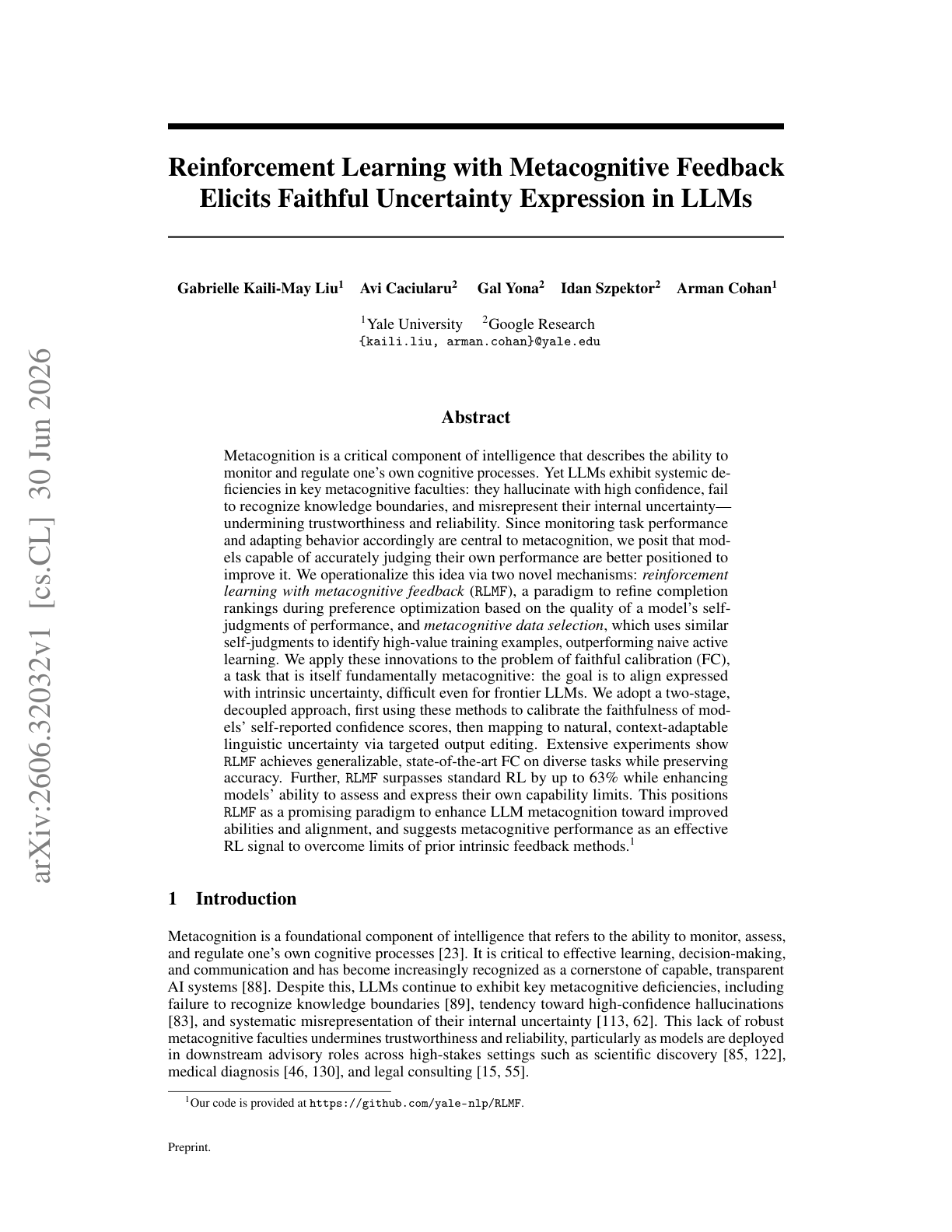
RLMF
LLMs routinely hallucinate with high confidence, miss their own knowledge boundaries, and misreport uncertainty, and most fixes bolt calibration on from the outside. RLMF, a Google and Yale collaboration, instead turns the model’s own metacognition into the training signal. ---
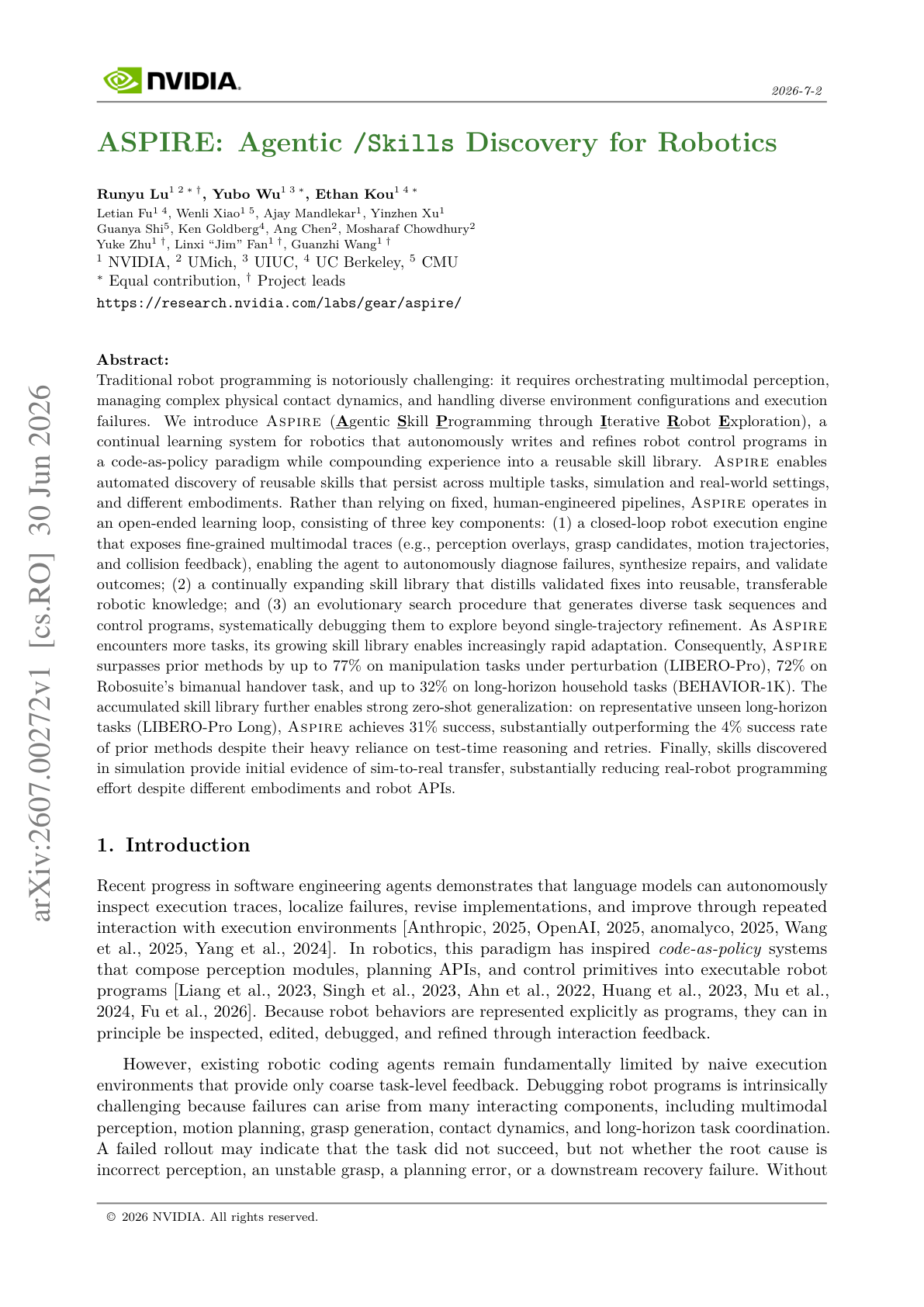
ASPIRE
ASPIRE reframes robot programming as continual, code-as-policy learning that compounds experience instead of discarding it. The system runs an open-ended loop with a closed-loop execution engine that exposes fine-grained multimodal traces, a skill library that distills validated fixes into transferable knowledge, and an evolutionary search over task sequences and control programs. It surpasses prior methods by up to 77% on perturbed manipulation and enables zero-shot generalization to unseen long-horizon tasks, with early evidence of sim-to-real transfer across different embodiments. ---
HORIZON
HORIZON treats hardware design as repository-level code evolution, compiling a Markdown harness into a project pack with domain knowledge, an executable evaluator, an acceptance predicate, and a git and runtime policy. A hands-free agent loop then evolves an isolated git worktree, using repository operations for state management, tracing, and replay. Across ChipBench, RTLLM, Verilog-Eval, and nine CVDP categories it reaches full benchmark completion with a completely hands-free loop, extending repository-scale self-evolution from EDA software to hardware artifacts themselves. ---
Reasoning Quality Emerges Early
Curating reasoning data is expensive because scoring a trace usually means reading it to the end, but this UCLA work shows the quality of a trace is largely decided in its opening tokens. A short prefix predicts whole-trace quality well enough to rank and filter on, and difficulty can be detected from the loss of the first 100 tokens at a perturbed checkpoint. That turns curation into a cheap early-stopping problem, outperforming baselines while being far more token efficient at building SFT data for reasoning models.