Can LLM Agents Infer World Models?
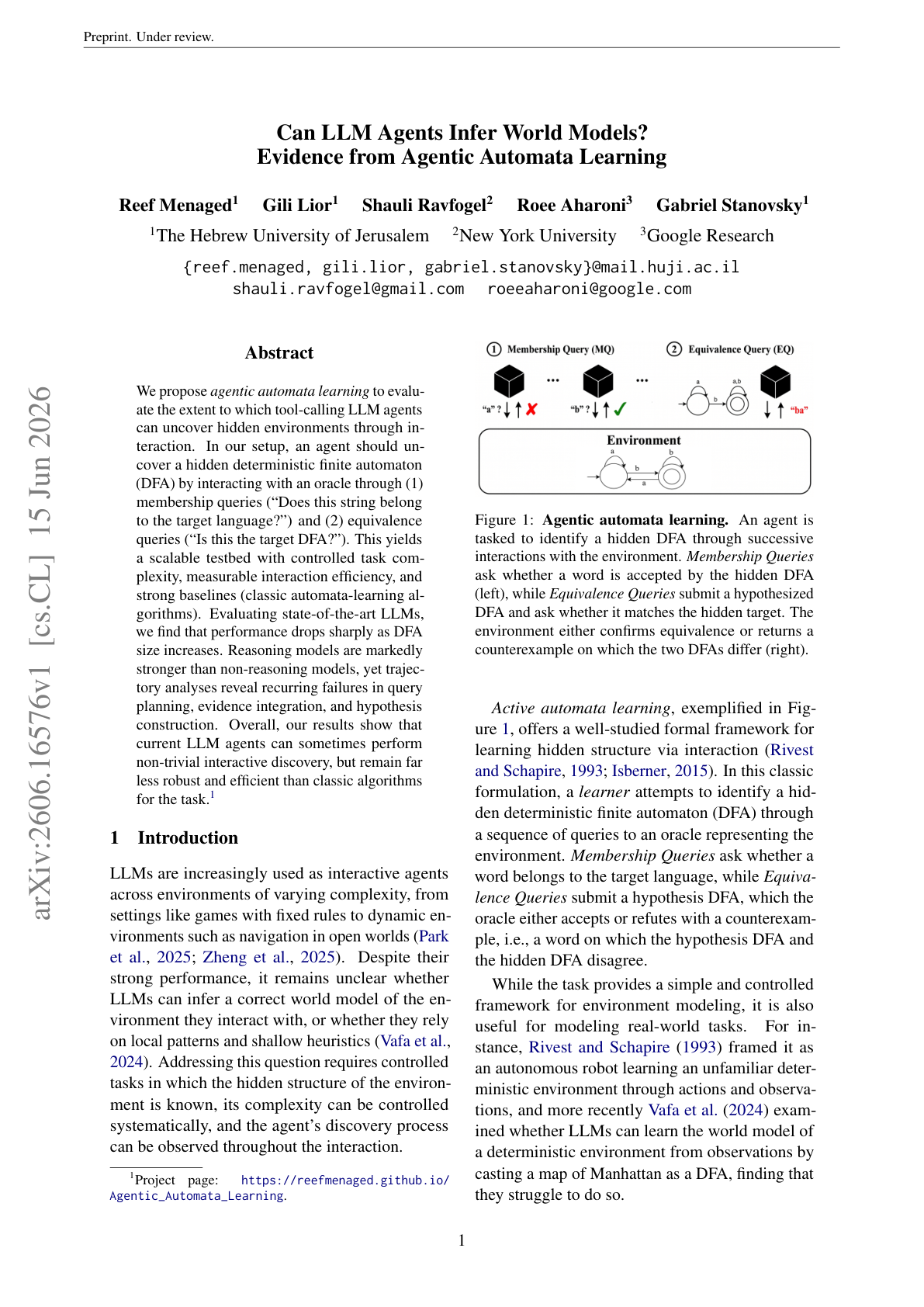
Can an LLM agent actually build a model of an environment it cannot see? This work makes that question gradeable through agentic automata learning. An agent has to uncover a hidden deterministic finite automaton by interacting with an oracle through two interfaces, membership queries that ask whether a string belongs to the target language, and equivalence queries that ask whether a proposed automaton is correct, which yields a clean, scalable testbed for interactive discovery.
Ask this paper
A gradeable world-model test: Casting world-model inference as DFA learning gives objective success criteria and measurable interaction efficiency, with classic automata-learning algorithms as strong, well-understood baselines.
Controlled, scalable difficulty: The size of the hidden automaton acts as a difficulty knob, so the benchmark can scale task complexity smoothly rather than relying on a fixed set of puzzles.
Agents lag classic algorithms: Current agents can sometimes perform non-trivial interactive discovery, but performance drops sharply as DFA size grows, and trajectory analyses reveal recurring failures in query planning, evidence integration, and hypothesis construction.
Why it matters: Reasoning models clearly beat non-reasoning ones here, but the large gap to classic algorithms shows that systematic, interactive world-model building is still an unsolved capability rather than a byproduct of scale.