SpatialClaw
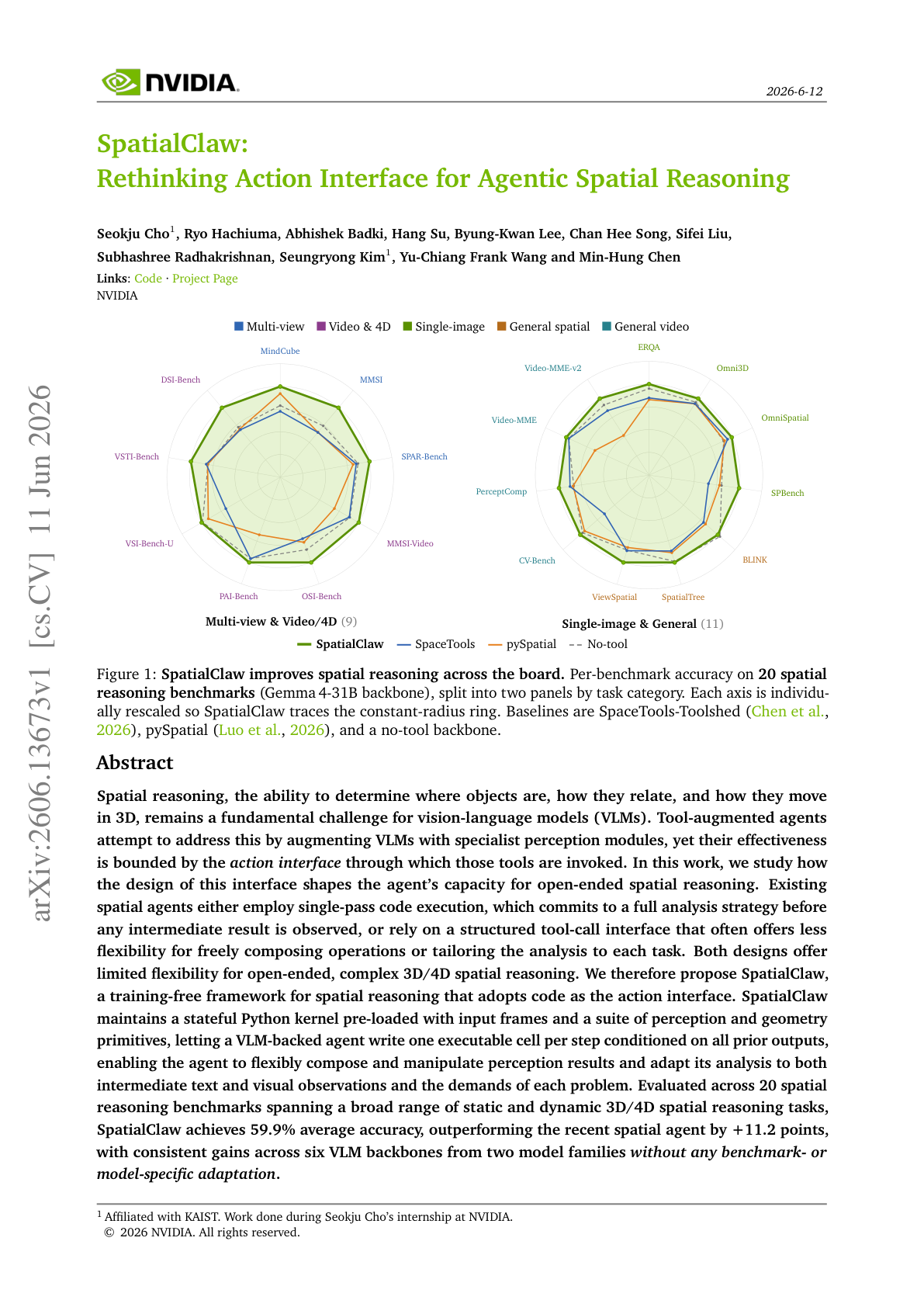
Spatial reasoning over 3D and 4D scenes is still where general vision-language models break down, because they emit a text answer directly rather than measuring anything. From NVIDIA, SpatialClaw is a training-free framework that rethinks the action interface and lets a VLM-backed agent reason through code instead. The agent writes one Python cell per step into a persistent Jupyter kernel preloaded with perception primitives and scientific libraries, then inspects intermediate results and revises its strategy across steps.
Ask this paper
Code as the action interface: Perception tools like SAM3 segmentation, Depth-Anything-3 reconstruction, and geometry utilities are exposed as plain Python callables, so the agent composes them programmatically rather than guessing spatial relationships from pixels.
A persistent, stateful kernel: Masks, depth maps, camera geometry, and trajectories are ordinary Python variables that the kernel preserves across turns, so any object produced at one step stays available for composition, inspection, and revision later.
Strong results without adaptation: Across 20 spatial reasoning benchmarks spanning static and dynamic tasks, SpatialClaw reaches 59.9% average accuracy, beating the prior spatial agent by 11.2 points, with consistent gains across six VLM backbones from two model families.
Why it matters: Because it is training-free and model-agnostic, SpatialClaw turns code execution into a general substrate for spatial reasoning that any capable VLM can plug into, instead of requiring bespoke spatial fine-tuning.