CoAT: Chain-of-Associated-Thoughts for LLM Reasoning
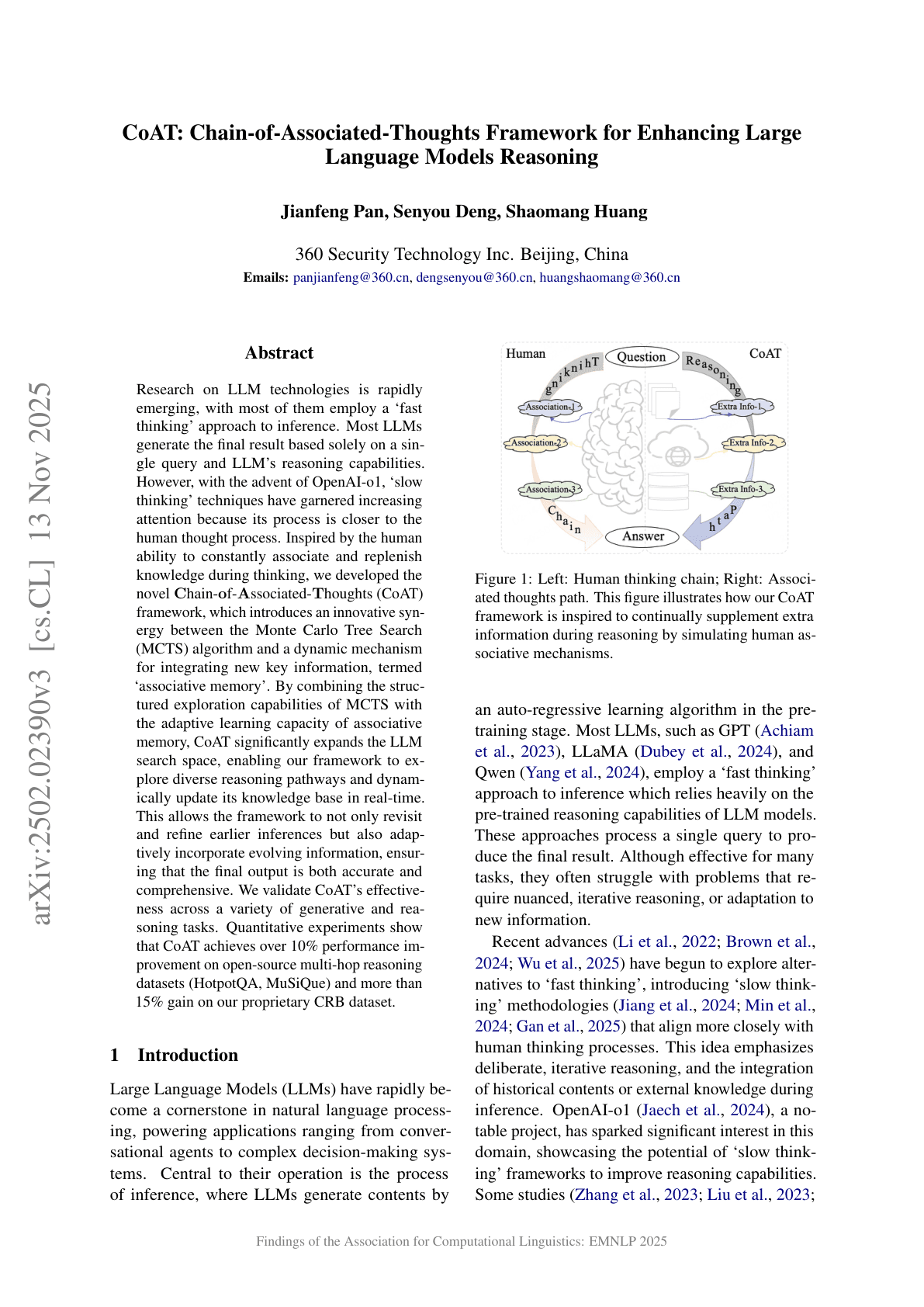
This work introduces CoAT, a new “slow thinking” inference framework that enables an LLM to reason more like a human by exploring and updating its thoughts. Main components:
Ask this paper
MCTS + associative memory – CoAT marries Monte Carlo Tree Search (MCTS) with an associative memory mechanism. MCTS lets the model systematically explore different reasoning branches (possible solutions), while the associative memory dynamically injects new relevant information into the context as needed (mimicking how humans recall facts mid-thought).
Iterative, self-improving reasoning – The framework can expand the search space of solutions and revisit or refine earlier intermediate conclusions. As it evaluates branches, it can incorporate new clues or correct itself, ensuring the final answer is more accurate and comprehensive. This is in contrast to standard one-pass LLM reasoning, which can’t easily backtrack or gather new info on the fly.
Improved accuracy and diversity – In experiments across various generation and reasoning tasks, CoAT outperformed conventional single-pass inference on metrics like accuracy, coherence of reasoning steps, and solution diversity. The ability to iteratively broaden the search while keeping relevant context yields better results than “fast thinking” alone.
Closer to human thought – CoAT is inspired by how humans solve problems: we iteratively consider alternatives, recall facts, and refine our thinking. It points toward LLM agents that can use search algorithms and memory to achieve more reliable reasoning.
Abstract
Research on LLM technologies is rapidly emerging, with most of them employ a 'fast thinking' approach to inference. Most LLMs generate the final result based solely on a single query and LLM's reasoning capabilities. However, with the advent of OpenAI-o1, 'slow thinking' techniques have garnered increasing attention because its process is closer to the human thought process. Inspired by the human ability to constantly associate and replenish knowledge during thinking, we developed the novel Chain-of-Associated-Thoughts (CoAT) framework, which introduces an innovative synergy between the Monte Carlo Tree Search (MCTS) algorithm and a dynamic mechanism for integrating new key information, termed 'associative memory'. By combining the structured exploration capabilities of MCTS with the adaptive learning capacity of associative memory, CoAT significantly expands the LLM search space, enabling our framework to explore diverse reasoning pathways and dynamically update its knowledge base in real-time. This allows the framework to not only revisit and refine earlier inferences but also adaptively incorporate evolving information, ensuring that the final output is both accurate and comprehensive. We validate CoAT's effectiveness across a variety of generative and reasoning tasks. Quantitative experiments show that CoAT achieves over 10% performance improvement on open-source multi-hop reasoning datasets (HotpotQA, MuSiQue) and more than 15% gain on our proprietary CRB dataset.