Confucius Code Agent
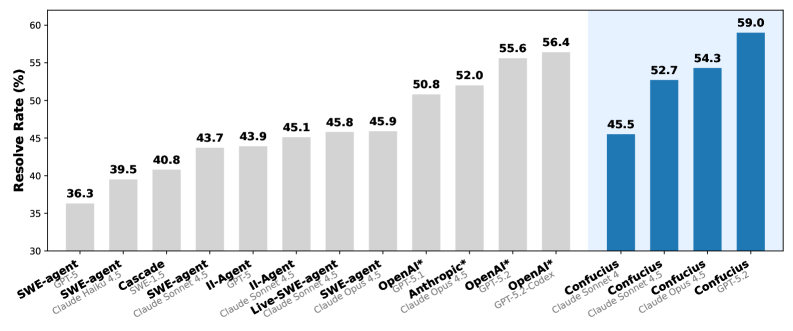
Confucius Code Agent (CCA) is a software engineering agent designed to operate on large-scale codebases. Built on the Confucius SDK, it introduces a three-axis design philosophy separating Agent Experience (AX), User Experience (UX), and Developer Experience (DX) to enable robust multi-step reasoning and modular tool use. - **Hierarchical working memory:** Uses adaptive context compression to maintain essential state during long-horizon reasoning without exceeding context limits. A planner agent summarizes earlier turns into structured plans, reducing prompt length by over 40% while preserving key reasoning chains. - **Persistent note-taking:** A dedicated note-taking agent distills interaction trajectories into structured Markdown notes, capturing both successful strategies and failure cases for cross-session learning. This reduces token costs by approximately 11k and improves resolve rates on repeated tasks. - **Modular extension system:** Tool-use behaviors are factored into typed extensions that attach to the orchestrator, enabling reusable, auditable, and adaptable capabilities across different agents and tool stacks. - **Meta-agent automation:** A meta-agent automates a build-test-improve loop that synthesizes, evaluates, and refines agent configurations, enabling rapid adaptation to new environments and tasks without manual prompt engineering. - **Strong benchmark results:** On SWE-Bench-Pro, CCA achieves 54.3% Resolve@1 with Claude 4.5 Opus, exceeding prior research baselines. With Claude 4.5 Sonnet, CCA reaches 52.7%, outperforming Claude 4.5 Opus with Anthropic's proprietary scaffold at 52.0%, demonstrating that scaffolding can outweigh raw model capability.
Ask this paper
Hierarchical working memory: Uses adaptive context compression to maintain essential state during long-horizon reasoning without exceeding context limits. A planner agent summarizes earlier turns into structured plans, reducing prompt length by over 40% while preserving key reasoning chains.
Persistent note-taking: A dedicated note-taking agent distills interaction trajectories into structured Markdown notes, capturing both successful strategies and failure cases for cross-session learning. This reduces token costs by approximately 11k and improves resolve rates on repeated tasks.
Modular extension system: Tool-use behaviors are factored into typed extensions that attach to the orchestrator, enabling reusable, auditable, and adaptable capabilities across different agents and tool stacks.
Meta-agent automation: A meta-agent automates a build-test-improve loop that synthesizes, evaluates, and refines agent configurations, enabling rapid adaptation to new environments and tasks without manual prompt engineering.
Strong benchmark results: On SWE-Bench-Pro, CCA achieves 54.3% Resolve@1 with Claude 4.5 Opus, exceeding prior research baselines. With Claude 4.5 Sonnet, CCA reaches 52.7%, outperforming Claude 4.5 Opus with Anthropic’s proprietary scaffold at 52.0%, demonstrating that scaffolding can outweigh raw model capability.
Abstract
Real-world software engineering tasks require coding agents that can operate on massive repositories, sustain long-horizon sessions, and reliably coordinate complex toolchains at test time. Existing research-grade coding agents offer transparency but struggle when scaled to heavier, production-level workloads, while production-grade systems achieve strong practical performance but provide limited extensibility, interpretability, and controllability. We introduce the Confucius Code Agent (CCA), a software engineering agent that can operate at large-scale codebases. CCA is built on top of the Confucius SDK, an agent development platform structured around three complementary perspectives: Agent Experience (AX), User Experience (UX), and Developer Experience (DX). The SDK supports a unified orchestrator with advanced context management for long-context reasoning, a persistent note-taking system for cross-session continual learning, and a modular extension system for reliable tool use. In addition, we introduce a meta-agent that automates the construction, evaluation, and refinement of agents through a build-test-improve cycle, enabling rapid agent development on new tasks and tool stacks. Instantiated on the Confucius SDK using the meta-agent, CCA demonstrates strong performance on real-world software engineering tasks. On SWE-Bench-Pro, CCA achieves a Resolve@1 of 59%, exceeding prior research baselines as well as commercial results, under identical repositories, model backends, and tool access.