Deep Think with Confidence
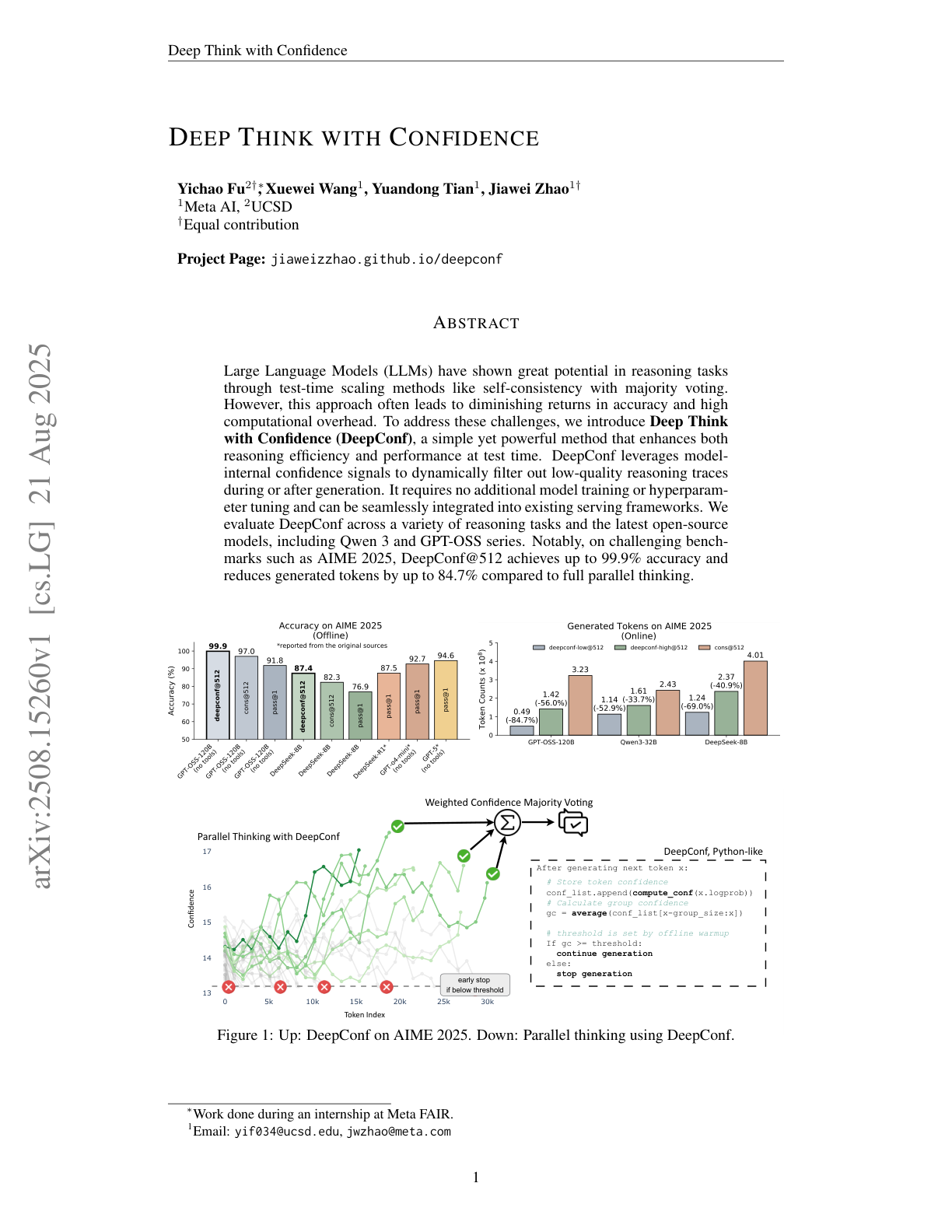
A lightweight test-time method that uses model-intrinsic confidence to prune weak reasoning paths, improving both accuracy and token efficiency for self-consistency ensembles. Works in offline and online modes without extra training or hyperparameter tuning.
Ask this paper
Key idea — Compute local confidence signals during generation, such as sliding-window group confidence, lowest group confidence, and tail confidence, then filter or early-stop low-quality traces. Vote with confidence-weighted majority rather than treating traces equally.
Offline gains — On AIME 2025 with GPT-OSS-120B at K=512, DeepConf reaches 99.9% accuracy vs 97.0% for unweighted voting, by keeping only top-confidence traces and weighting their votes. Similar gains appear across AIME24, BRUMO25, and HMMT25.
Online efficiency — With a short warmup (Ninit=16) to set a stopping threshold and adaptive sampling until consensus, DeepConf-low cuts generated tokens by 43–85% while matching or improving accuracy; best case on AIME 2025 with GPT-OSS-120B saves 84.7% tokens with slightly higher accuracy than the baseline. A more conservative DeepConf-high saves 18–59% with near-identical accuracy.
When to filter aggressively — Retaining the top 10% most confident traces often yields the largest boosts, but can regress when the model is confidently wrong. Keeping top 90% is safer and still beats or matches plain voting.
Easy to deploy — Minimal changes to vLLM enable confidence-based early stopping via the OpenAI-compatible API by toggling a flag and providing a window size and threshold. No retraining required.