Scaling Test-Time Inference with Parallel Graph-Retrieval-Augmented Reasoning Chains
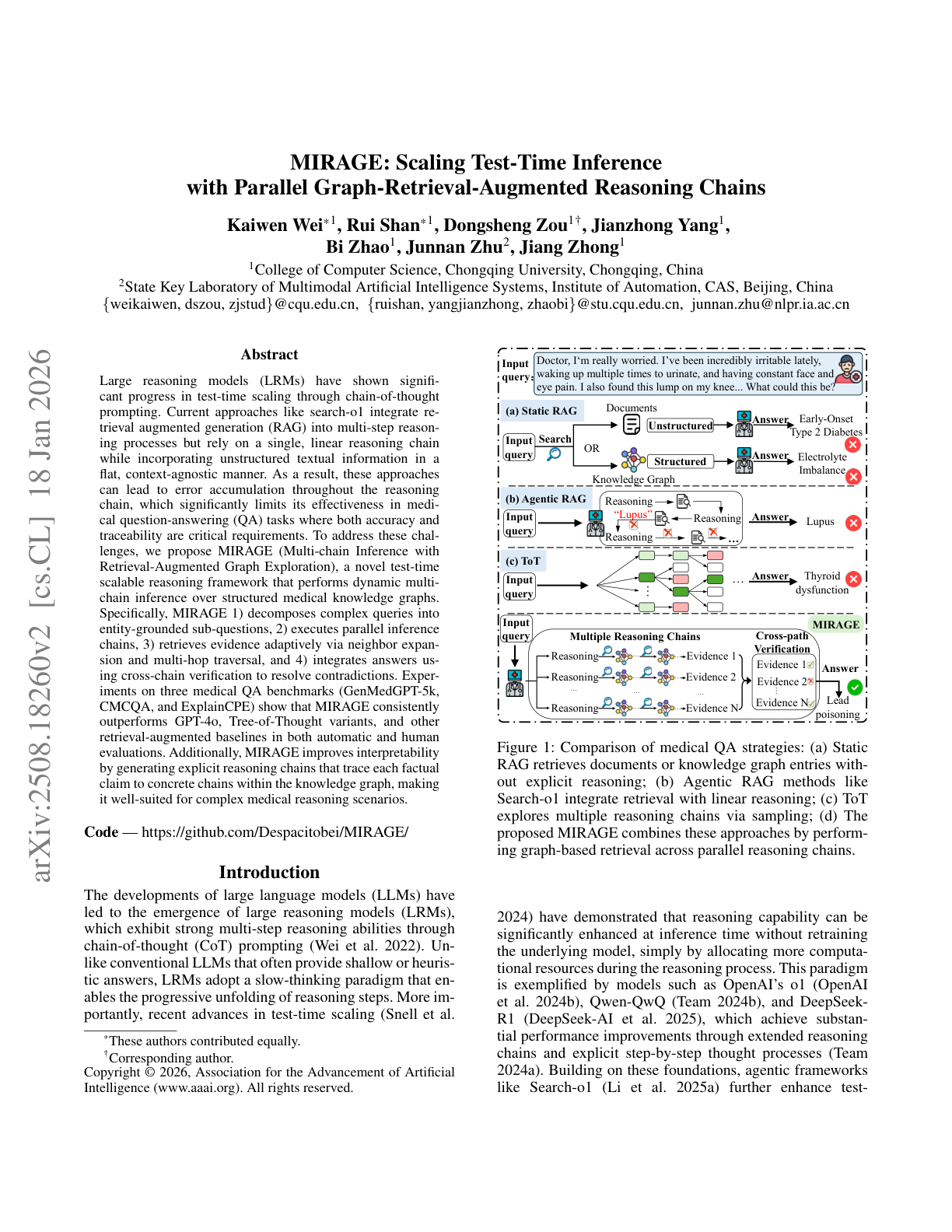
A test-time reasoning framework that replaces a single linear chain with multiple parallel, entity-grounded chains over medical knowledge graphs. MIRAGE decomposes a query into sub-questions, runs adaptive graph retrieval in Anchor and Bridge modes, then reconciles answers via cross-chain verification, yielding higher accuracy and clearer provenance than linear ToT or web-centric agentic RAG.
Ask this paper
What’s new: Parallel multi-chain inference over a structured KG, not just longer single chains. Two retrieval modes: Anchor (single-entity neighborhood) and Bridge (multi-hop paths between entity pairs). A synthesizer verifies cross-chain consistency and normalizes medical terms before emitting a concise final answer.
Why it matters: Linear chains accumulate early errors and treat evidence as flat text. Graph-based retrieval preserves relations and hierarchies, supporting precise multi-hop medical reasoning with traceable paths. The comparative schematic highlights these failure modes and MIRAGE’s fix.
Results: State-of-the-art across three medical QA benchmarks. On ExplainCPE, MIRAGE reaches 84.8% accuracy and the best GPT-4o ranking; similar gains appear on GenMedGPT-5k and CMCQA. Robustness holds when swapping in DeepSeek-R1-32B as the backbone. Human evals on GenMedGPT-5k also prefer MIRAGE.
Scaling insights: More sub-questions help until over-decomposition adds noise, while allowing more retrieval steps shows diminishing but steady gains. Tuning the sub-question cap and retrieval budget is key.
Interpretability: Every claim ties back to explicit KG chains, with an audit record of decomposition, queries, and synthesis. A case study contrasts MIRAGE’s disentangled chains vs a single-chain web search approach, resolving toward a coherent diagnosis.