Disentangling Agent Self-Evolution
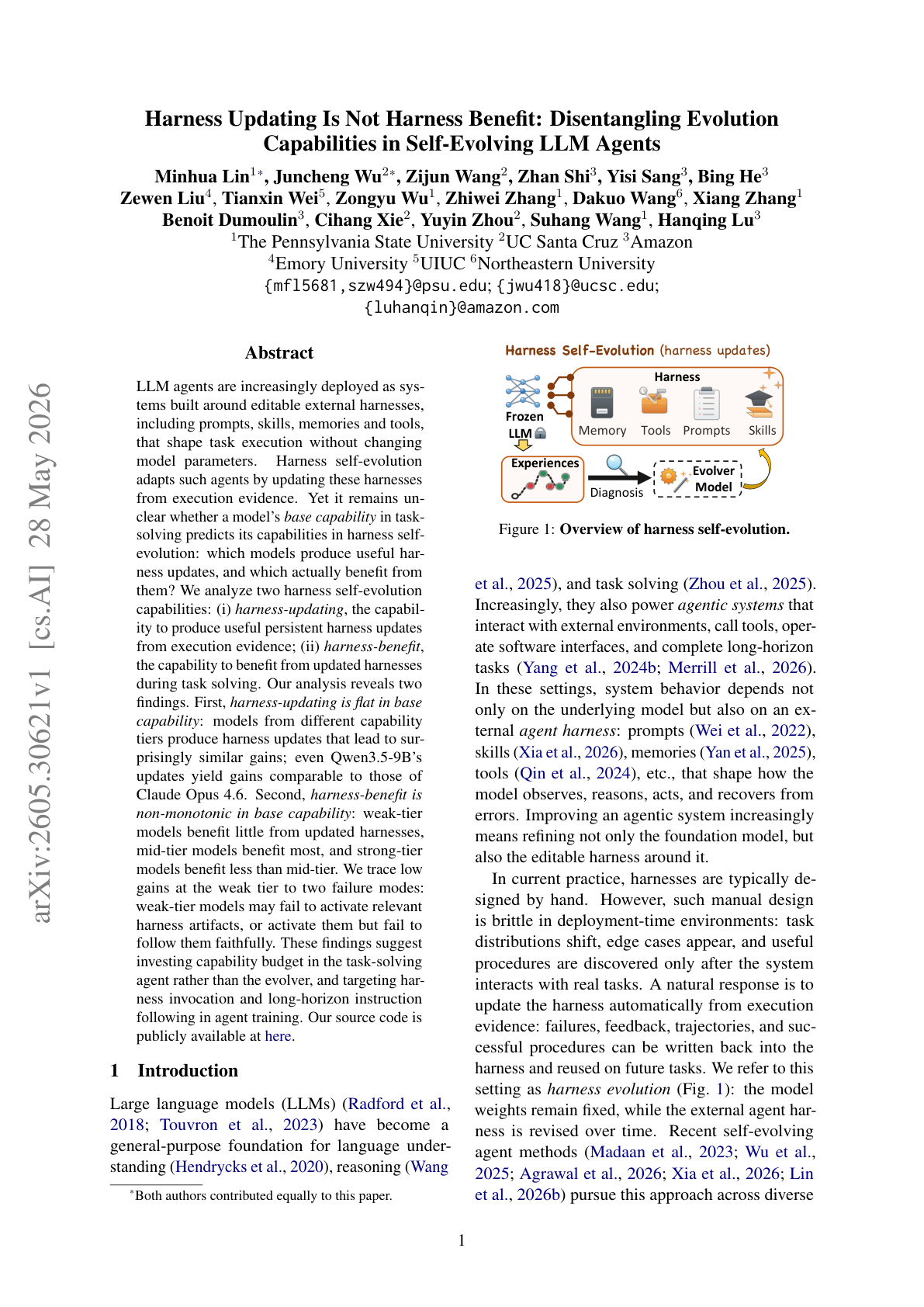
This paper asks a question every agent builder eventually hits: if an agent rewrites its own harness, does a stronger model make a better self-evolving agent? The answer is no, and the reason is that "self-evolution" is actually two separate abilities that scale very differently. The work separates harness-updating, where an evolver model writes edits to memory, tools, prompts, and skills, from harness-benefit, where a solver model actually exploits those edits on the task.
Ask this paper
Updating is flat across model tiers: The quality of harness edits barely depends on model strength. Updates written by Qwen3.5-9B yield gains comparable to those from Claude Opus 4.6, so paying for a frontier model on the evolver side buys almost nothing.
Benefit is non-monotonic: The ability to use a better harness follows a curve. Weak models gain little, mid-tier models benefit most, and the strongest models benefit less than mid-tier ones, often because they already solve the task without the scaffold.
Failure modes are concrete: Weaker solvers either fail to activate the relevant harness component or follow its instructions inconsistently, which is why their gains stay small even when the edits themselves are good.
Why it matters: The practical lever is to put a cheap model on the evolver and spend your capability budget on the solver. System design, not raw model scale, is doing most of the work in agent self-improvement.