Self-Revising Discovery Systems
From MIT, this paper argues that genuine scientific discovery is not answer generation but a change in the search space itself, and that an AI scientist must perceive that shift without being told. It develops a category-theoretic framework in which evidence, artifacts, operations, and verifiers are typed, and discovery is defined as a principled revision of that representational regime rather than more search within a fixed one.
Disentangling Agent Self-Evolution
This paper asks a question every agent builder eventually hits: if an agent rewrites its own harness, does a stronger model make a better self-evolving agent? The answer is no, and the reason is that "self-evolution" is actually two separate abilities that scale very differently. The work separates harness-updating, where an evolver model writes edits to memory, tools, prompts, and skills, from harness-benefit, where a solver model actually exploits those edits on the task.
LEAP
New research from Google shows how far a custom agent harness can push a general-purpose model on formal mathematics. LEAP wraps a general LLM in an agentic scaffold that grounds every step in the Lean compiler and iterates against verifier feedback. Rather than fine-tuning a specialized prover, it leans on informal reasoning, instruction following, and self-refinement, then forces every formal step through a compiler check before moving on.
Scaling Laws for Agent Harnesses
Most harness tuning treats every token and tool call as if volume is what counts. This paper shows that it mostly does not, and introduces Effective Feedback Compute (EFC), a trace-level scaling coordinate that credits feedback only when it is informative, valid, non-redundant, and retained for later decisions, then normalizes by task demand.
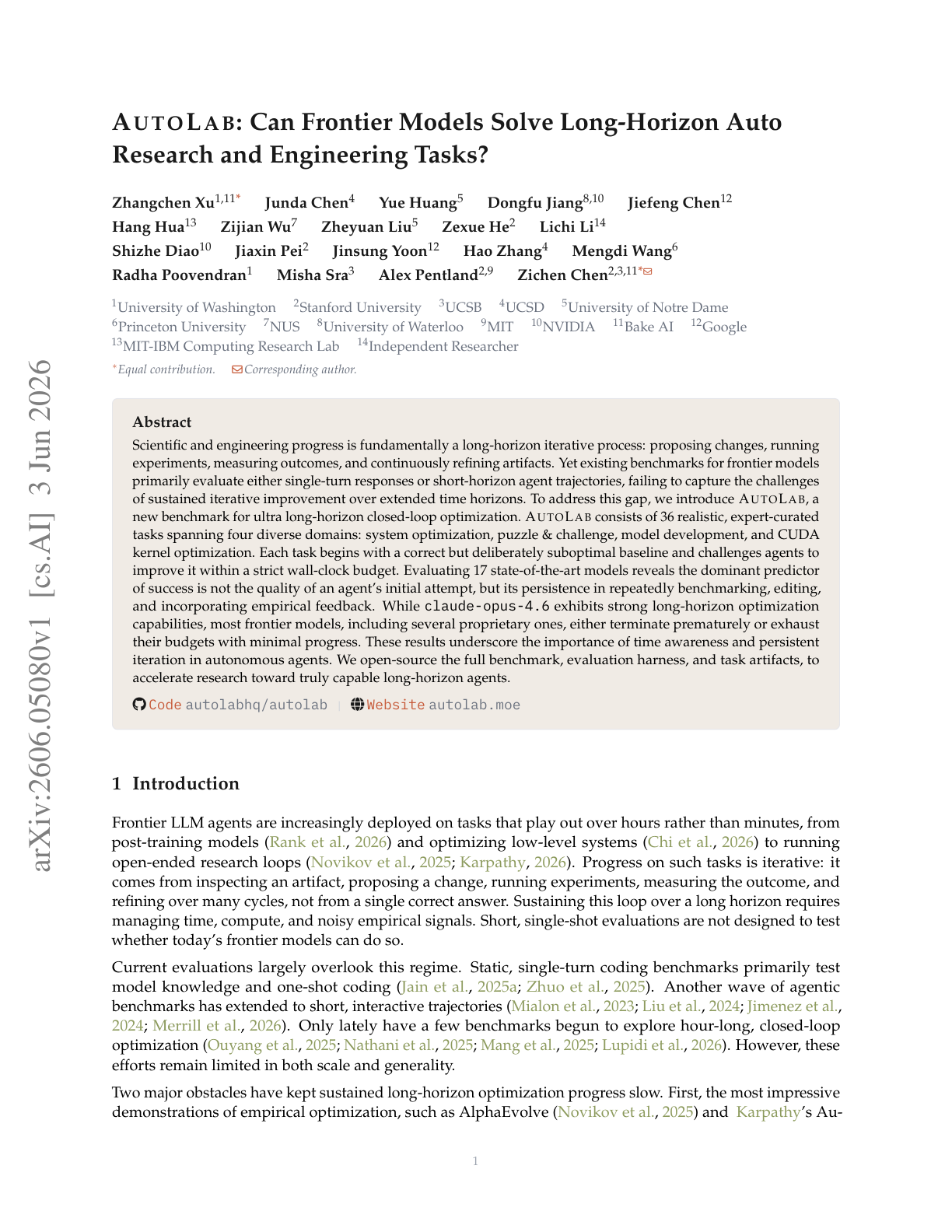
AutoLab
Can frontier models actually grind on a hard engineering problem the way a good researcher does? AutoLab is a benchmark for ultra long-horizon, closed-loop optimization built to answer that. It contains 36 realistic, expert-curated tasks across four domains: system optimization, puzzle and challenge, model development, and CUDA kernel optimization. Each task hands the agent a correct but deliberately suboptimal baseline and asks it to improve within a strict wall-clock budget.
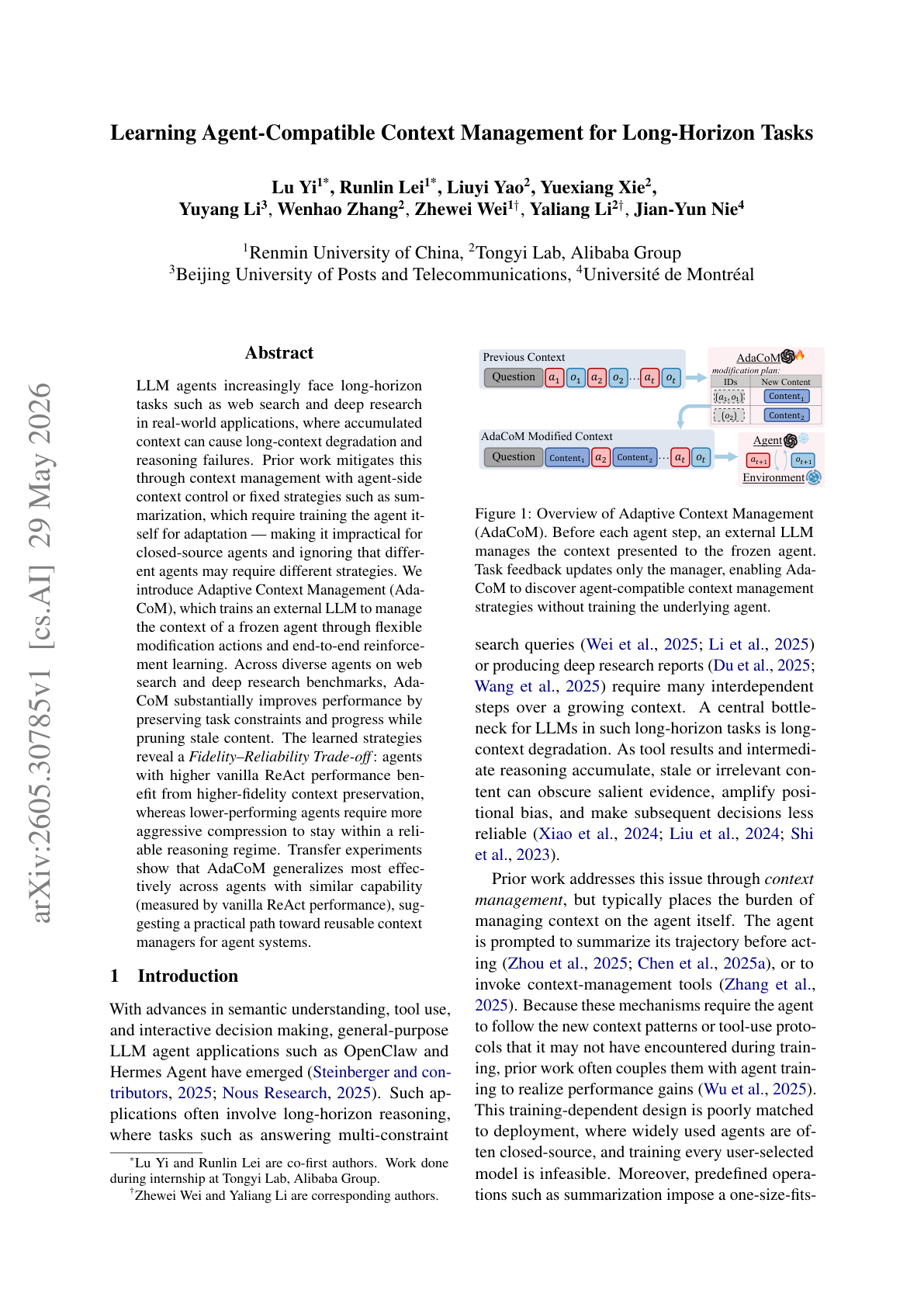
Reusable Context Engineering
Context bloat quietly kills long-horizon runs, and the usual fixes are baked into an agent's own prompt or weights, so they do not transfer. AdaCoM takes a different route: it trains a separate external model to manage the context of a frozen agent through flexible modification actions, optimized end-to-end with reinforcement learning. The agent never changes; only the context flowing into it does.
Learn From Your Own Latents
LLMs learn by predicting tokens, while world models like JEPA and data2vec learn by predicting their own internal representations. This paper provides a sample-complexity theory for why the second approach can be dramatically more data-efficient, using a tractable probabilistic context-free grammar as the analytical setting where compositional structure can be measured exactly.
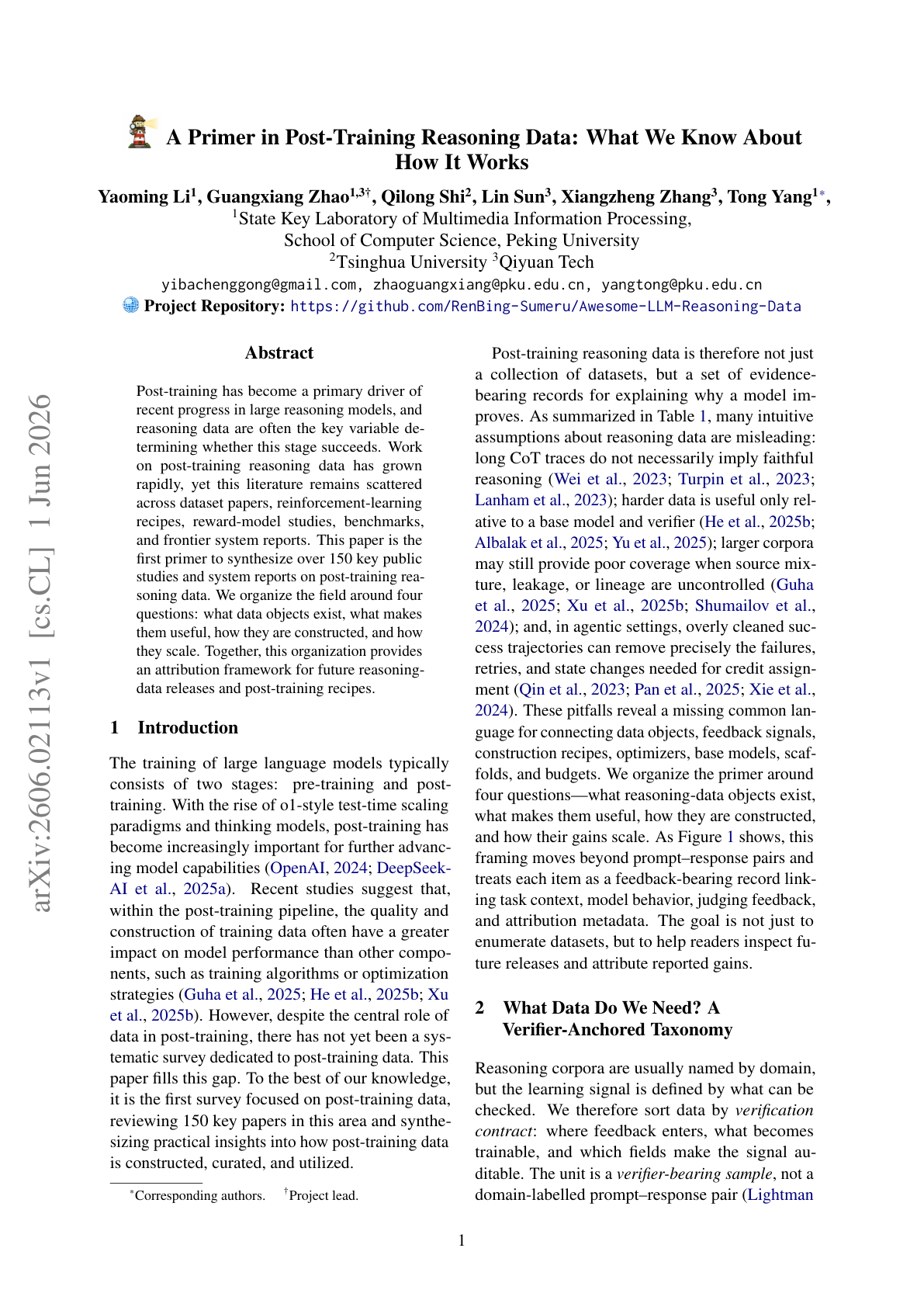
A Primer on Post-Training Reasoning Data
This primer is the first to pull the scattered post-training reasoning-data literature into one place, synthesizing over 150 public studies and system reports that previously lived across dataset papers, RL write-ups, and lab reports. It organizes the field around four questions: what data objects exist, what makes them useful, how they are constructed, and how they scale. The key reframing is that a reasoning-data item is more than a prompt-response pair: it packages a problem or state, model behavior, judging feedback, and attribution metadata, with usefulness defined relative to the verifier and the rest of the corpus rather than in isolation.
State-Externalizing Harnesses
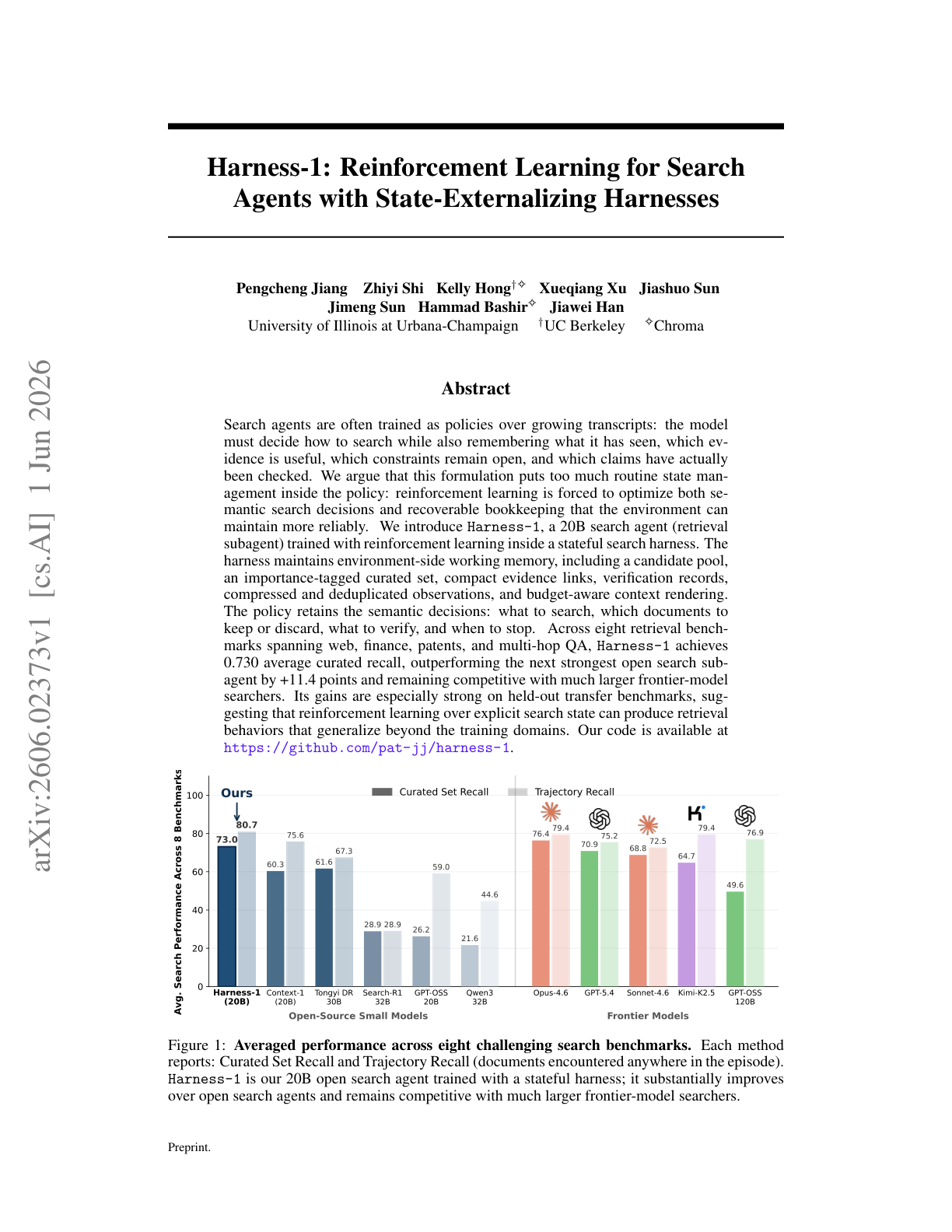
Harness-1 is a 20B search agent trained with reinforcement learning inside a stateful harness that offloads routine bookkeeping to the environment. The argument is that search agents are usually trained as policies over a growing transcript, forcing RL to optimize both genuine search decisions and recoverable state like which evidence is useful or which claims are checked. Harness-1 moves that state out of the policy and into an environment-side working memory of candidate pools, an importance-tagged curated set, compact evidence links, and verification records. The 20B agent reaches an average curated recall of 0.730 across eight retrieval benchmarks, beating open-source baselines by 11.4 points and matching or outperforming much larger frontier searchers, with stronger generalization on unseen domains.
Do More Agents Help?
This paper studies whether adding agents actually makes a single LLM-driven multi-agent system better, using a Sequential Iterative Multi-Agent System (SIMAS) framework. The finding is that performance does not scale monotonically with agent count but follows a pattern of diminishing returns, with degradation eventually driven by coordination overhead. Effective systems still require a capable base model, the optimal number of agents depends on the task type, and collective intelligence turns out to be a product of strategic interaction design rather than a guaranteed outcome of agent plurality. The takeaway for builders is to design the interaction, not just stack more agents.