Reusable Context Engineering
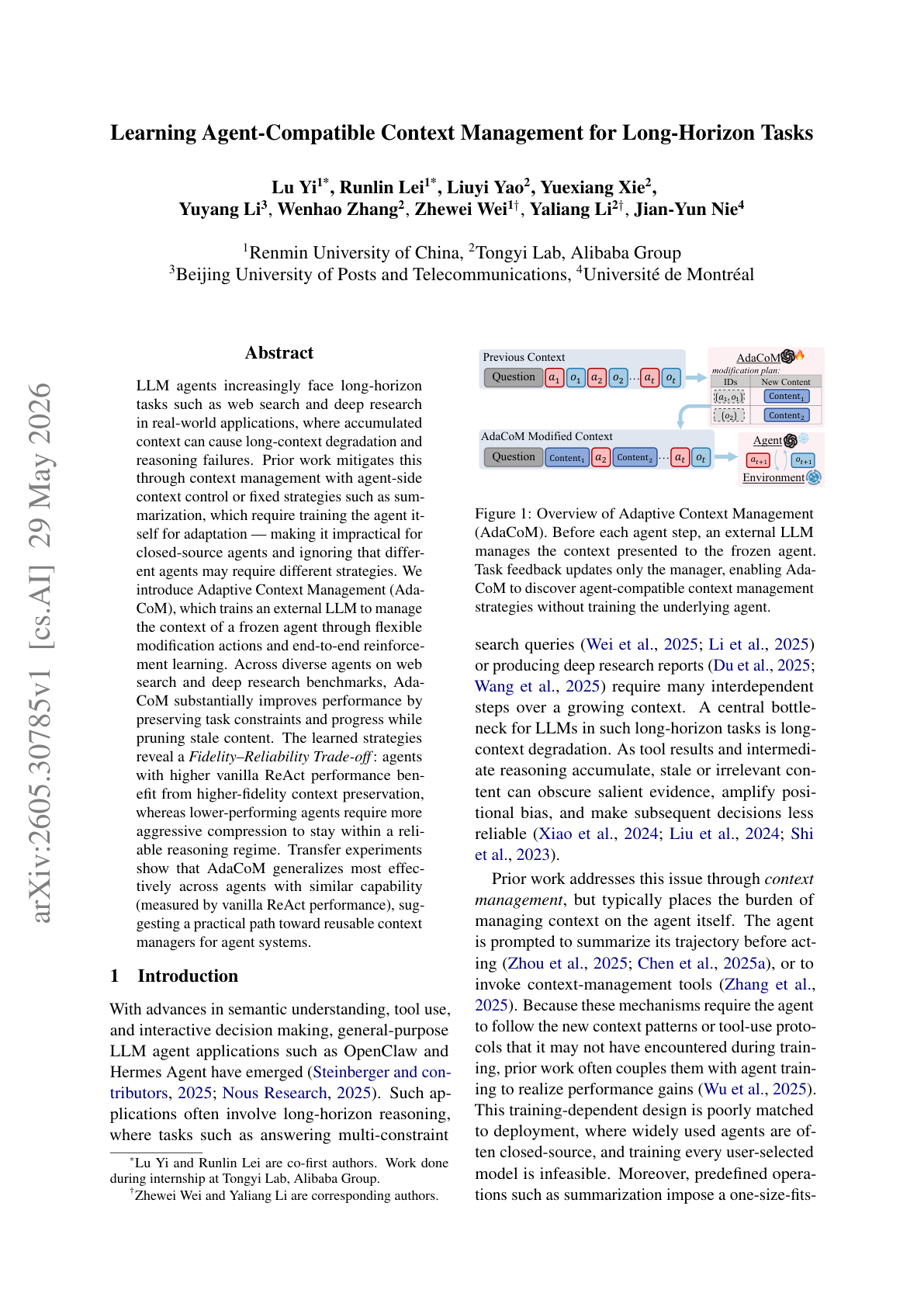
Context bloat quietly kills long-horizon runs, and the usual fixes are baked into an agent's own prompt or weights, so they do not transfer. AdaCoM takes a different route: it trains a separate external model to manage the context of a frozen agent through flexible modification actions, optimized end-to-end with reinforcement learning. The agent never changes; only the context flowing into it does.
Ask this paper
An external context manager: A dedicated model edits the agent's working context, deciding what to keep, compress, or drop. Because it sits outside the agent, it can be reused as a drop-in component rather than re-engineered per backbone.
Trained with reinforcement learning: The manager is optimized end-to-end against task outcomes, learning context-editing policies instead of relying on hand-written heuristics or fixed truncation rules.
Transfers across similar agents: Transfer experiments show AdaCoM generalizes most effectively across agents of similar capability, pointing toward genuinely reusable context managers. It improves web search and deep research by preserving task constraints and progress while pruning stale content.
Why it matters: Treating context management as a separate, trainable, transferable module decouples it from the agent itself. That is a cleaner abstraction than stuffing context logic into every prompt, and it fixes bloat from the outside without touching the underlying model.