Does Prompt Formatting Impact LLM Performance
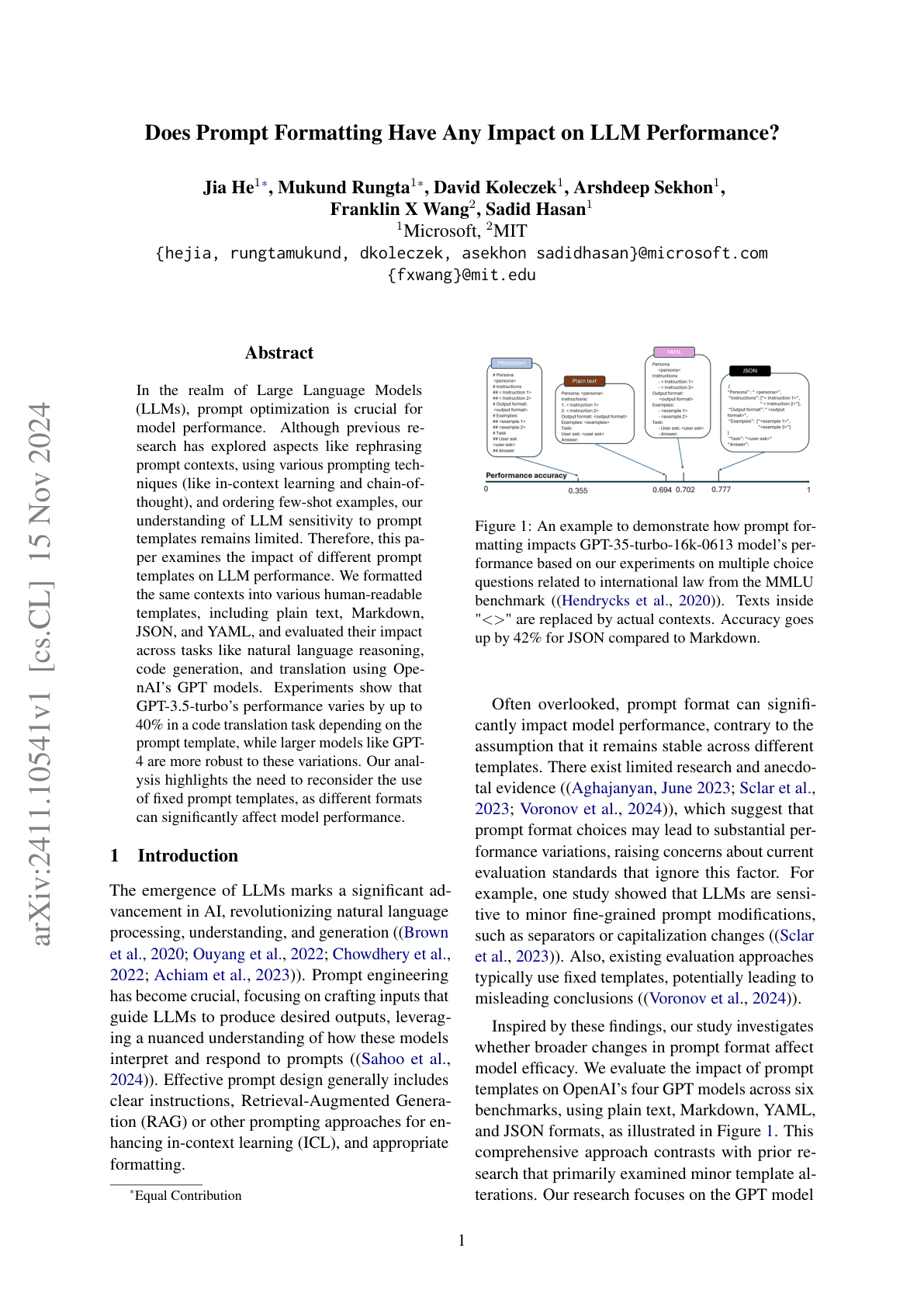
examines how different prompt formats (plain text, Markdown, JSON, and YAML) affect GPT model performance across various tasks; finds that GPT-3.5-turbo's performance can vary by up to 40% depending on the prompt format, while larger models like GPT-4 show more robustness to format changes; argues that there is no universally optimal format across models or tasks - for instance, GPT-3.5-turbo generally performed better with JSON formats while GPT-4 preferred Markdown; models from the same family showed similar format preferences, but these preferences didn't transfer well between different model families; suggests that prompt formatting significantly impacts model performance and should be carefully considered when performing prompt engineering and model evaluation, and how to apply it to applications.
Ask this paper
Abstract
In the realm of Large Language Models (LLMs), prompt optimization is crucial for model performance. Although previous research has explored aspects like rephrasing prompt contexts, using various prompting techniques (like in-context learning and chain-of-thought), and ordering few-shot examples, our understanding of LLM sensitivity to prompt templates remains limited. Therefore, this paper examines the impact of different prompt templates on LLM performance. We formatted the same contexts into various human-readable templates, including plain text, Markdown, JSON, and YAML, and evaluated their impact across tasks like natural language reasoning, code generation, and translation using OpenAI's GPT models. Experiments show that GPT-3.5-turbo's performance varies by up to 40\% in a code translation task depending on the prompt template, while larger models like GPT-4 are more robust to these variations. Our analysis highlights the need to reconsider the use of fixed prompt templates, as different formats can significantly affect model performance.