DROID
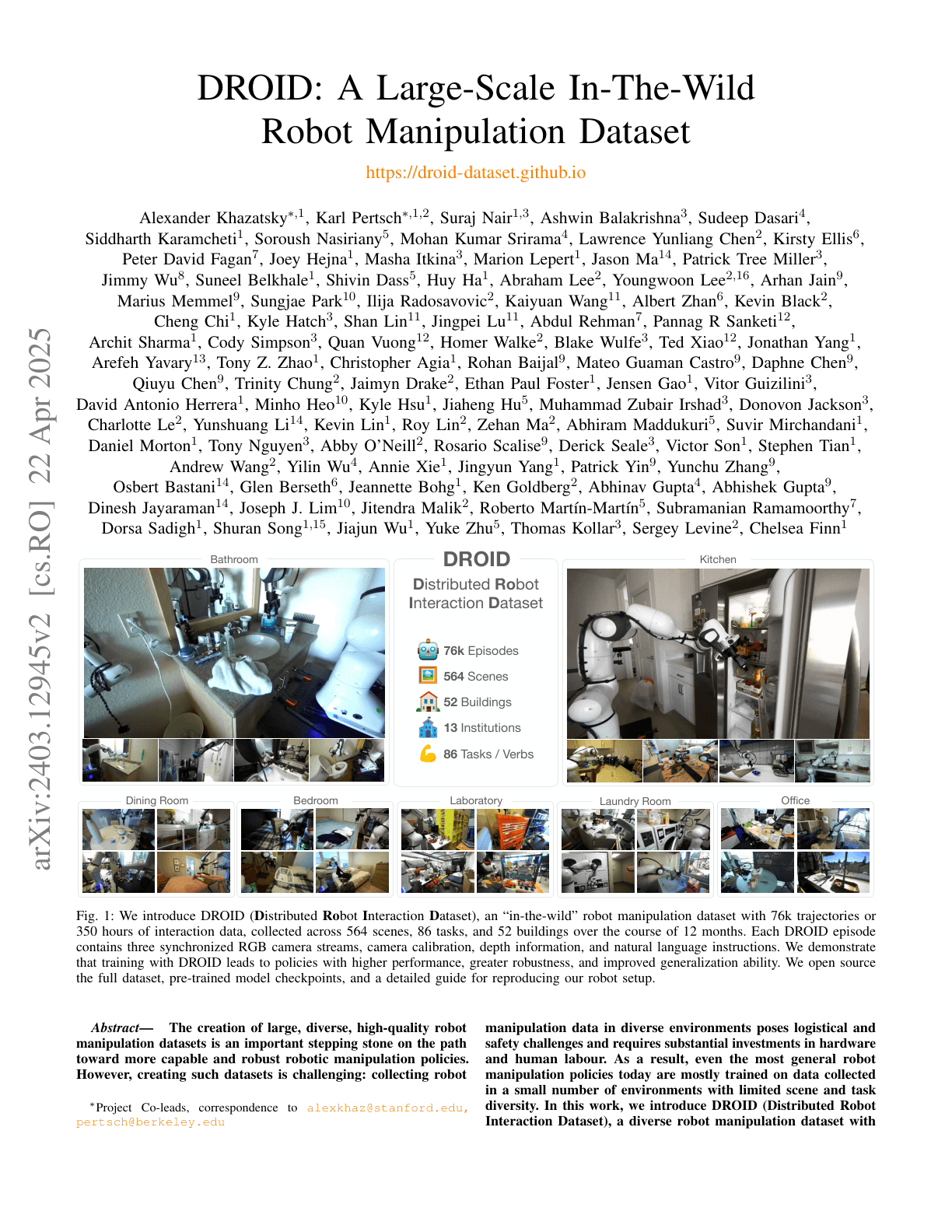
DROID is an open-source robot manipulation dataset that dramatically expands the diversity of real-world robot demonstrations available for imitation-learning research.
Ask this paper
Scale and diversity: 76K demonstration trajectories (~350 hours of interaction) collected across 564 scenes and 84 manipulation tasks - substantially more varied than prior public datasets.
Distributed collection: 50 data collectors across multiple international locations contributed over 12 months, using a standardized hardware setup that is released alongside the data.
Stronger policies: Policies trained on DROID show higher success rates and improved out-of-distribution generalization compared to training on earlier, less diverse datasets.
Full open release: Dataset, training code, and hardware reproduction guides are all public, giving the community a common substrate to benchmark and iterate on manipulation policies.
Abstract
The creation of large, diverse, high-quality robot manipulation datasets is an important stepping stone on the path toward more capable and robust robotic manipulation policies. However, creating such datasets is challenging: collecting robot manipulation data in diverse environments poses logistical and safety challenges and requires substantial investments in hardware and human labour. As a result, even the most general robot manipulation policies today are mostly trained on data collected in a small number of environments with limited scene and task diversity. In this work, we introduce DROID (Distributed Robot Interaction Dataset), a diverse robot manipulation dataset with 76k demonstration trajectories or 350 hours of interaction data, collected across 564 scenes and 84 tasks by 50 data collectors in North America, Asia, and Europe over the course of 12 months. We demonstrate that training with DROID leads to policies with higher performance and improved generalization ability. We open source the full dataset, policy learning code, and a detailed guide for reproducing our robot hardware setup.