Effective Long-Context Scaling (Meta)
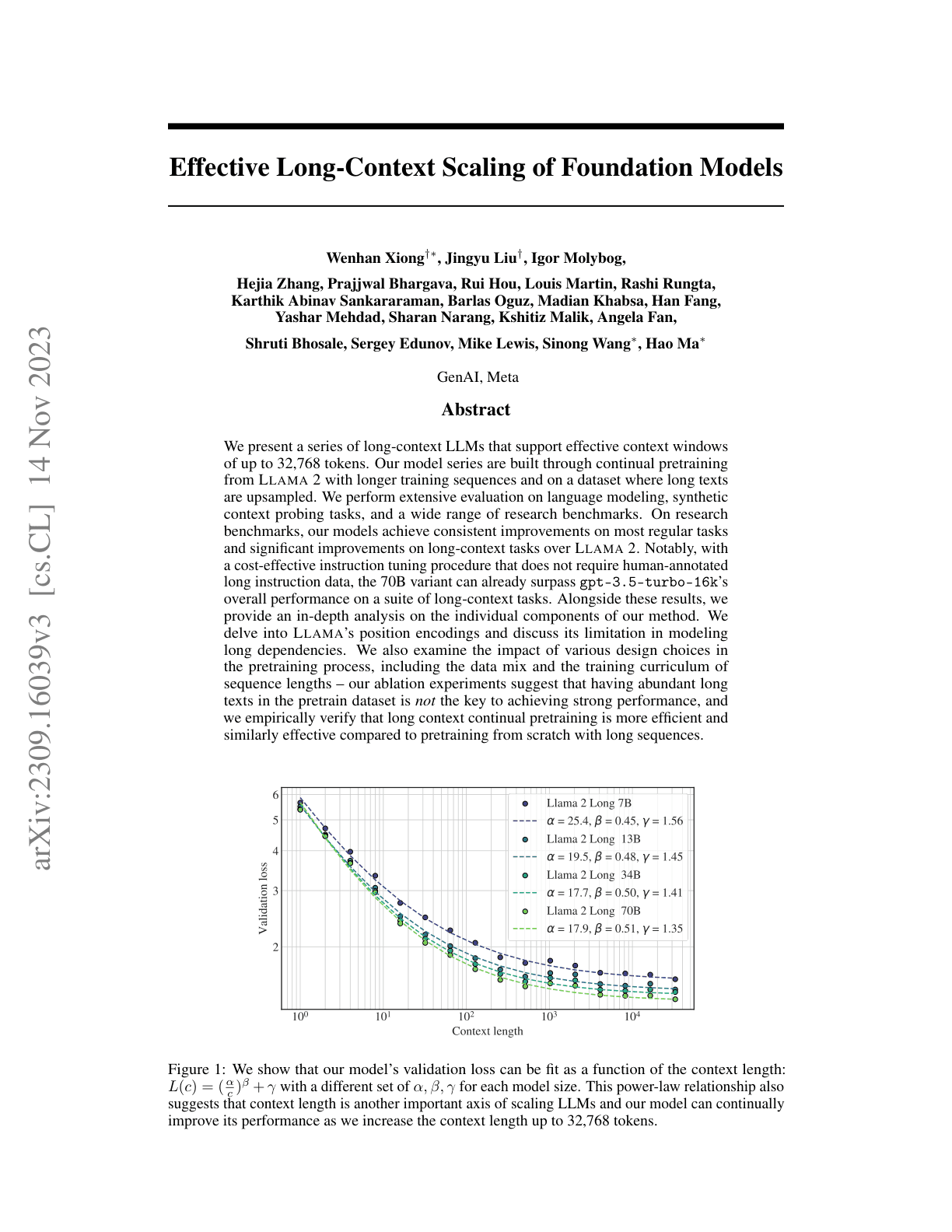
Meta proposes a 70B long-context LLM that surpasses GPT-3.5-turbo-16k on long-context benchmarks.
Ask this paper
Continual pretraining recipe: Uses continual pretraining on long documents to extend Llama 2's context window efficiently, without training a new model from scratch.
Beats GPT-3.5-turbo-16k: The 70B variant outperforms GPT-3.5-turbo-16k on a suite of long-context tasks including document QA, summarization, and multi-hop reasoning.
Cost-effective instruction tuning: Introduces an instruction-tuning procedure that doesn't require human-annotated long-instruction data - a common bottleneck for long-context fine-tuning.
Open release: Produces an open long-context Llama 2 variant, making strong long-context capability accessible to the research community.
Abstract
We present a series of long-context LLMs that support effective context windows of up to 32,768 tokens. Our model series are built through continual pretraining from Llama 2 with longer training sequences and on a dataset where long texts are upsampled. We perform extensive evaluation on language modeling, synthetic context probing tasks, and a wide range of research benchmarks. On research benchmarks, our models achieve consistent improvements on most regular tasks and significant improvements on long-context tasks over Llama 2. Notably, with a cost-effective instruction tuning procedure that does not require human-annotated long instruction data, the 70B variant can already surpass gpt-3.5-turbo-16k's overall performance on a suite of long-context tasks. Alongside these results, we provide an in-depth analysis on the individual components of our method. We delve into Llama's position encodings and discuss its limitation in modeling long dependencies. We also examine the impact of various design choices in the pretraining process, including the data mix and the training curriculum of sequence lengths -- our ablation experiments suggest that having abundant long texts in the pretrain dataset is not the key to achieving strong performance, and we empirically verify that long context continual pretraining is more efficient and similarly effective compared to pretraining from scratch with long sequences.