Graph Neural Prompting (GNP)
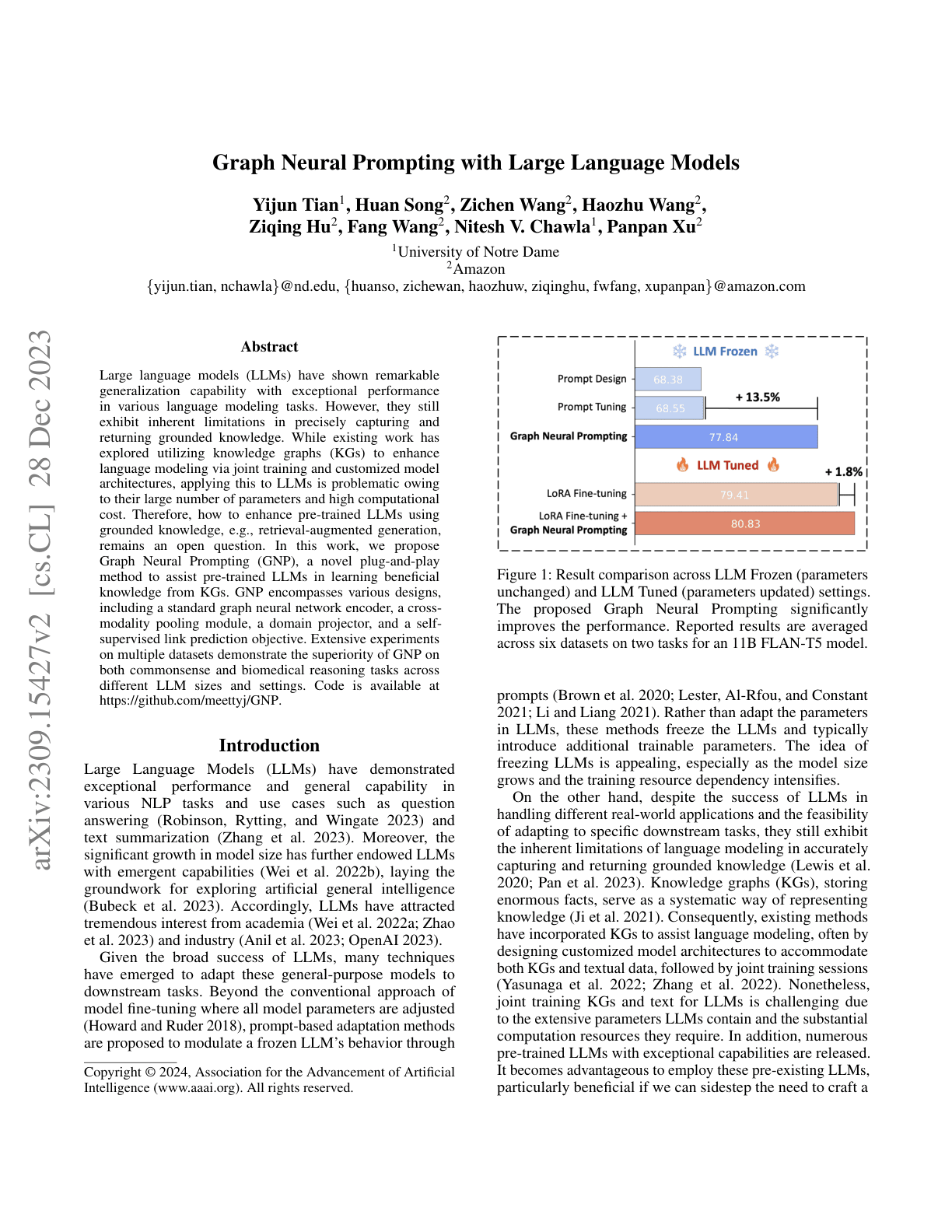
A plug-and-play method that injects knowledge-graph information into frozen pretrained LLMs.
Ask this paper
KG-to-embedding bridge: Uses a graph neural network to encode relevant knowledge-graph subgraphs into a soft prompt embedding that conditions the LLM.
Frozen-LLM compatible: Works with frozen pretrained LLMs without requiring any fine-tuning, making it cheap to adopt.
Commonsense gains: Improves performance on commonsense QA benchmarks where structured knowledge-graph information is known to help.
Modular extensibility: The GNN-encoded soft-prompt pattern generalizes beyond KGs to any structured input that can be encoded into embeddings.
Abstract
Large language models (LLMs) have shown remarkable generalization capability with exceptional performance in various language modeling tasks. However, they still exhibit inherent limitations in precisely capturing and returning grounded knowledge. While existing work has explored utilizing knowledge graphs (KGs) to enhance language modeling via joint training and customized model architectures, applying this to LLMs is problematic owing to their large number of parameters and high computational cost. Therefore, how to enhance pre-trained LLMs using grounded knowledge, e.g., retrieval-augmented generation, remains an open question. In this work, we propose Graph Neural Prompting (GNP), a novel plug-and-play method to assist pre-trained LLMs in learning beneficial knowledge from KGs. GNP encompasses various designs, including a standard graph neural network encoder, a cross-modality pooling module, a domain projector, and a self-supervised link prediction objective. Extensive experiments on multiple datasets demonstrate the superiority of GNP on both commonsense and biomedical reasoning tasks across different LLM sizes and settings. Code is available at https://github.com/meettyj/GNP.