Emergent Hierarchical Reasoning
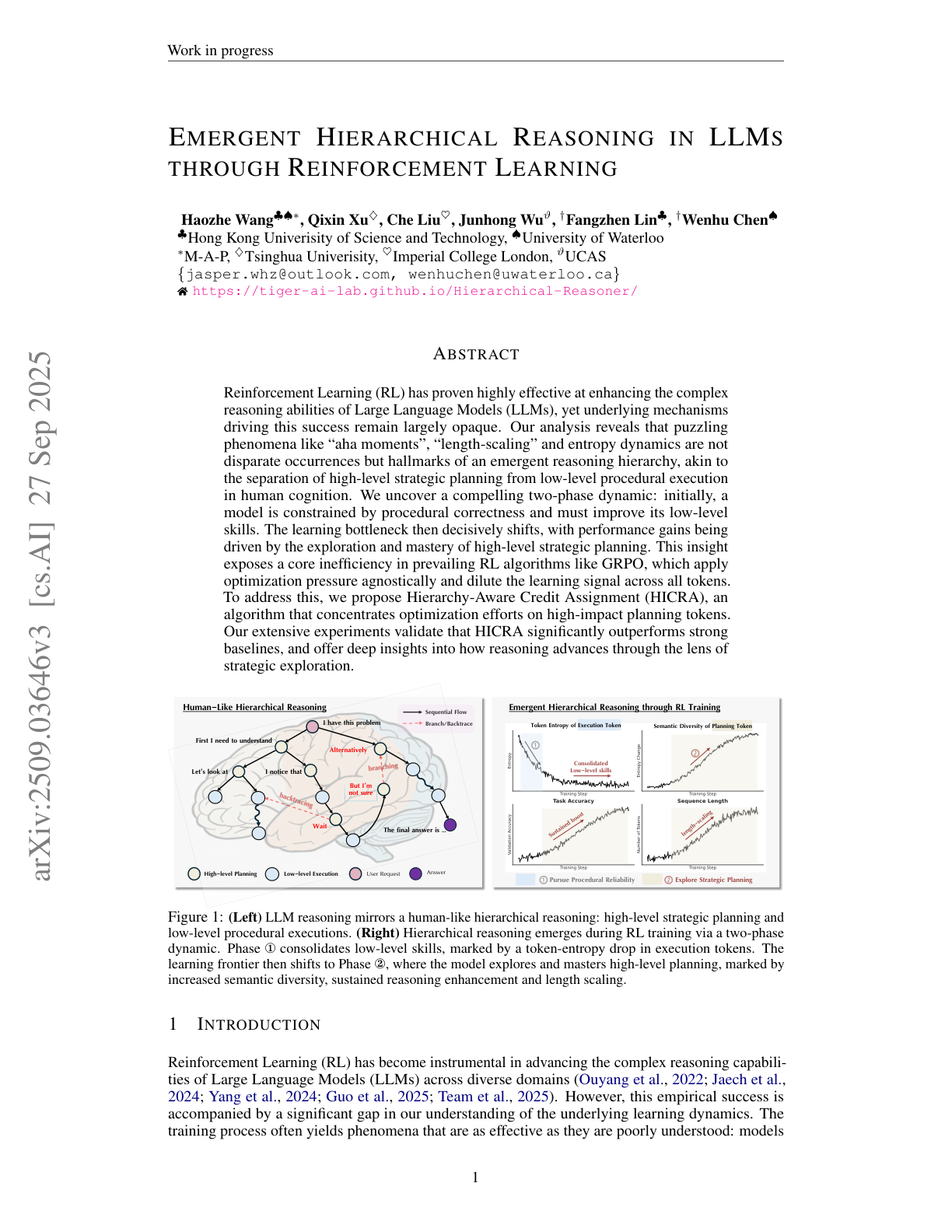
The paper argues that RL improves LLM reasoning via an emergent two-phase hierarchy: first the model firms up low-level execution, then progress hinges on exploring high-level planning. Building on this, the authors propose HICRA, which boosts credit on strategic planning tokens, and show consistent gains over GRPO. They also propose semantic entropy as a better exploration signal than token-level entropy.
Ask this paper
Two-phase dynamic. Early RL training reduces perplexity and entropy on execution tokens, consolidating procedural skills. Later gains align with increased diversity in planning tokens and longer, more accurate traces, explaining “aha moments” and length scaling.
Planning vs execution. The paper functionally tags strategic grams (e.g., deduction, branching, backtracing) as planning tokens, distinguishing them from procedural steps. This labeling exposes the shift in the learning bottleneck toward strategy.
HICRA algorithm. Modifies GRPO by amplifying advantages on planning tokens with a scalar α, concentrating optimization on high-impact strategic decisions instead of spreading it across all tokens. This creates targeted exploration and faster reinforcement of effective strategies. Section 3 gives the formulation.
Results. Across Qwen, Llama, and VLMs, HICRA improves Pass@1 on AIME24/25, Math500, AMC23, and multimodal math suites, often by several points over GRPO, with plots showing higher semantic entropy tracking higher validation accuracy.
Signals that matter. Token-level entropy can decline even as true exploration grows, since execution tokens dominate. Semantic entropy over strategic grams better captures strategic exploration and correlates with performance.
Limits and scope. HICRA works best when a model already has a procedural foundation; on weaker bases, the focus on planning may not help. The paper suggests future work on higher-level action spaces, adaptive curricula, and process-oriented rewards.