ParaThinker
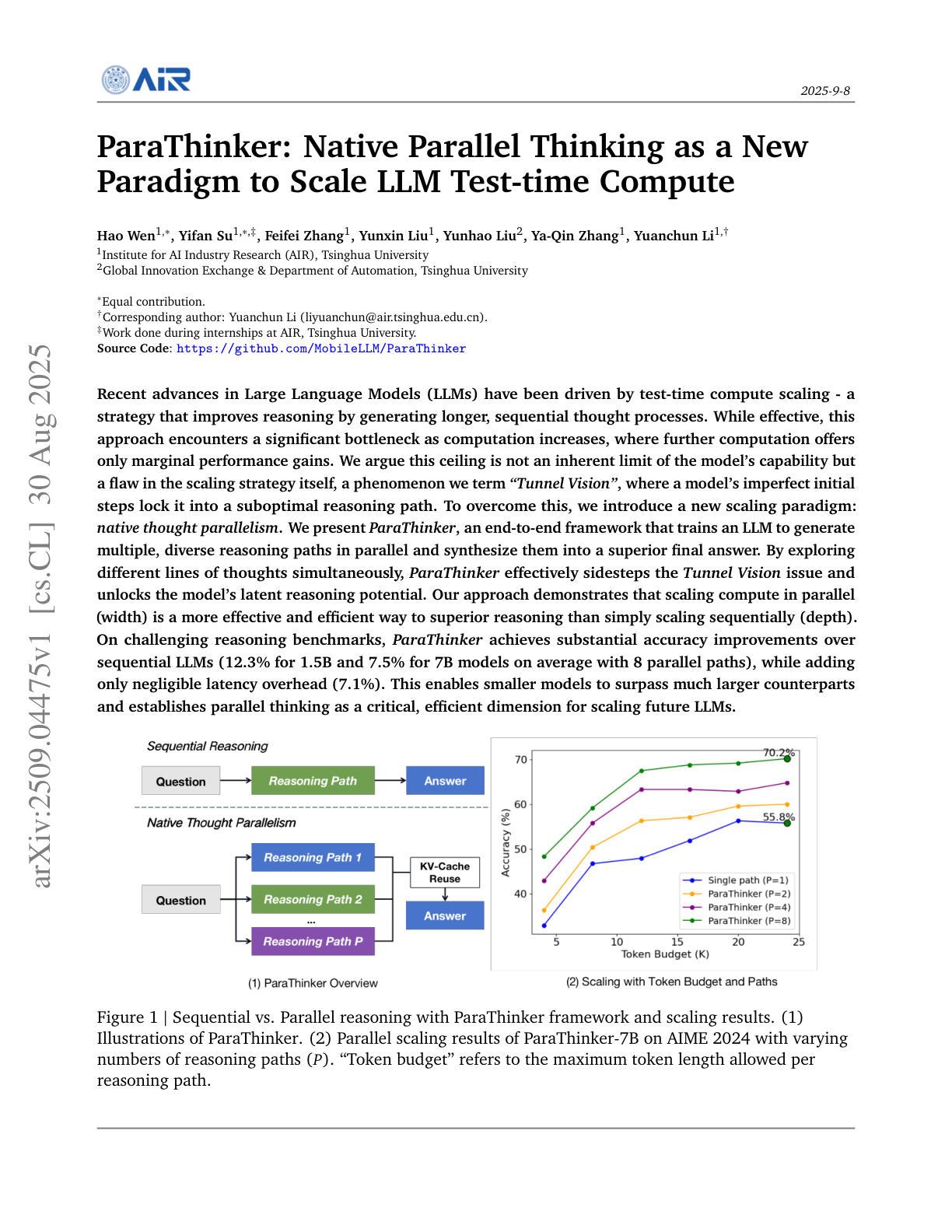
This paper argues that today’s “think longer” strategies trap LLMs in a single line of thought. They propose ParaThinker, which trains models to generate several independent reasoning paths in parallel and then fuse them into one answer. Across math benchmarks, this width-scaling lifts accuracy while adding only a small latency cost.
Ask this paper
Problem framing. The paper identifies a test-time bottleneck called “Tunnel Vision,” where early tokens commit the model to a suboptimal path; majority-style parallel sampling can beat one long chain under the same token budget.
Method. ParaThinker runs two stages: parallel reasoning then summarization. It uses trainable control tokens <think i> to start diverse paths, thought-specific positional embeddings to disambiguate tokens from different paths, and a two-phase attention mask that isolates paths during thinking and unifies them for summarization, reusing KV caches to avoid re-prefill.
Training recipe. Supervised fine-tuning on multi-path traces sampled from teacher models, with random assignment of <think i> so the student can generalize to more paths than seen in training; details and data sources are outlined in Section 4 and the SFT tables in the appendix.
Results. On AIME 2024/2025, AMC 2023, and MATH-500, ParaThinker improves pass@1 over sequential baselines by about 12.3% for 1.5B and 7.5% for 7B with 8 paths at fixed per-path budgets, and beats majority voting by 4.3% (1.5B) and 2.0% (7B) on average. Combining ParaThinker with majority voting yields further gains.
Efficiency and design insights. Latency increases slightly with more paths because decoding is memory-bandwidth bound; on a single A800, 16 paths take less than 2× the time of one path for the same length. The best termination policy is “first-finish,” which equalizes path lengths and improves both accuracy and speed. Thought embeddings are crucial; naive flattened positions hurt performance.