Epistemia
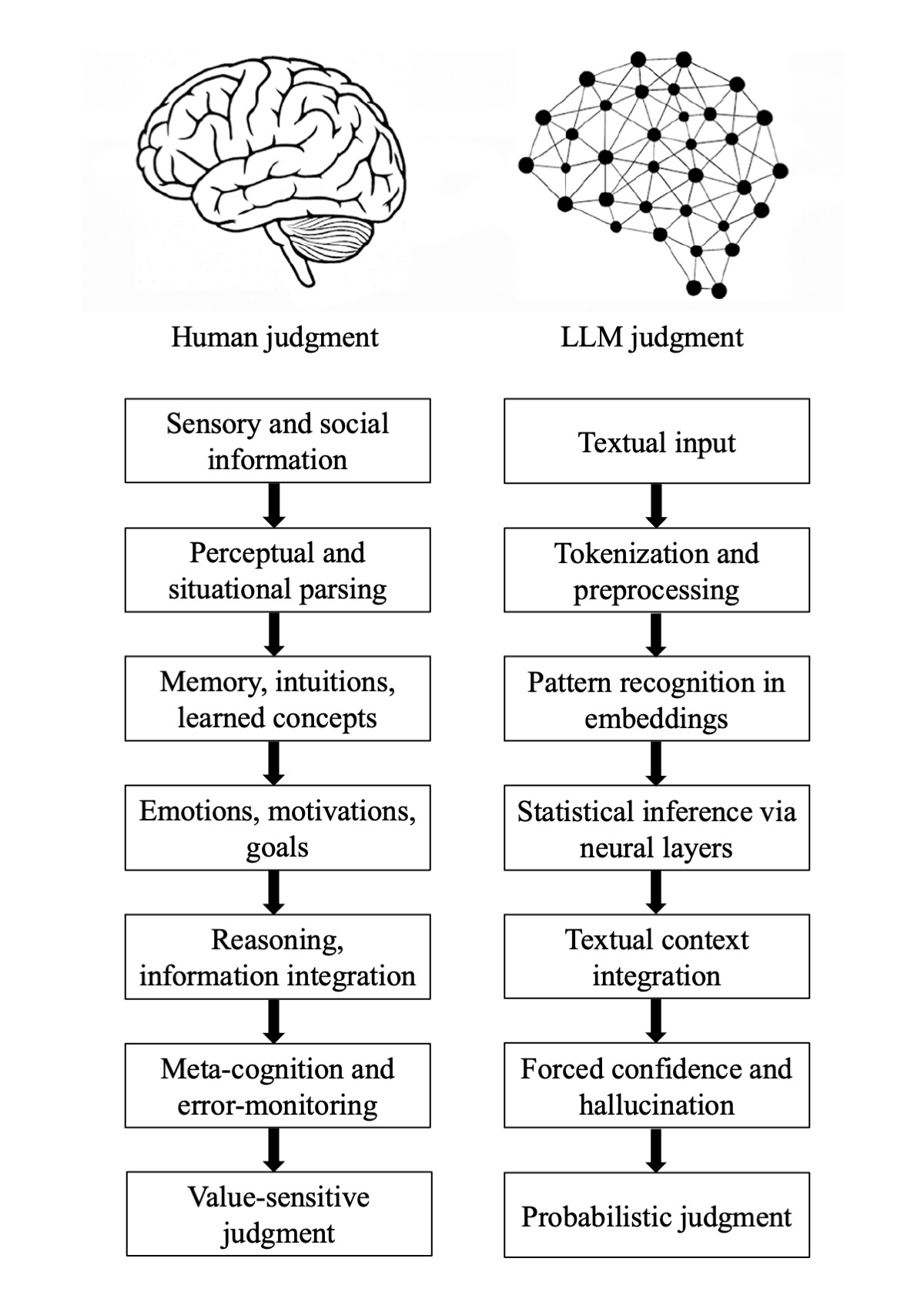
This paper argues that LLMs are not epistemic agents but stochastic pattern-completion systems. By mapping human and artificial epistemic pipelines, the authors identify seven fundamental fault lines where human and machine judgment diverge, despite producing superficially similar outputs. - **Seven epistemic fault lines:** The paper identifies divergences in grounding (perception vs text), parsing (situation understanding vs tokenization), experience (episodic memory vs embeddings), motivation (goals and emotions vs statistical optimization), causality (causal reasoning vs correlations), metacognition (uncertainty monitoring vs forced confidence), and value (moral commitment vs probabilistic prediction). - **Introducing Epistemia:** The authors define Epistemia as the structural condition where linguistic plausibility substitutes for epistemic evaluation. Users experience having an answer without the cognitive labor of judgment - the feeling of knowing without actually knowing. - **Why hallucinations are not bugs:** In this framework, hallucinations are not anomalous failures but the default operational state. LLMs produce ungrounded content because they lack reference, truth conditions, or evidential constraints. Grounded outputs only occur when probability structure happens to coincide with factual structure. - **Implications for AI governance:** The paper calls for epistemic evaluation beyond surface alignment, governance frameworks that regulate how generative outputs enter epistemic workflows, and new forms of epistemic literacy that help users recognize when apparent judgments are pattern completion rather than genuine evaluation.
Ask this paper
Seven epistemic fault lines: The paper identifies divergences in grounding (perception vs text), parsing (situation understanding vs tokenization), experience (episodic memory vs embeddings), motivation (goals and emotions vs statistical optimization), causality (causal reasoning vs correlations), metacognition (uncertainty monitoring vs forced confidence), and value (moral commitment vs probabilistic prediction).
Introducing Epistemia: The authors define Epistemia as the structural condition where linguistic plausibility substitutes for epistemic evaluation. Users experience having an answer without the cognitive labor of judgment - the feeling of knowing without actually knowing.
Why hallucinations are not bugs: In this framework, hallucinations are not anomalous failures but the default operational state. LLMs produce ungrounded content because they lack reference, truth conditions, or evidential constraints. Grounded outputs only occur when the probability structure happens to coincide with the factual structure.
Implications for AI governance: The paper calls for epistemic evaluation beyond surface alignment, governance frameworks that regulate how generative outputs enter epistemic workflows, and new forms of epistemic literacy that help users recognize when apparent judgments are pattern completion rather than genuine evaluation.
Abstract
Large language models (LLMs) are widely described as artificial intelligence, yet their epistemic profile diverges sharply from human cognition. Here we show that the apparent alignment between human and machine outputs conceals a deeper structural mismatch in how judgments are produced. Tracing the historical shift from symbolic AI and information filtering systems to large-scale generative transformers, we argue that LLMs are not epistemic agents but stochastic pattern-completion systems, formally describable as walks on high-dimensional graphs of linguistic transitions rather than as systems that form beliefs or models of the world. By systematically mapping human and artificial epistemic pipelines, we identify seven epistemic fault lines, divergences in grounding, parsing, experience, motivation, causal reasoning, metacognition, and value. We call the resulting condition Epistemia: a structural situation in which linguistic plausibility substitutes for epistemic evaluation, producing the feeling of knowing without the labor of judgment. We conclude by outlining consequences for evaluation, governance, and epistemic literacy in societies increasingly organized around generative AI.