From Bytes to Ideas
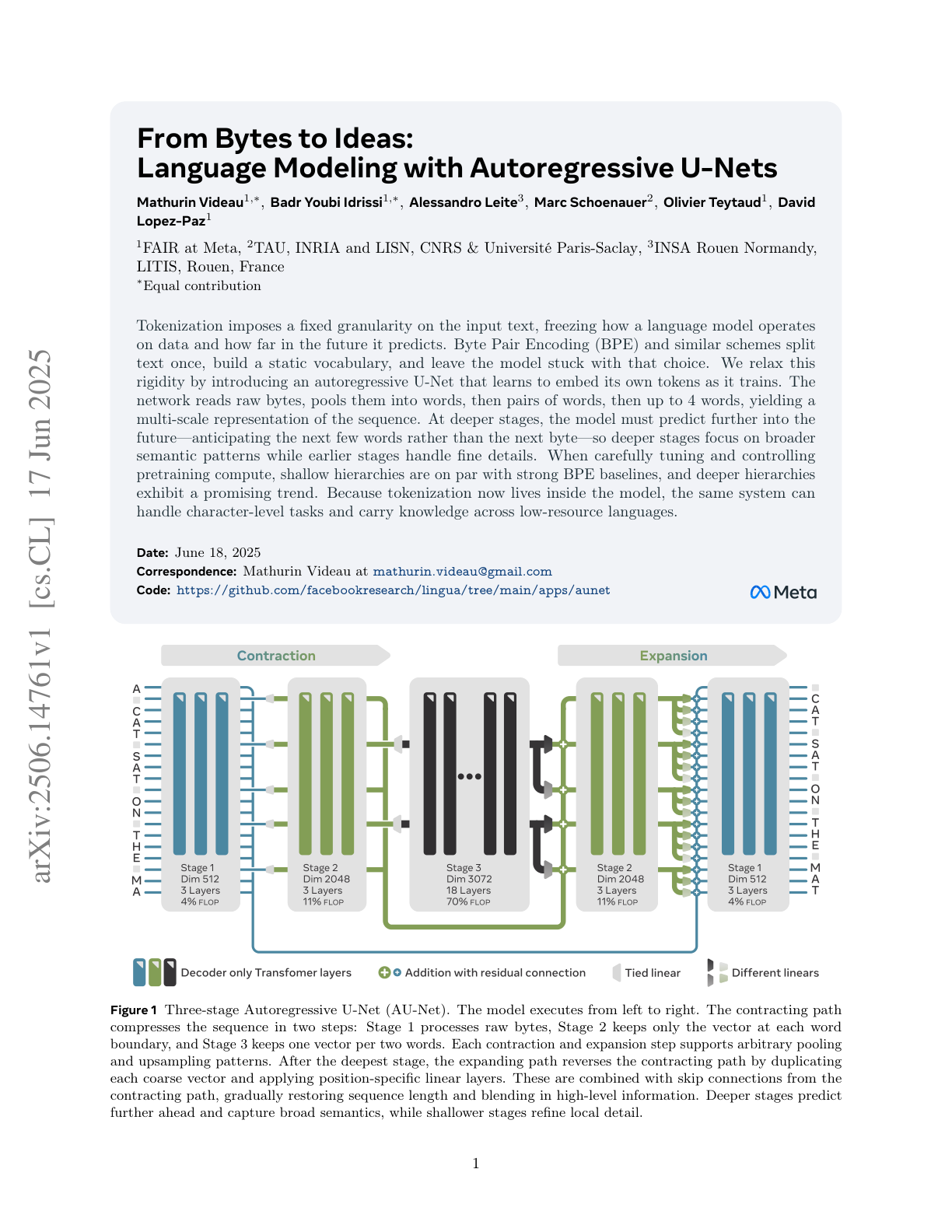
Proposes AU-Net, a hierarchical byte-level language model that internalizes tokenization by learning to embed text from raw bytes through a multiscale, autoregressive U-Net architecture. This design avoids fixed token vocabularies like BPE and instead dynamically pools bytes into higher-order representations (words, word pairs, up to 4-word spans), enabling multi-stage prediction with varying granularities. Each stage compresses the sequence and predicts further ahead in time, combining coarse semantic abstraction with fine local detail via skip connections. Key insights:
Ask this paper
Hierarchical architecture: AU-Net processes input in multiple stages, bytes → words → multi-word units, using adaptive pooling and multi-linear upsampling. Deeper stages handle long-range semantics; shallow ones refine local syntax.
Strong performance under budget: On a compute-equal basis (up to 5e21 FLOPs), AU-Net matches or exceeds strong BPE-based Transformers across many tasks. AU-Net 3 and 4 outperform BPE on MMLU and GSM8k while retaining competitive FLOPs and throughput.
Multilingual and low-resource gains: Despite being trained on mostly English, AU-Net shows consistent improvements in BLEU and MMLU on low-resource and Latin-script languages, thanks to its byte-level generalization and vocabulary-agnostic design.
Scaling behavior: AU-Net follows predictable scaling laws. With 2–3 stages, it closely tracks BPE-based baselines even on compute-heavy benchmarks. Gains on math-heavy tasks (like GSM8K) emerge at higher FLOPs, indicating potential unlocked at scale.
Character-level robustness: On the CUTE benchmark, AU-Net outperforms BPE models on character-level tasks (e.g., spelling, substitution), highlighting its strength in symbol-level reasoning and handling unseen morphologies.