RAG+
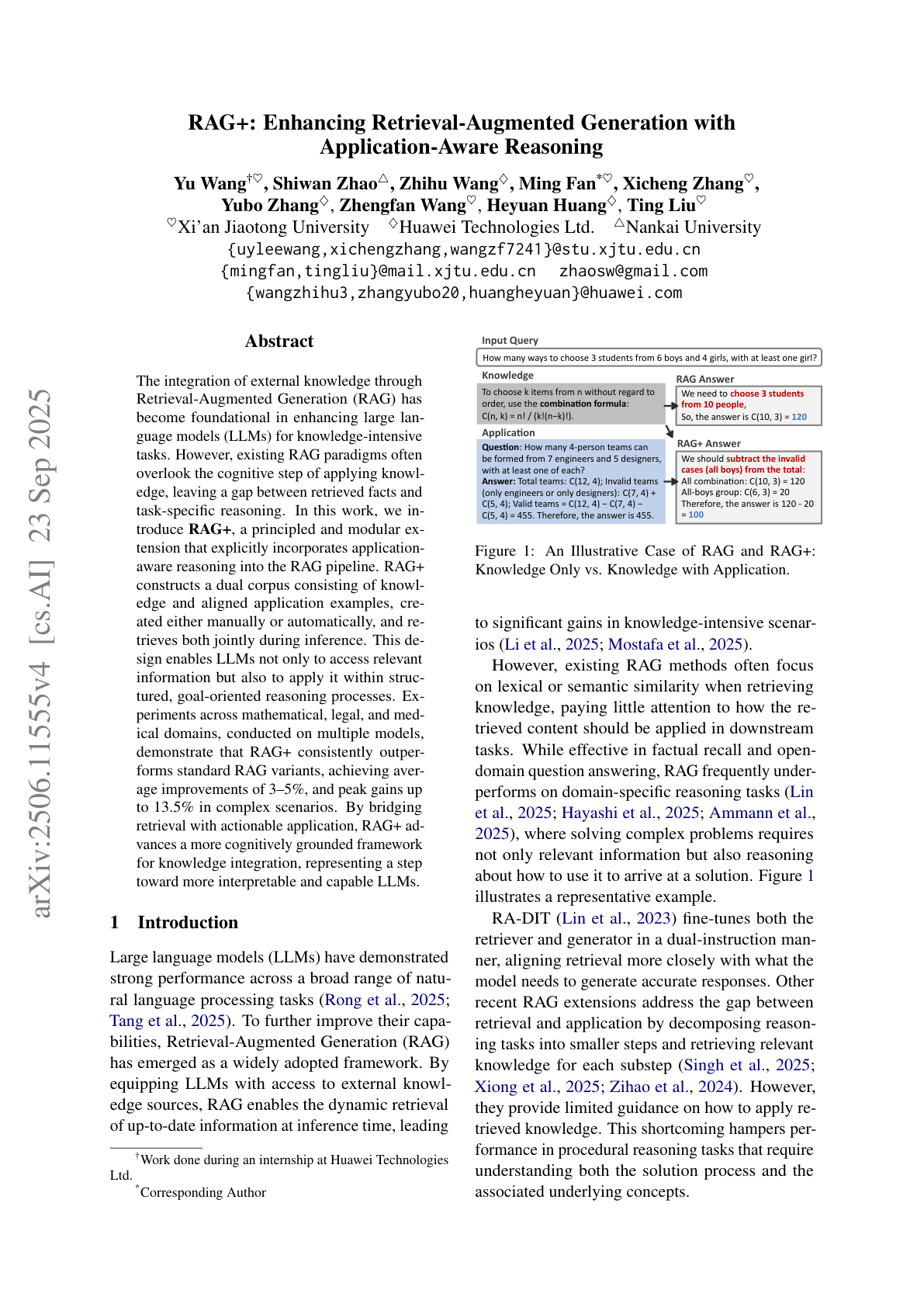
Introduces RAG+, a modular framework that improves traditional RAG systems by explicitly incorporating application-level reasoning into the retrieval and generation pipeline. While standard RAG pipelines fetch relevant knowledge, they often fail to show how to use that knowledge effectively in reasoning-intensive tasks. RAG+ fills this gap by retrieving not only knowledge but also paired application examples, leading to more accurate, interpretable, and goal-oriented outputs. Key highlights:
Ask this paper
Dual corpus retrieval: RAG+ constructs two aligned corpora: one of factual knowledge and another of task-specific applications (e.g., step-by-step reasoning traces or worked examples). During inference, both are jointly retrieved, providing the LLM with explicit procedural guidance rather than relying solely on semantic similarity.
Plug-and-play design: The system is retrieval-agnostic and model-agnostic—no fine-tuning or architectural changes are required. This makes it easy to augment any RAG system with application-awareness.
Significant gains across domains: Evaluated on MathQA, MedQA, and legal sentencing prediction, RAG+ outperforms vanilla RAG variants by 2.5–7.5% on average, with peak gains of up to 10% for large models like Qwen2.5-72B in legal reasoning..
Stronger with scale and reranking: Larger models benefit more from RAG+ augmentation, especially when combined with reranking via stronger LLMs. For example, reranking with Qwen2.5-72B boosted smaller models' performance by up to 7%.
Application-only helps, but full combo is best: Including only application examples (without knowledge) still improves performance, but the full combination (RAG+) consistently yields the best results, demonstrating the synergistic effect of pairing knowledge with its usage.