HtmlRAG
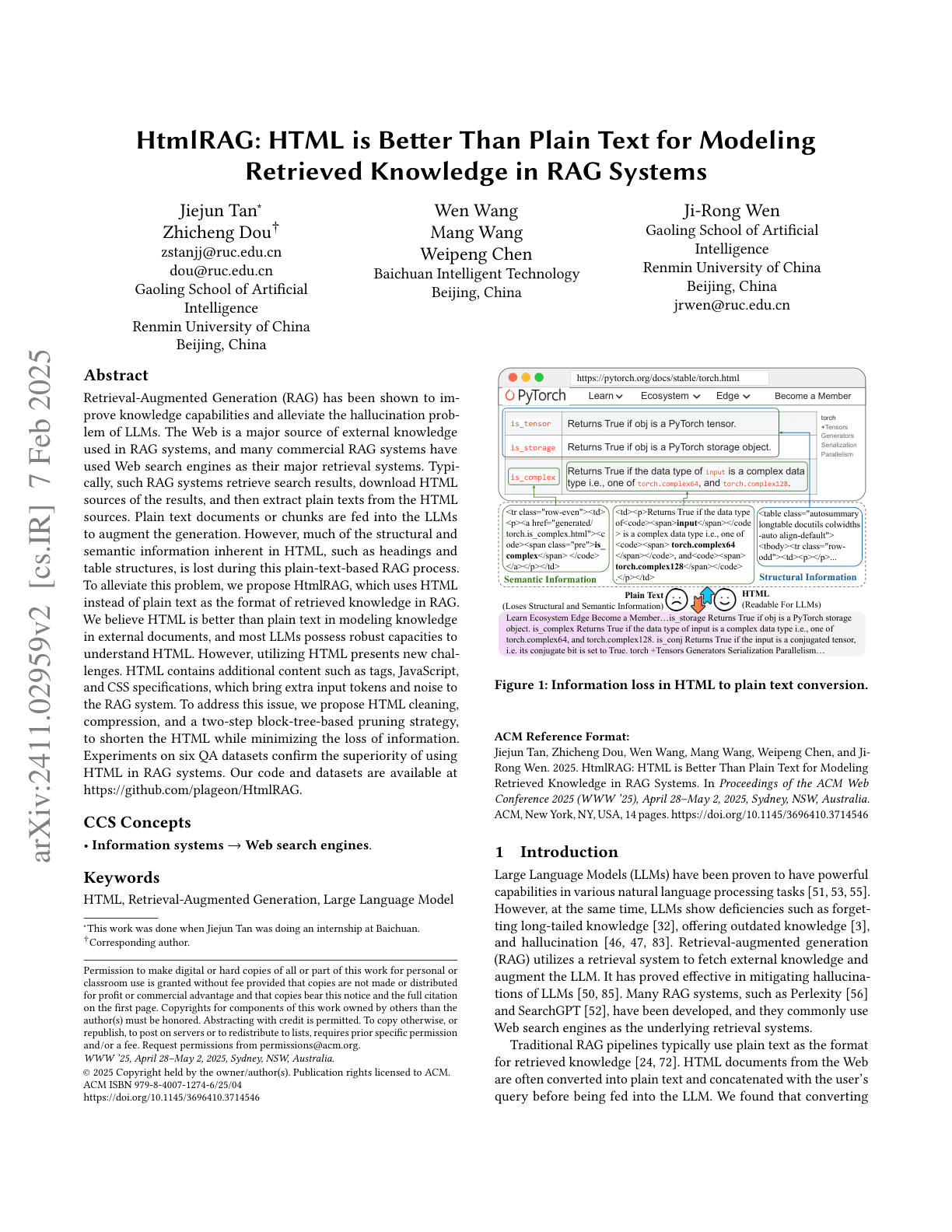
a novel approach that proposes using HTML instead of plain text as the format for building RAG systems; the key finding is that preserving HTML structure provides richer semantic and structural information compared to plain text conversion, which typically loses important formatting like headings, tables, and semantic tags; to address the challenge of HTML documents being too long for LLM context windows, the authors develop a two-step pruning method: first cleaning unnecessary HTML elements (reducing length by 94%), then using a block-tree-based pruning approach that combines embedding-based and generative pruning to further reduce the content while maintaining important information; experiments across six different QA datasets demonstrate that HtmlRAG outperforms existing plain-text based methods, validating the advantages of preserving HTML structure in RAG systems.
Ask this paper
Abstract
Retrieval-Augmented Generation (RAG) has been shown to improve knowledge capabilities and alleviate the hallucination problem of LLMs. The Web is a major source of external knowledge used in RAG systems, and many commercial RAG systems have used Web search engines as their major retrieval systems. Typically, such RAG systems retrieve search results, download HTML sources of the results, and then extract plain texts from the HTML sources. Plain text documents or chunks are fed into the LLMs to augment the generation. However, much of the structural and semantic information inherent in HTML, such as headings and table structures, is lost during this plain-text-based RAG process. To alleviate this problem, we propose HtmlRAG, which uses HTML instead of plain text as the format of retrieved knowledge in RAG. We believe HTML is better than plain text in modeling knowledge in external documents, and most LLMs possess robust capacities to understand HTML. However, utilizing HTML presents new challenges. HTML contains additional content such as tags, JavaScript, and CSS specifications, which bring extra input tokens and noise to the RAG system. To address this issue, we propose HTML cleaning, compression, and a two-step block-tree-based pruning strategy, to shorten the HTML while minimizing the loss of information. Experiments on six QA datasets confirm the superiority of using HTML in RAG systems.