Humanity's Sixth Sense: Benchmarking Intuitive Visual Reasoning in Multimodal Models
Xingang Guo, Jing Gu, Jared Lichtarge and colleagues at Scale AI (with Elorian) introduce Humanity's Sixth Sense (HSS), a benchmark for the intuitive visual reasoning people perform at a glance.
Ask this paper
Target capability. Inferring implicit information from images and video: past causes and future trajectories, whether a vehicle fits between two cars, who holds authority in a room, or unwritten rules in a short clip.
Benchmark. Image and video items organized under a structured taxonomy, each paired with human-written prompts probing temporal, spatial, social and abstract structure.
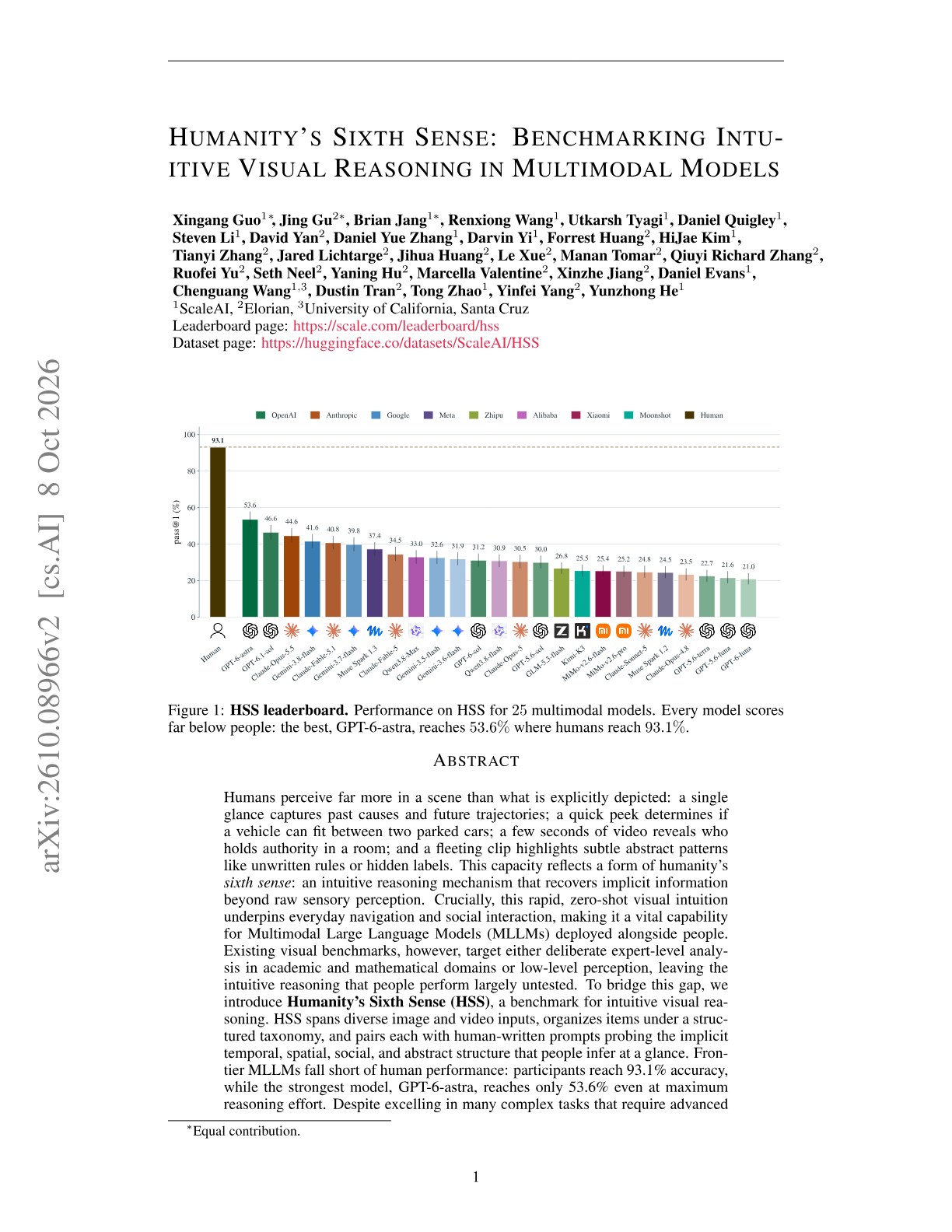
Results. Human participants reach 93.1% accuracy, while the strongest model, GPT-6-astra, reaches 53.6% even at maximum reasoning effort.
Agentic setup. Giving models dynamic visual manipulation tools narrows the gap but does not close it.
Judge audit. The authors measure same-vendor judge bias across Claude, GPT and Gemini judges and find residual effects of about one point or less.
Abstract
Humans perceive far more in a scene than what is explicitly depicted: a single glance captures past causes and future trajectories; a quick peek determines if a vehicle can fit between two parked cars; a few seconds of video reveals who holds authority in a room; and a fleeting clip highlights subtle abstract patterns like unwritten rules or hidden labels. This capacity reflects a form of humanity's sixth sense: an intuitive reasoning mechanism that recovers implicit information beyond raw sensory perception. Crucially, this rapid, zero-shot visual intuition underpins everyday navigation and social interaction, making it a vital capability for Multimodal Large Language Models (MLLMs) deployed alongside people. Existing visual benchmarks, however, target either deliberate expert-level analysis in academic and mathematical domains or low-level perception, leaving the intuitive reasoning that people perform largely untested. To bridge this gap, we introduce Humanity's Sixth Sense (HSS), a benchmark for intuitive visual reasoning. HSS spans diverse image and video inputs, organizes items under a structured taxonomy, and pairs each with human-written prompts probing the implicit temporal, spatial, social, and abstract structure that people infer at a glance. Frontier MLLMs fall short of human performance: participants reach 93.1% accuracy, while the strongest model, GPT-6-astra, reaches only 53.6% even at maximum reasoning effort. Despite excelling in many complex tasks that require advanced perception and knowledge, current models still struggle significantly on these visual tasks that are intuitive for humans. We further explore agentic setup that apply dynamic visual manipulation to HSS, which narrows but does not close the gap. HSS establishes intuitive visual reasoning as a measurable axis and directs attention to a capability that scaling on current benchmarks has so far left behind.