Improving Planning of Agents for Long-Horizon Tasks
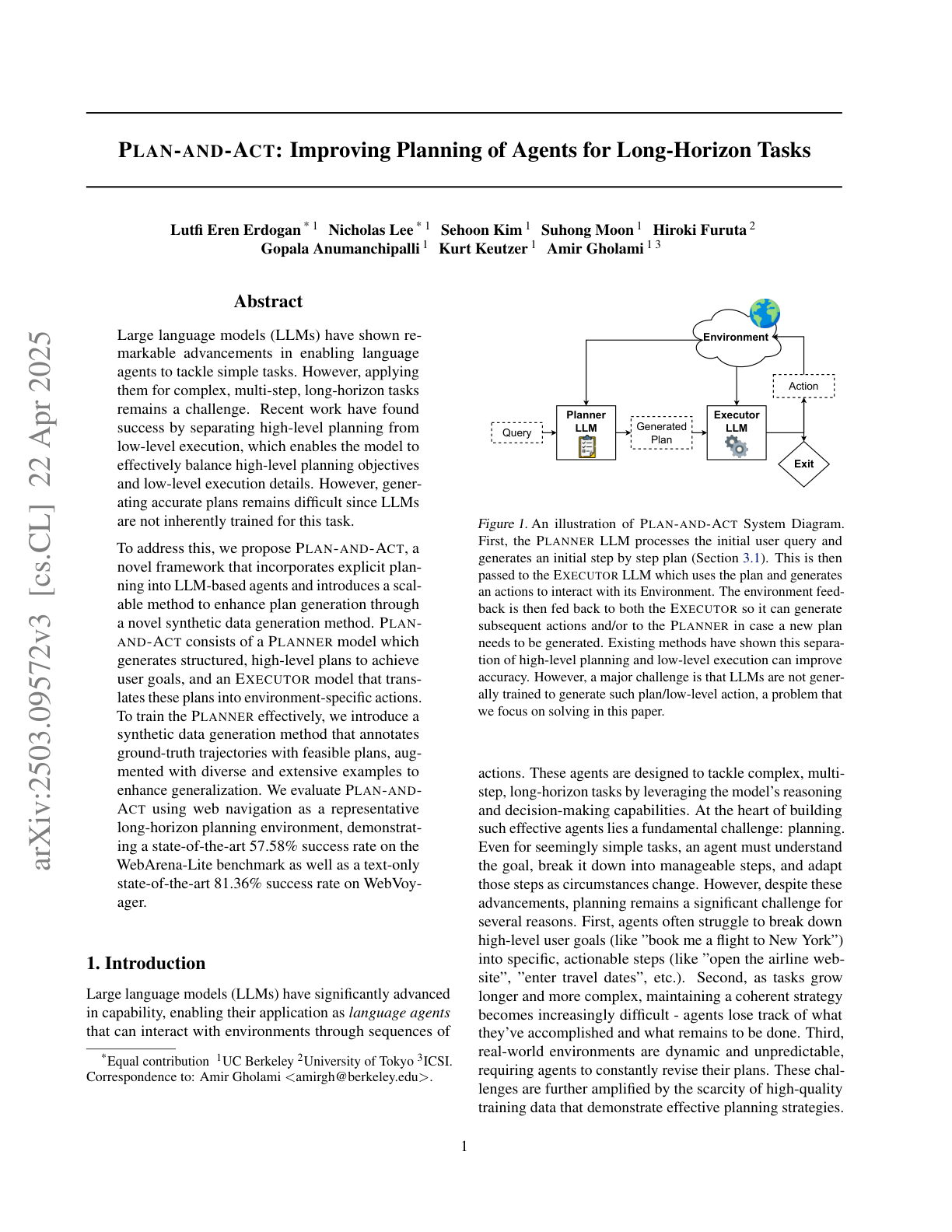
A team from UC Berkeley and the University of Tokyo presents a new framework, Plan-and-Act, that separates high-level planning from low-level execution in LLM-based agents. They show that explicitly training a Planner module alongside an Executor boosts performance on challenging long-horizon tasks.
Ask this paper
Planner + Executor Architecture – The authors propose splitting an agent’s reasoning into two distinct modules: a Planner that breaks down the user goal into structured steps, and an Executor that carries them out in the environment. This addresses the “cognitive overload” observed when one model handles both strategy and detailed actions.
Synthetic Data Generation – They introduce a pipeline to automatically generate high-quality plan–action pairs. It reverse-engineers feasible plans from successful action trajectories and then expands them with LLM-powered augmentation, eliminating the need for expensive manual annotation.
Dynamic Replanning – Unlike static task decomposition, Plan-and-Act periodically updates the high-level plan based on the latest environment state. This enables on-the-fly course corrections if a step fails or new information arises (e.g., analyzing new search results).
State-of-the-Art on WebArena-Lite – Evaluated on web navigation tasks, the approach achieves a 54% success rate—significantly above the previous best of ~49%. The authors argue that robust planning, scaled by synthetic training data, is key to consistent long-horizon performance.