Traveling Waves Integrate Spatial Information Through Time
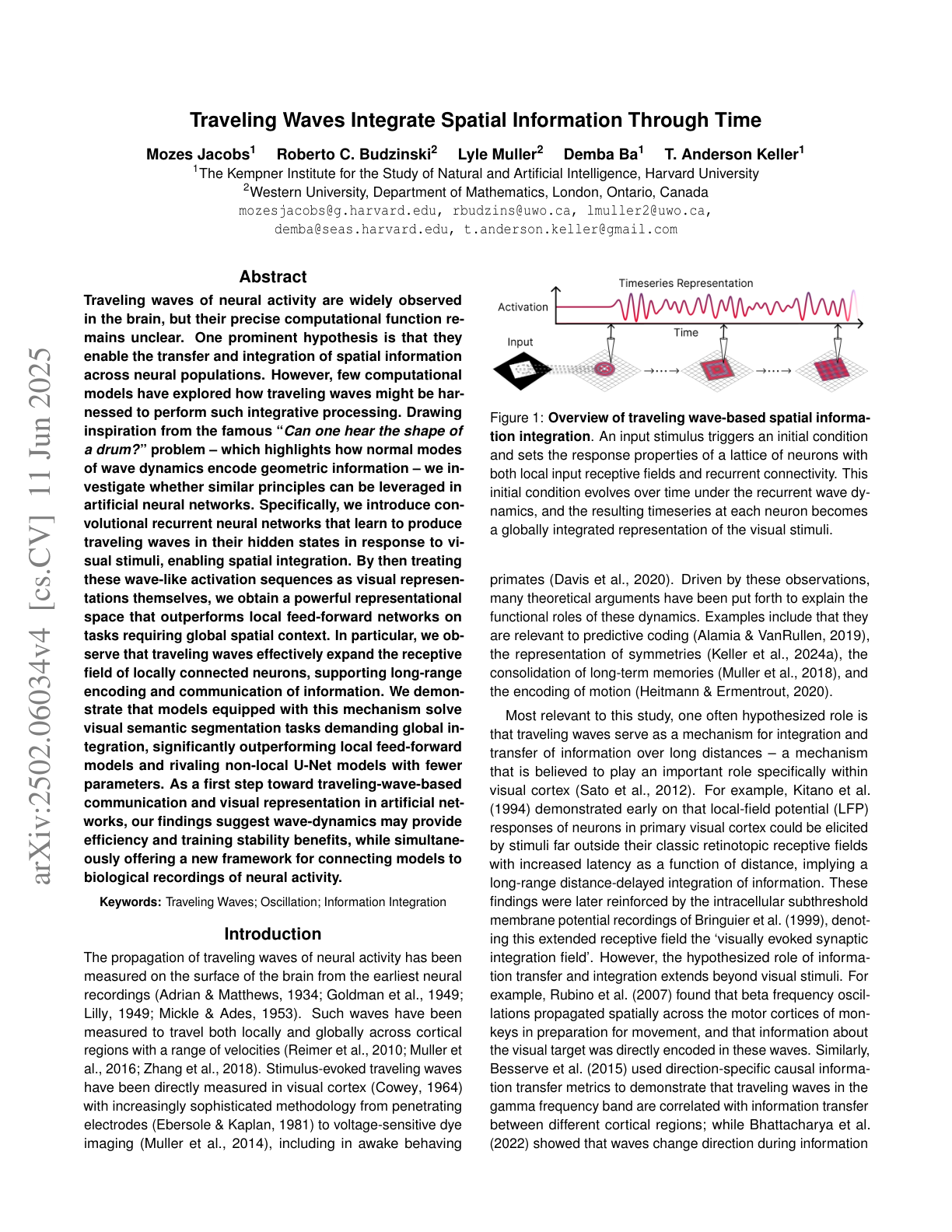
Researchers from Harvard University and Western University propose a wave-based recurrent neural network framework that uses traveling waves of neural activity to perform global spatial integration on visual tasks. Key ideas include:
Ask this paper
“Hearing the Shape of a Drum” analogy – The authors draw inspiration from the famous question “Can one hear the shape of a drum?” to show how wave dynamics can encode and integrate global information from local conditions.
Locally coupled oscillators as RNNs – By discretizing the 2D wave equation into a convolutional recurrent model, each neuron can propagate and reflect wavefronts, capturing long-distance spatial context over time.
Global information via time-series readout – Rather than decoding from just the final state, the model aggregates information across the entire wave evolution (e.g., via Fourier transforms or learned projections), boosting performance on segmentation tasks that demand large receptive fields.
Performance rivaling deeper networks – On synthetic datasets (polygons, tetrominoes) and real-world benchmarks (MNIST variants), the wave-based networks outperform or match global CNN/U-Net baselines with fewer parameters, indicating traveling waves may be an efficient alternative to standard deep architectures.
Potential neuroscience link – Because traveling waves appear ubiquitously in cortex, this approach could provide a computational model aligning with observed neural phenomena and spatiotemporal brain dynamics.