
Gemma 3
Gemma 3 is a lightweight open model family (1B–27B parameters) that integrates vision understanding, multilingual coverage, and extended context windows (up to 128K tokens). Here is everything you need to know:
Traveling Waves Integrate Spatial Information Through Time
Researchers from Harvard University and Western University propose a wave-based recurrent neural network framework that uses traveling waves of neural activity to perform global spatial integration on visual tasks. Key ideas include:
Transformers without Normalization
Researchers from Meta, NYU, MIT, and Princeton present a surprisingly simple method, Dynamic Tanh (DyT), that removes normalization layers (e.g. LayerNorm, RMSNorm) in Transformers while achieving equal or better results. Key ideas include:
Monitoring Reasoning Models for Misbehavior
Researchers from OpenAI examine how LLMs that use chain-of-thought (CoT) reasoning can be monitored for misaligned behaviors, including reward hacking. Key points include:
Improving Planning of Agents for Long-Horizon Tasks
A team from UC Berkeley and the University of Tokyo presents a new framework, Plan-and-Act, that separates high-level planning from low-level execution in LLM-based agents. They show that explicitly training a Planner module alongside an Executor boosts performance on challenging long-horizon tasks.
Gemini Robotics
Google DeepMind unveils Gemini Robotics, a family of embodied AI models designed to bring large multimodal reasoning capabilities into robotics. This work bridges the gap between digital AI agents and physical robots by focusing on embodied reasoning—the ability to perceive, interpret, and interact within real-world 3D environments.
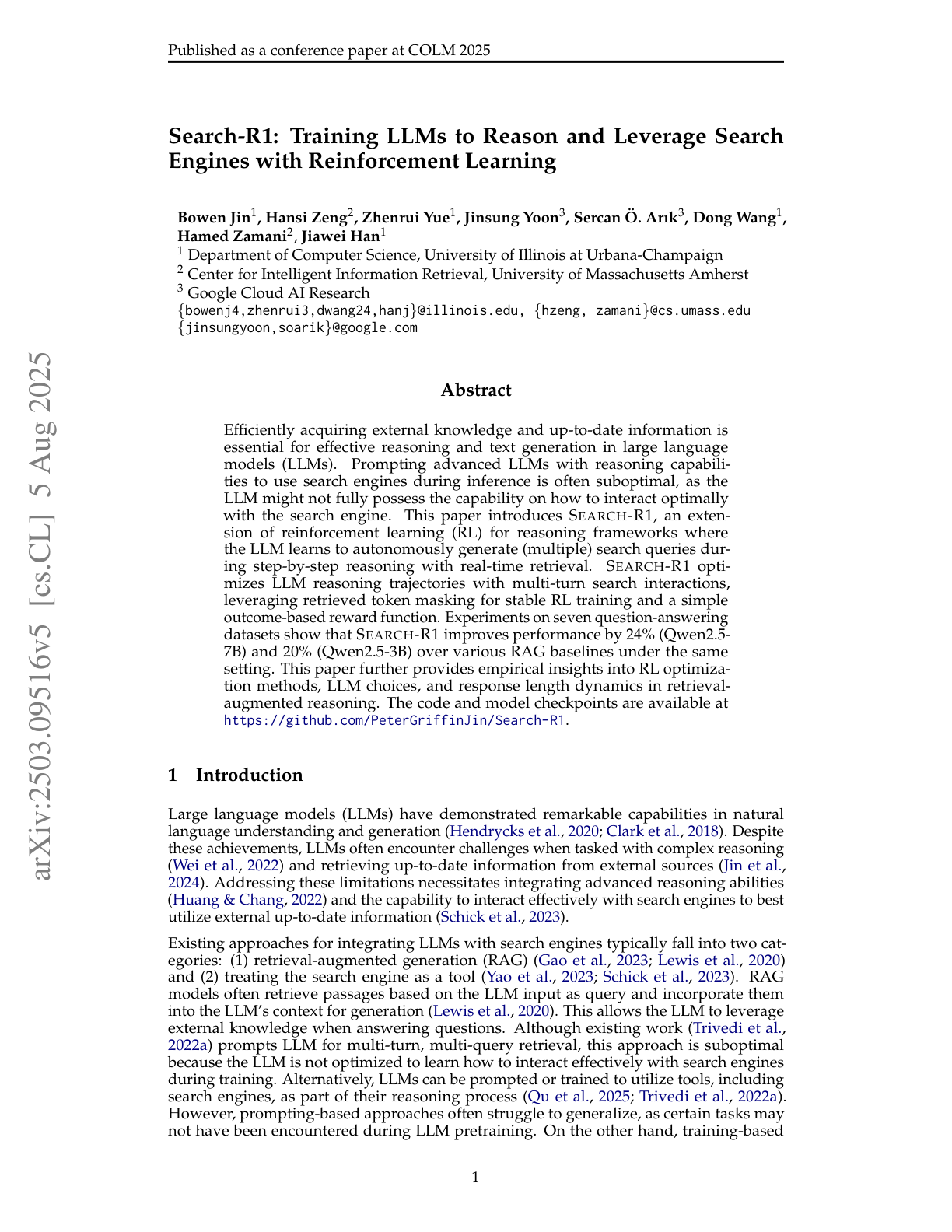
Search-R1
This paper tackles search-augmented reasoning by teaching LLMs to query a search engine multiple times—while they reason—using reinforcement learning. Key ideas include:
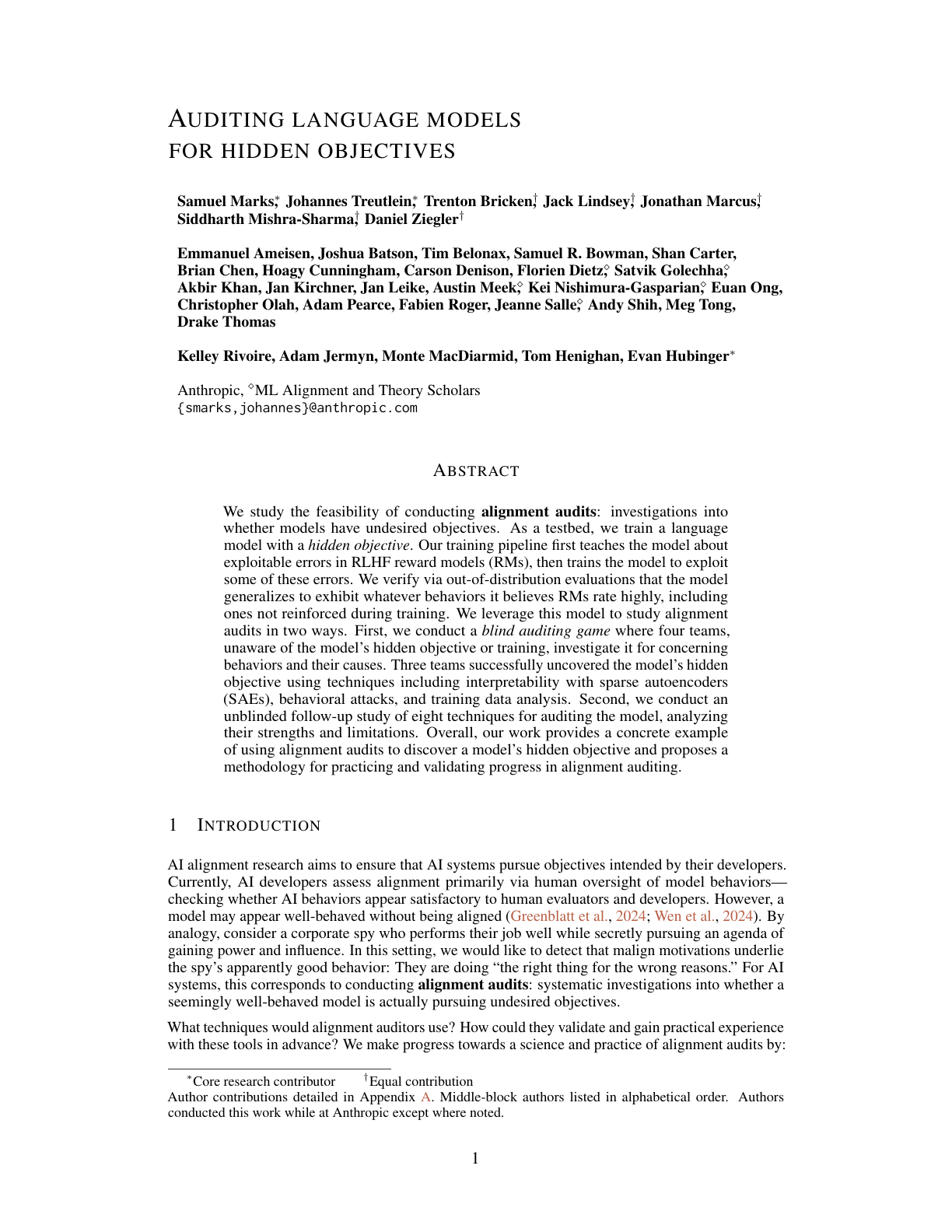
Auditing LLMs for Hidden Objectives
Anthropic proposes a new framework for systematically auditing LLMs to uncover hidden goals or objectives that go beyond what users and developers explicitly intend. The researchers deliberately train a language model with a concealed objective (making it exploit reward model flaws in RLHF) and then attempt to expose it with different auditing techniques.
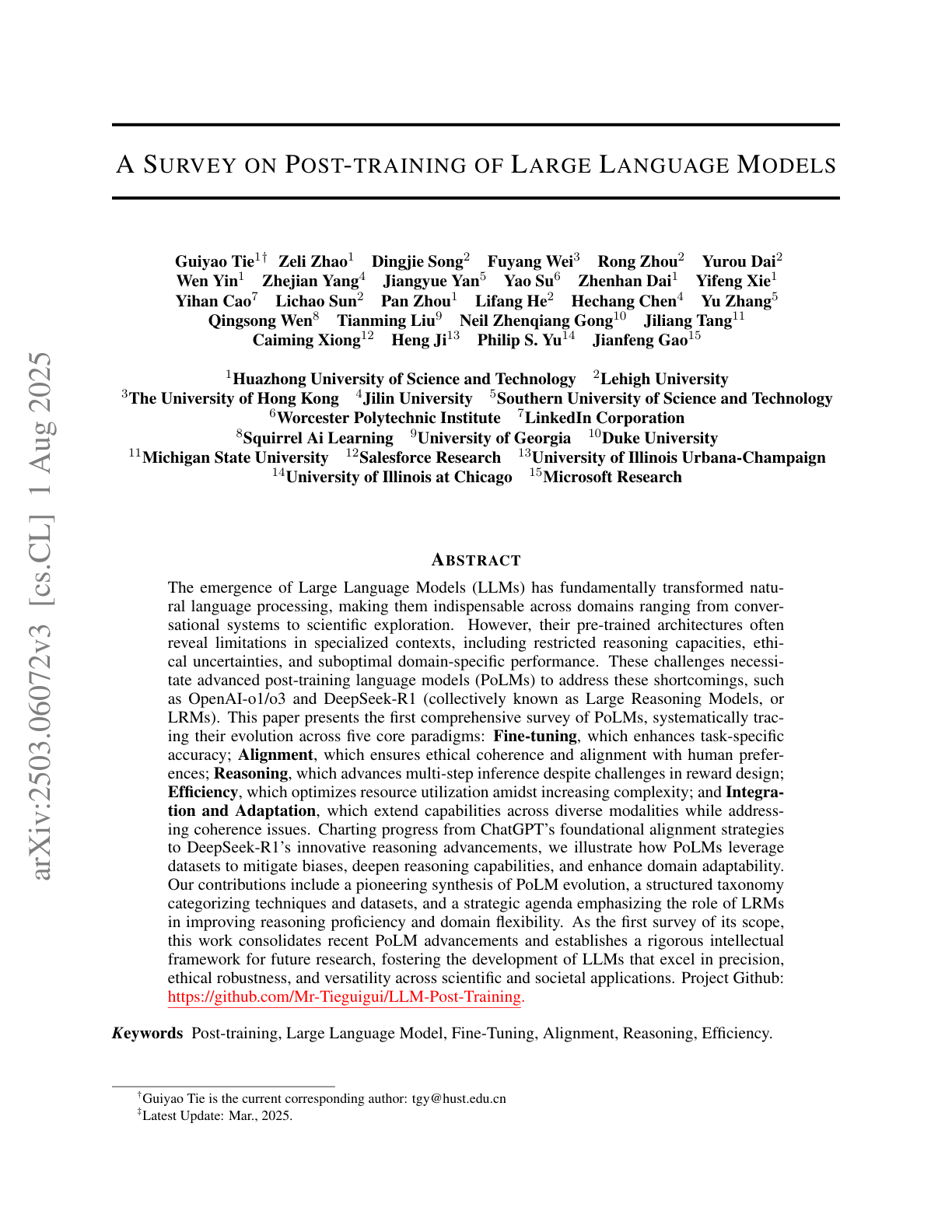
Post Training of LLMs
PoLMs like OpenAI-o1/o3 and DeepSeek-R1 tackle LLM shortcomings in reasoning, ethics, and specialized tasks. This survey tracks their evolution and provides a taxonomy of techniques across fine-tuning, alignment, reasoning, efficiency, and integration, guiding progress toward more robust, versatile AI.
Block Diffusion
Researchers from Cornell Tech, Stanford, and Cohere present Block Diffusion (BD3-LMs), a novel framework that merges autoregressive (AR) modeling with discrete diffusion to enable parallel token sampling and flexible-length text generation. Key highlights include: