LAMP: Language-Augmented Multi-Agent RL
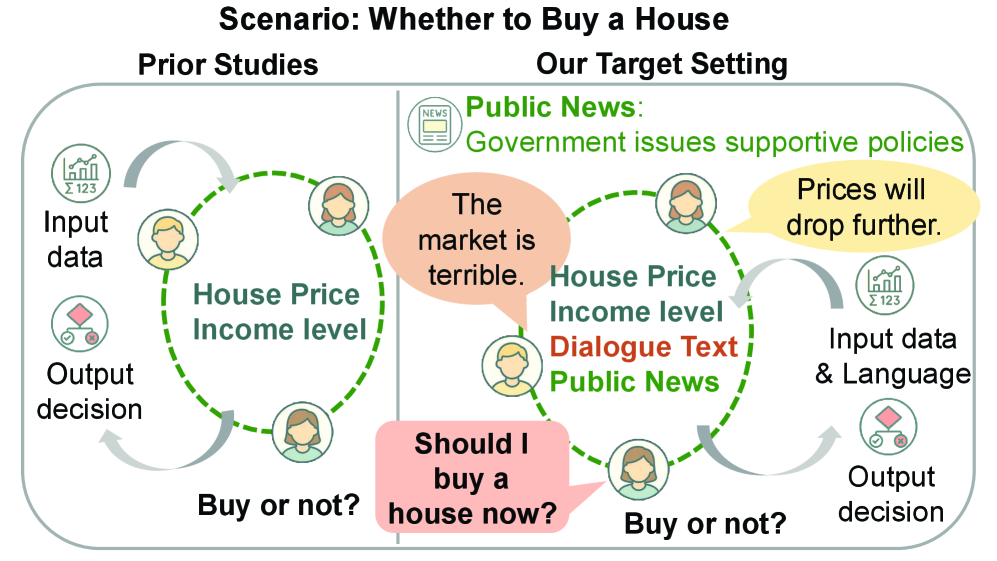
LAMP (Language-Augmented Multi-Agent Policy) integrates natural language processing into multi-agent reinforcement learning through a three-stage pipeline: Think (processes numerical data and identifies market patterns), Speak (generates strategic communications between agents), and Decide (synthesizes information into optimized policy). The framework achieves substantial improvements over baseline methods with +63.5% and +34.0% gains in cumulative return and +18.8% and +59.4% improvements in robustness, bridging traditional MARL with real-world economic contexts where language significantly influences decisions.
Ask this paper
Abstract
Economic decision-making depends not only on structured signals such as prices and taxes, but also on unstructured language, including peer dialogue and media narratives. While multi-agent reinforcement learning (MARL) has shown promise in optimizing economic decisions, it struggles with the semantic ambiguity and contextual richness of language. We propose LAMP (Language-Augmented Multi-Agent Policy), a framework that integrates language into economic decision-making and narrows the gap to real-world settings. LAMP follows a Think-Speak-Decide pipeline: (1) Think interprets numerical observations to extract short-term shocks and long-term trends, caching high-value reasoning trajectories; (2) Speak crafts and exchanges strategic messages based on reasoning, updating beliefs by parsing peer communications; and (3) Decide fuses numerical data, reasoning, and reflections into a MARL policy to optimize language-augmented decision-making. Experiments in economic simulation show that LAMP outperforms both MARL and LLM-only baselines in cumulative return (+63.5%, +34.0%), robustness (+18.8%, +59.4%), and interpretability. These results demonstrate the potential of language-augmented policies to deliver more effective and robust economic strategies.