MAKER: Solving Million-Step LLM Tasks
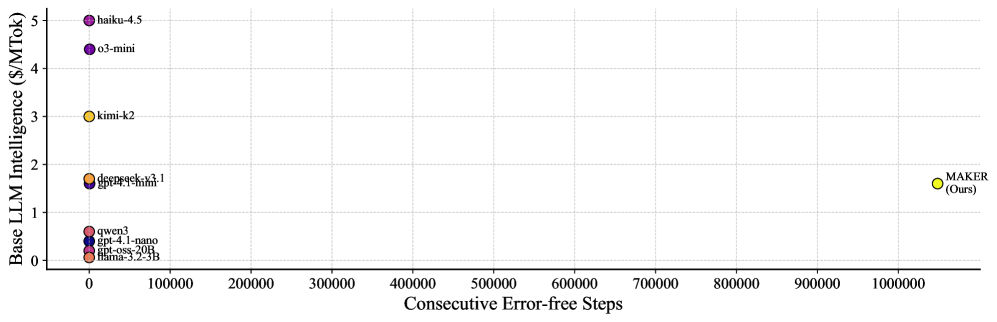
MAKER is the first system to successfully solve tasks requiring over one million LLM steps with zero errors, overcoming a fundamental limitation where LLMs typically fail after a few hundred steps in complex multi-step processes. The approach demonstrates that massively decomposed agentic processes can efficiently handle lengthy sequences of dependent logical operations through extreme decomposition and error correction. - **Extreme decomposition with specialized microagents:** The system breaks tasks into numerous focused subtasks, each handled by specialized microagents. This radical decomposition enables LLMs to maintain correctness across million-step sequences by avoiding the accumulation of errors that plague traditional approaches on extended problems. - **Multi-agent voting for error correction:** At each step, an efficient multi-agent voting scheme validates results and corrects errors before proceeding. This error-checking mechanism prevents derailment and ensures fault tolerance across the entire execution pipeline, enabling reliable completion at unprecedented scale. - **Benchmark validation on complex tasks:** Successfully handles tasks like Towers of Hanoi and other multi-step logical problems that previously became derailed after at most a few hundred steps. The zero-error execution at million-step scale represents a qualitative breakthrough in agentic reliability. - **Path to organizational-scale problem solving:** The authors propose that massively decomposed agentic processes could enable solving problems at the organizational and societal level, suggesting this modular approach offers a practical path forward without requiring fundamental LLM improvements.
Ask this paper
Extreme decomposition with specialized microagents: The system breaks tasks into numerous focused subtasks, each handled by specialized microagents. This radical decomposition enables LLMs to maintain correctness across million-step sequences by avoiding the accumulation of errors that plague traditional approaches on extended problems.
Multi-agent voting for error correction: At each step, an efficient multi-agent voting scheme validates results and corrects errors before proceeding. This error-checking mechanism prevents derailment and ensures fault tolerance across the entire execution pipeline, enabling reliable completion at unprecedented scale.
Benchmark validation on complex tasks: Successfully handles tasks like the Towers of Hanoi and other multi-step logical problems that previously became derailed after at most a few hundred steps. The zero-error execution at the million-step scale represents a qualitative breakthrough in agentic reliability.
Path to organizational-scale problem solving: The authors propose that massively decomposed agentic processes could enable solving problems at the organizational and societal level, suggesting this modular approach offers a practical path forward without requiring fundamental LLM improvements.
Abstract
LLMs have achieved remarkable breakthroughs in reasoning, insights, and tool use, but chaining these abilities into extended processes at the scale of those routinely executed by humans, organizations, and societies has remained out of reach. The models have a persistent error rate that prevents scale-up: for instance, recent experiments in the Towers of Hanoi benchmark domain showed that the process inevitably becomes derailed after at most a few hundred steps. Thus, although LLM research is often still benchmarked on tasks with relatively few dependent logical steps, there is increasing attention on the ability (or inability) of LLMs to perform long range tasks. This paper describes MAKER, the first system that successfully solves a task with over one million LLM steps with zero errors, and, in principle, scales far beyond this level. The approach relies on an extreme decomposition of a task into subtasks, each of which can be tackled by focused microagents. The high level of modularity resulting from the decomposition allows error correction to be applied at each step through an efficient multi-agent voting scheme. This combination of extreme decomposition and error correction makes scaling possible. Thus, the results suggest that instead of relying on continual improvement of current LLMs, massively decomposed agentic processes (MDAPs) may provide a way to efficiently solve problems at the level of organizations and societies.