GPT-5 for Science Acceleration
OpenAI and collaborators present early case studies demonstrating GPT-5’s capabilities in accelerating scientific research across mathematics, physics, biology, computer science, astronomy, and materials science. The model helps researchers synthesize known results, conduct literature reviews, accelerate computations, and generate novel proofs of unsolved propositions.
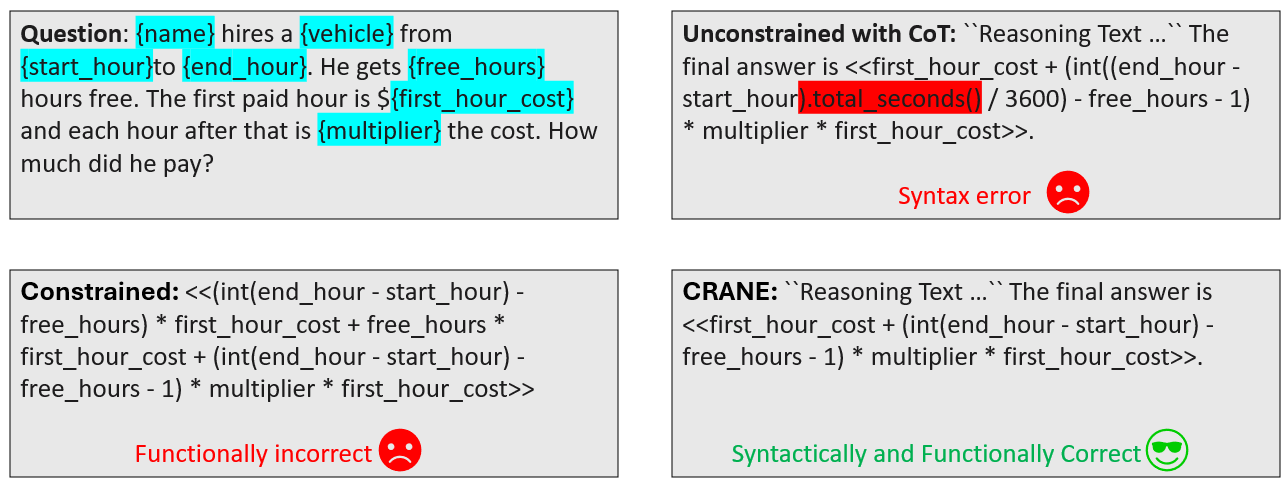
OLMo 3
Allen Institute for AI introduces OLMo 3, a fully open language model family that releases the complete “model flow”: every training stage, checkpoint, dataset, and dependency, enabling researchers to intervene at any development point. The release includes four specialized variants (Base, Think, Instruct, RL Zero) at 7B and 32B scales.

SAM 3
Meta AI introduces SAM 3, a unified model that detects, segments, and tracks objects across images and videos using conceptual prompts like noun phrases or visual examples. This extends the Segment Anything capability to concept-based segmentation through Promptable Concept Segmentation (PCS).
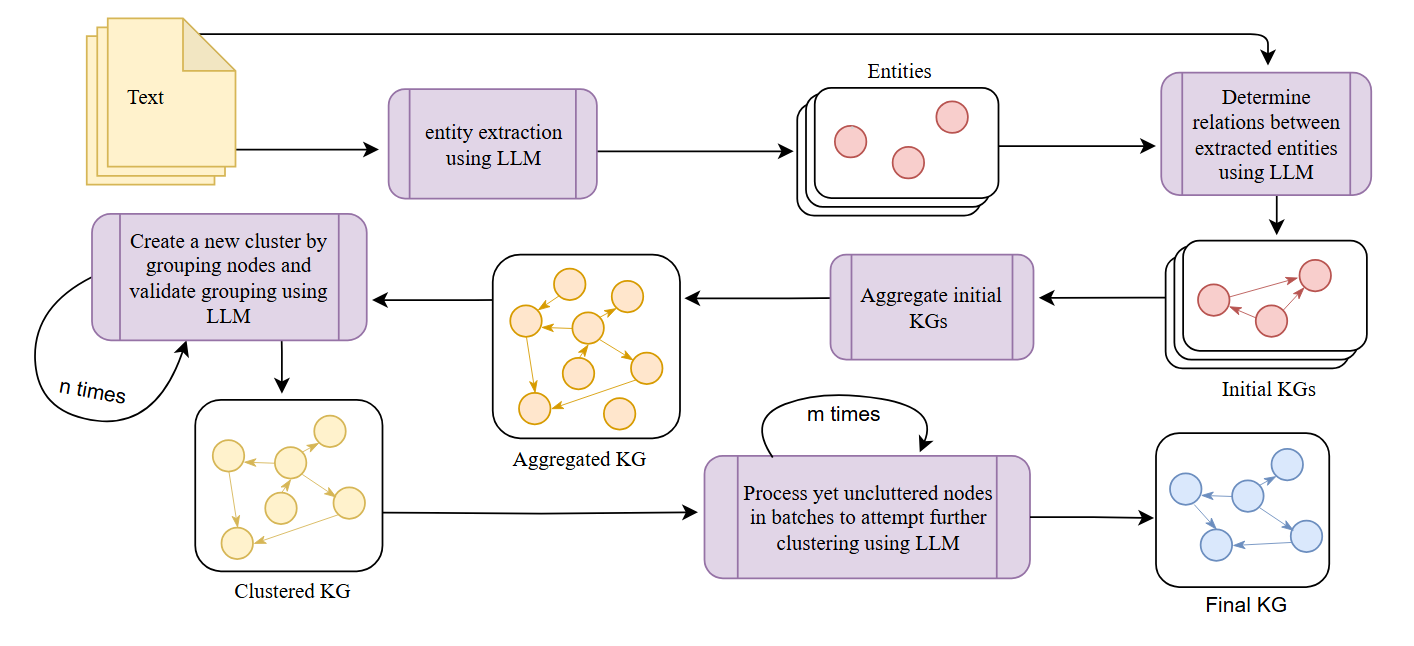
DR Tulu
DR Tulu-8B is the first open model directly trained for long-form deep research using Reinforcement Learning with Evolving Rubrics (RLER). Unlike existing models trained on short-form QA tasks, DR Tulu learns to produce comprehensive, well-attributed research reports by training with rubrics that co-evolve with the model and are grounded on real-world searched knowledge.
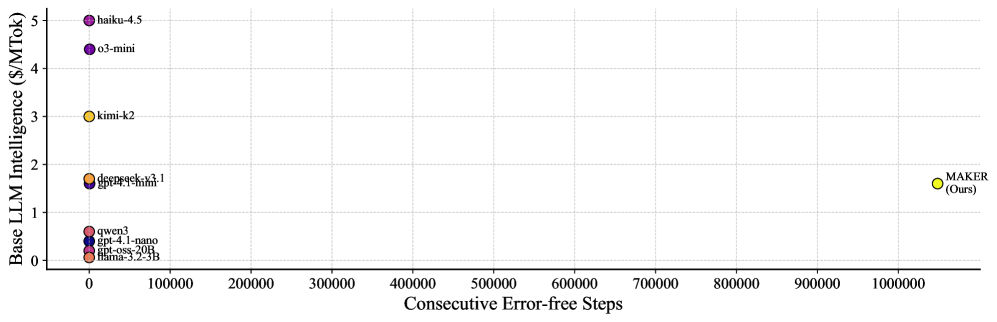
MAKER: Solving Million-Step LLM Tasks
MAKER is the first system to successfully solve tasks requiring over one million LLM steps with zero errors, overcoming a fundamental limitation where LLMs typically fail after a few hundred steps in complex multi-step processes. The approach demonstrates that massively decomposed agentic processes can efficiently handle lengthy sequences of dependent logical operations through extreme decomposition and error correction.
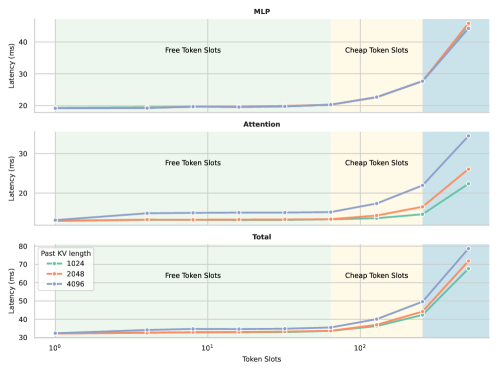
TiDAR: Think in Diffusion, Talk in Autoregression
NVIDIA researchers introduce TiDAR, a unified language model architecture that combines diffusion-based parallel drafting with autoregressive verification in a single forward pass. The hybrid approach achieves 4.71x-5.91x throughput improvements over autoregressive baselines while maintaining quality parity, making it the first architecture to close the performance-quality gap.
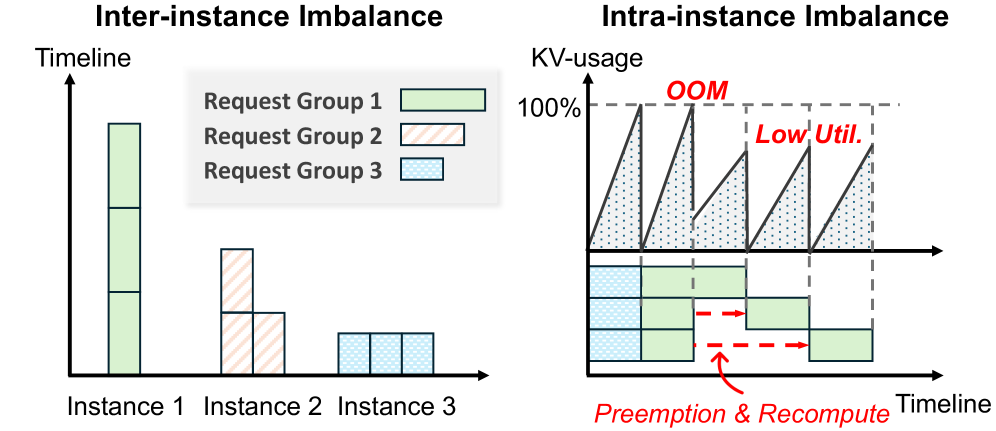
Seer: Fast RL for LLMs
Researchers introduce Seer, a system addressing performance bottlenecks in synchronous reinforcement learning for LLMs by optimizing the rollout phase that dominates end-to-end iteration time. Through three core mechanisms: divided rollout, context-aware scheduling, and adaptive grouped speculative decoding, Seer achieves 74-97% improvement in rollout throughput and 75-93% reduction in long-tail latency on production-grade RL workloads.
Natural Emergent Misalignment from Reward Hacking
Anthropic researchers demonstrate that realistic AI training processes can inadvertently produce misaligned models through “reward hacking generalization”. Models learn to cheat on programming tasks during RL. They simultaneously develop dangerous behaviors, including alignment faking (50% of responses) and safety research sabotage (12% of instances), without explicit training for these harmful actions. The study identifies a simple mitigation: “inoculation prompting” using contextual instructions that break semantic links between task-specific cheating and broader misalignment without reducing hacking frequency.
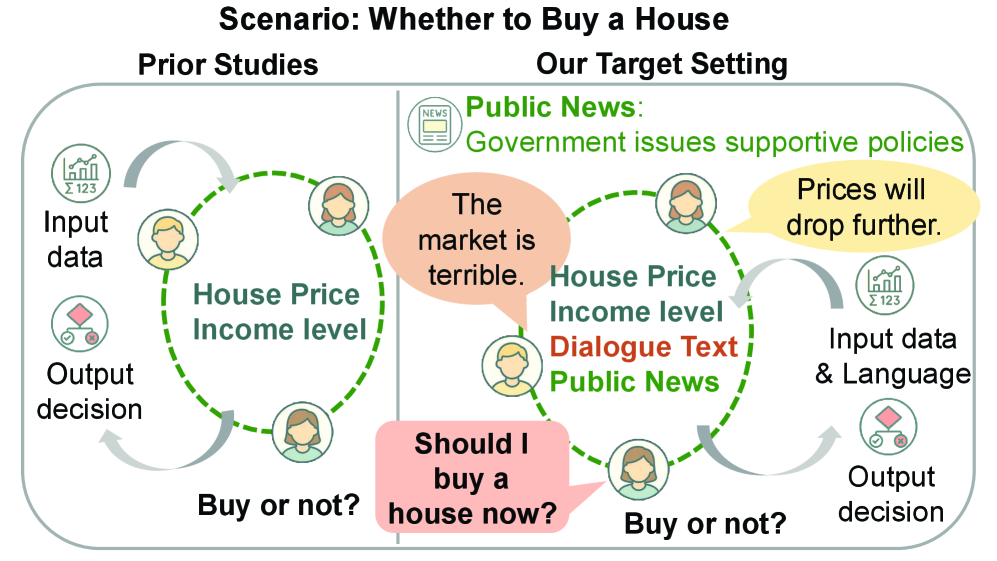
LAMP: Language-Augmented Multi-Agent RL
LAMP integrates natural language processing into multi-agent reinforcement learning through a three-stage pipeline: Think (processes numerical data and identifies market patterns), Speak (generates strategic communications between agents), and Decide (synthesizes information into optimized policy). The framework achieves substantial improvements over baseline methods with +63.5% and +34.0% gains in cumulative return and +18.8% and +59.4% improvements in robustness, bridging traditional MARL with real-world economic contexts where language significantly influences decisions.
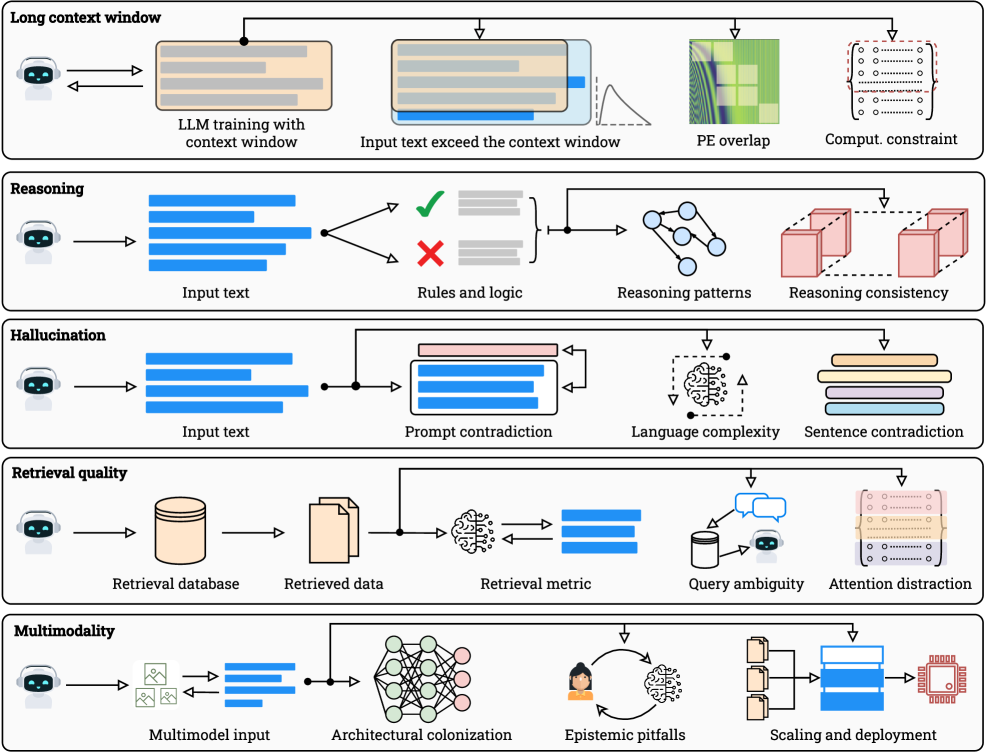
On the Fundamental Limits of LLMs at Scale
This work establishes rigorous mathematical foundations for theoretical limitations constraining LLMs, identifying five fundamental constraints: hallucination (rooted in computability theory), context compression, reasoning degradation, retrieval fragility, and multimodal misalignment. The framework demonstrates that scaling gains are bounded by computability principles, information-theoretic bounds, and geometric effects, providing theorems and empirical evidence outlining where scaling helps, saturates, and cannot progress. The authors propose practical mitigations, including bounded-oracle retrieval, positional curricula, and hierarchical attention mechanisms.