Lumiere
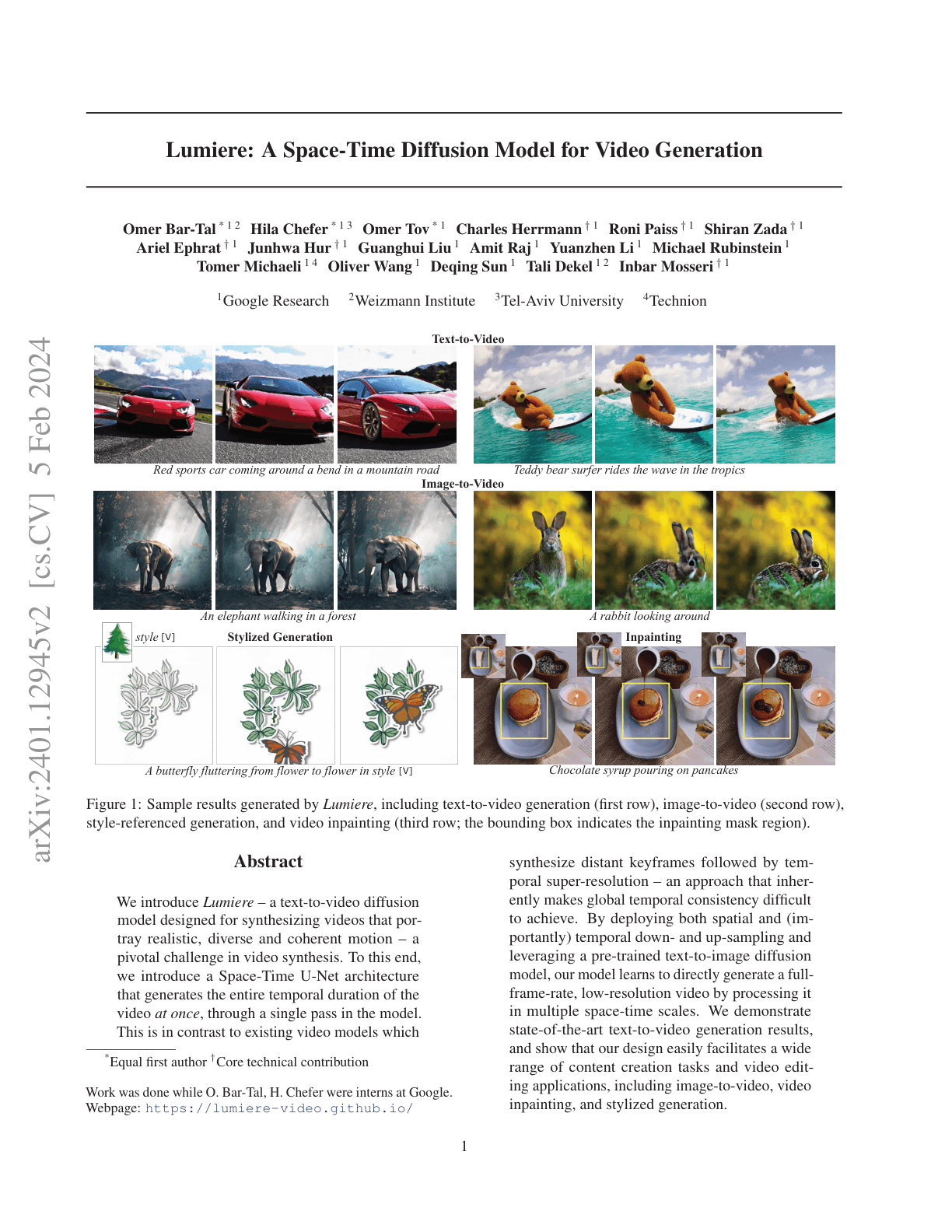
Google's Lumiere is a space-time diffusion model for text-to-video that generates the entire video duration in a single forward pass rather than cascading short clips.
Ask this paper
Space-Time U-Net (STUNet): A new architecture that jointly downsamples in both spatial and temporal dimensions, producing globally coherent motion instead of stitched-together keyframes.
Single-pass generation: Produces full-length videos in one pass, avoiding the motion discontinuities and temporal artifacts that plague cascaded models.
SoTA text-to-video: Achieves state-of-the-art results on standard text-to-video benchmarks in both quality and motion coherence.
Versatile video tasks: A single model supports image-to-video, stylized generation, cinemagraphs, and video inpainting - positioning Lumiere as a general-purpose video foundation model.
Abstract
We introduce Lumiere -- a text-to-video diffusion model designed for synthesizing videos that portray realistic, diverse and coherent motion -- a pivotal challenge in video synthesis. To this end, we introduce a Space-Time U-Net architecture that generates the entire temporal duration of the video at once, through a single pass in the model. This is in contrast to existing video models which synthesize distant keyframes followed by temporal super-resolution -- an approach that inherently makes global temporal consistency difficult to achieve. By deploying both spatial and (importantly) temporal down- and up-sampling and leveraging a pre-trained text-to-image diffusion model, our model learns to directly generate a full-frame-rate, low-resolution video by processing it in multiple space-time scales. We demonstrate state-of-the-art text-to-video generation results, and show that our design easily facilitates a wide range of content creation tasks and video editing applications, including image-to-video, video inpainting, and stylized generation.