TiDAR: Think in Diffusion, Talk in Autoregression
NVIDIA researchers introduce TiDAR, a unified language model architecture that combines diffusion-based parallel drafting with autoregressive verification in a single forward pass. The hybrid approach achieves 4.71x-5.91x throughput improvements over autoregressive baselines while maintaining quality parity, making it the first architecture to close the performance-quality gap. - **Dual-phase unified architecture:** TiDAR operates in two phases within one computational pass: the Thinking phase uses diffusion-based token generation for parallel computation efficiency, while the Talking phase applies autoregressive sampling to refine outputs with causal structure. Specially designed structured attention masks enable both operations simultaneously while preserving the quality benefits of sequential language modeling. - **Significant throughput gains without quality loss:** The model achieves 4.71x-5.91x throughput improvement over autoregressive baselines while maintaining quality parity with AR models, making it the first architecture to demonstrate these aren't mutually exclusive. The approach outperforms both speculative decoding methods and pure diffusion variants (Dream, Llada) through improved GPU utilization via parallel drafting. - **Addresses fundamental language generation trade-off:** Diffusion models excel at parallelization but traditionally struggle with output quality, while autoregressive models deliver quality but bottleneck on sequential decoding. TiDAR demonstrates these trade-offs aren't inevitable by unifying both paradigms, positioning hybrid architectures as practical alternatives for inference-constrained applications at both 1.5B and 8B parameter scales.
Ask this paper
Dual-phase unified architecture: TiDAR operates in two phases within one computational pass: the Thinking phase uses diffusion-based token generation for parallel computation efficiency, while the Talking phase applies autoregressive sampling to refine outputs with causal structure. Specially designed structured attention masks enable both operations simultaneously while preserving the quality benefits of sequential language modeling.
Significant throughput gains without quality loss: The model achieves 4.71x-5.91x throughput improvement over autoregressive baselines while maintaining quality parity with AR models, making it the first architecture to demonstrate these aren’t mutually exclusive. The approach outperforms both speculative decoding methods and pure diffusion variants (Dream, Llada) through improved GPU utilization via parallel drafting.
Addresses fundamental language generation trade-off: Diffusion models excel at parallelization but traditionally struggle with output quality, while autoregressive models deliver quality but bottleneck on sequential decoding. TiDAR demonstrates these trade-offs aren’t inevitable by unifying both paradigms, positioning hybrid architectures as practical alternatives for inference-constrained applications at both 1.5B and 8B parameter scales.
Abstract
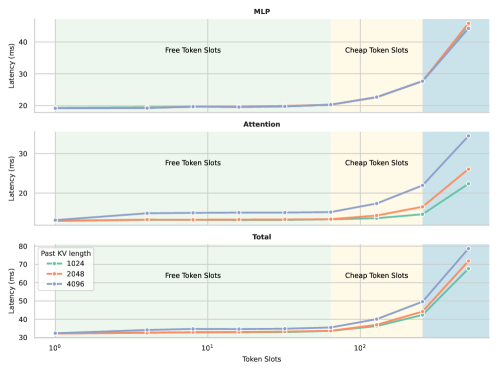
Diffusion language models hold the promise of fast parallel generation, while autoregressive (AR) models typically excel in quality due to their causal structure aligning naturally with language modeling. This raises a fundamental question: can we achieve a synergy with high throughput, higher GPU utilization, and AR level quality? Existing methods fail to effectively balance these two aspects, either prioritizing AR using a weaker model for sequential drafting (speculative decoding), leading to lower drafting efficiency, or using some form of left-to-right (AR-like) decoding logic for diffusion, which still suffers from quality degradation and forfeits its potential parallelizability. We introduce TiDAR, a sequence-level hybrid architecture that drafts tokens (Thinking) in Diffusion and samples final outputs (Talking) AutoRegressively - all within a single forward pass using specially designed structured attention masks. This design exploits the free GPU compute density, achieving a strong balance between drafting and verification capacity. Moreover, TiDAR is designed to be serving-friendly (low overhead) as a standalone model. We extensively evaluate TiDAR against AR models, speculative decoding, and diffusion variants across generative and likelihood tasks at 1.5B and 8B scales. Thanks to the parallel drafting and sampling as well as exact KV cache support, TiDAR outperforms speculative decoding in measured throughput and surpasses diffusion models like Dream and Llada in both efficiency and quality. Most notably, TiDAR is the first architecture to close the quality gap with AR models while delivering 4.71x to 5.91x more tokens per second.