MoE-LLaVA
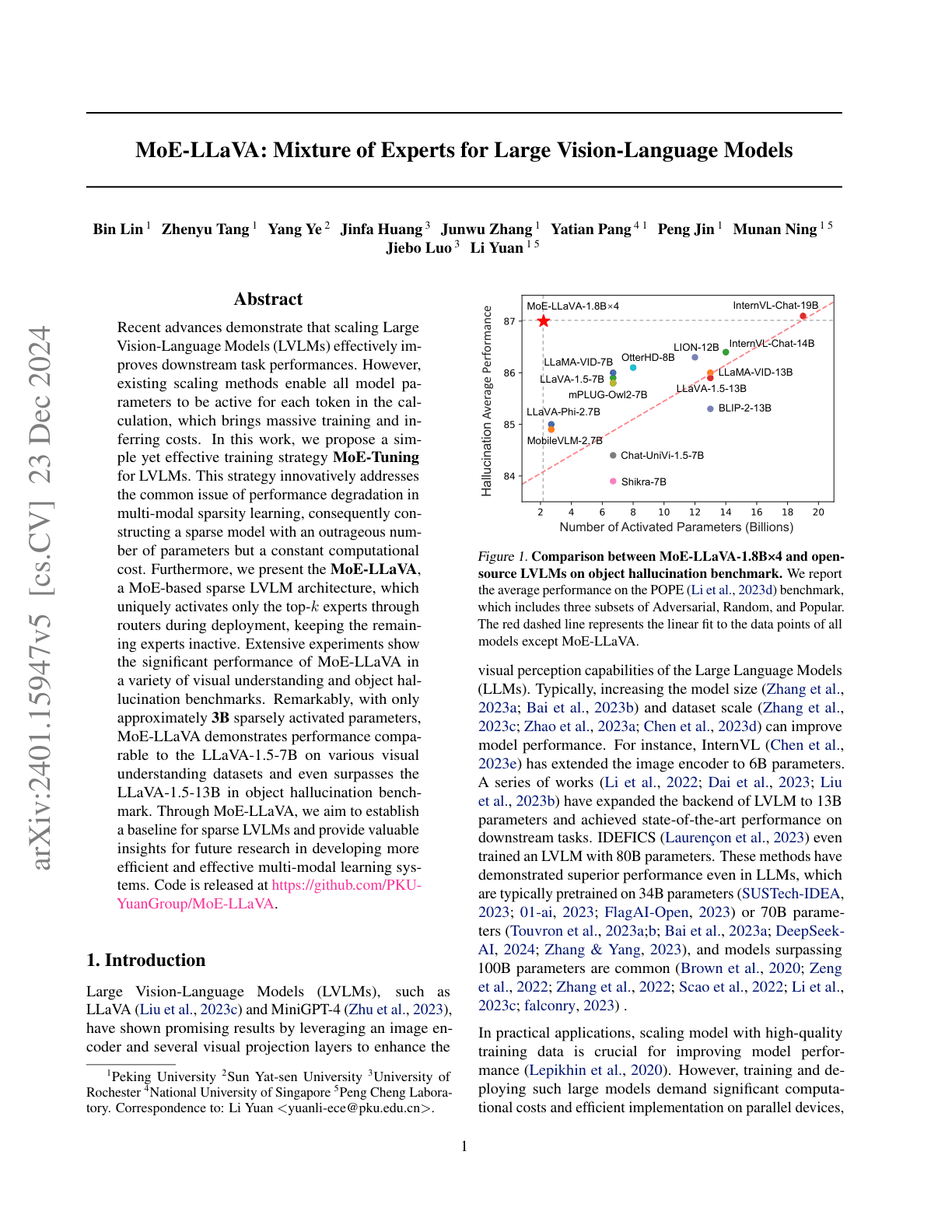
MoE-LLaVA applies Mixture-of-Experts tuning to the LLaVA vision-language architecture, getting a sparse model with dramatically fewer active parameters at the same compute cost.
Ask this paper
MoE for VLMs: Replaces the dense feed-forward layers in LLaVA's decoder with sparse MoE layers and introduces a three-stage training recipe that stabilizes the typically fragile MoE + multimodal combo.
Efficient inference: Only a fraction of experts are active per token, giving the model effective sparsity while keeping FLOPs per forward pass similar to a smaller dense baseline.
Matches larger dense VLMs: A MoE-LLaVA with 3B activated parameters matches or beats 7B dense VLMs on standard multimodal benchmarks, closing the parameter/performance gap.
Mitigates sparsity degradation: The auxiliary balancing losses and staged training schedule address the usual MoE pitfalls of routing collapse and modality interference.
Abstract
Recent advances demonstrate that scaling Large Vision-Language Models (LVLMs) effectively improves downstream task performances. However, existing scaling methods enable all model parameters to be active for each token in the calculation, which brings massive training and inferring costs. In this work, we propose a simple yet effective training strategy MoE-Tuning for LVLMs. This strategy innovatively addresses the common issue of performance degradation in multi-modal sparsity learning, consequently constructing a sparse model with an outrageous number of parameters but a constant computational cost. Furthermore, we present the MoE-LLaVA, a MoE-based sparse LVLM architecture, which uniquely activates only the top-k experts through routers during deployment, keeping the remaining experts inactive. Extensive experiments show the significant performance of MoE-LLaVA in a variety of visual understanding and object hallucination benchmarks. Remarkably, with only approximately 3B sparsely activated parameters, MoE-LLaVA demonstrates performance comparable to the LLaVA-1.5-7B on various visual understanding datasets and even surpasses the LLaVA-1.5-13B in object hallucination benchmark. Through MoE-LLaVA, we aim to establish a baseline for sparse LVLMs and provide valuable insights for future research in developing more efficient and effective multi-modal learning systems. Code is released at https://github.com/PKU-YuanGroup/MoE-LLaVA.