NeuroImagen
First page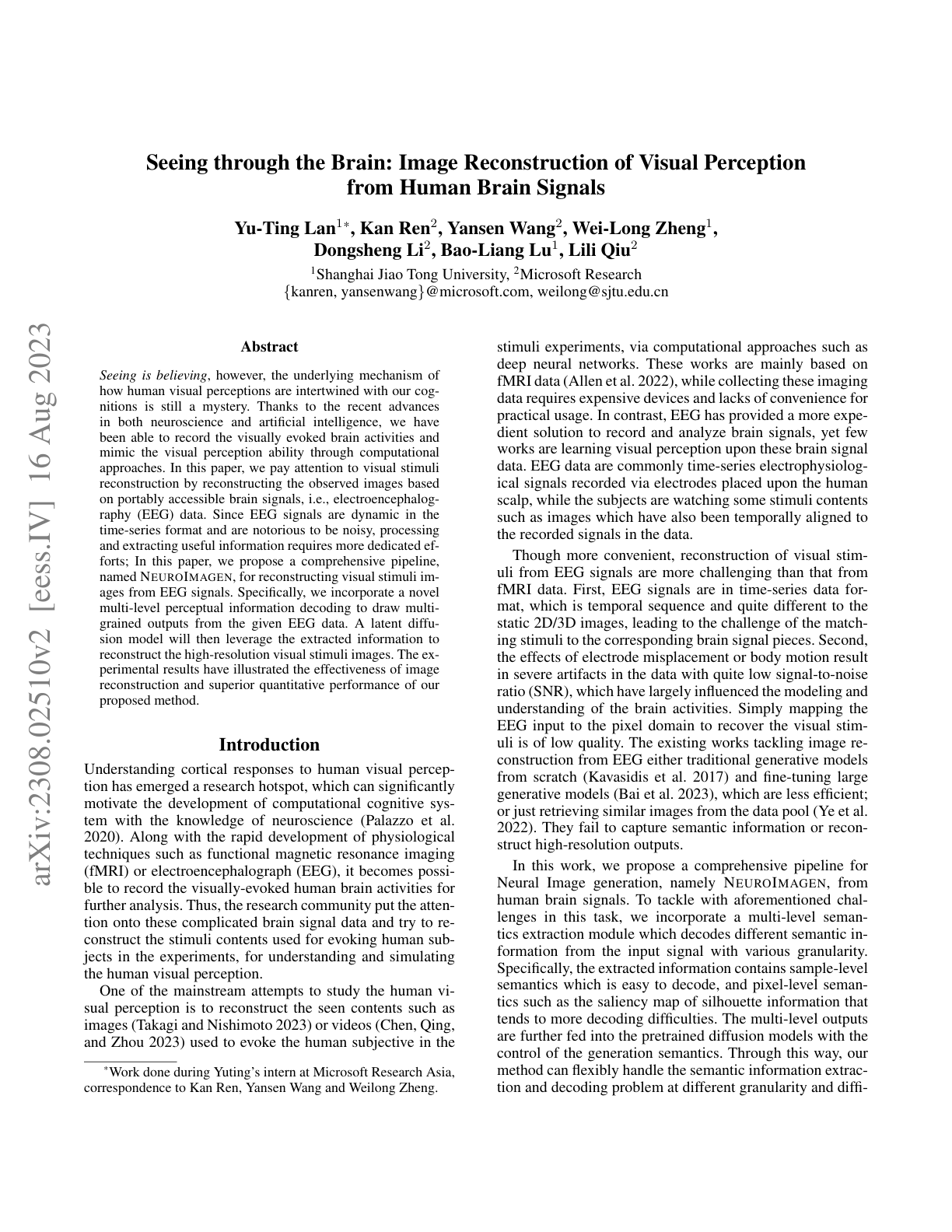
Paper summary
Reconstructs visual stimuli images from EEG signals using latent diffusion, opening new windows into visually-evoked brain activity.
Ask this paper
01
EEG-to-image reconstruction: Reconstructs high-resolution visual stimuli images from EEG signals recorded while subjects viewed those images.
02
Latent diffusion pipeline: Uses a latent diffusion model conditioned on EEG features, inheriting the high-fidelity generation capabilities of diffusion priors.
03
Non-invasive BCI: EEG is non-invasive and comparatively cheap, making this approach more practical for real-world brain-computer interface research than fMRI-based alternatives.
04
Cognitive-science bridge: Provides a new tool for studying visual cognition, complementing and extending earlier fMRI-decoding work.