NeuroSkill
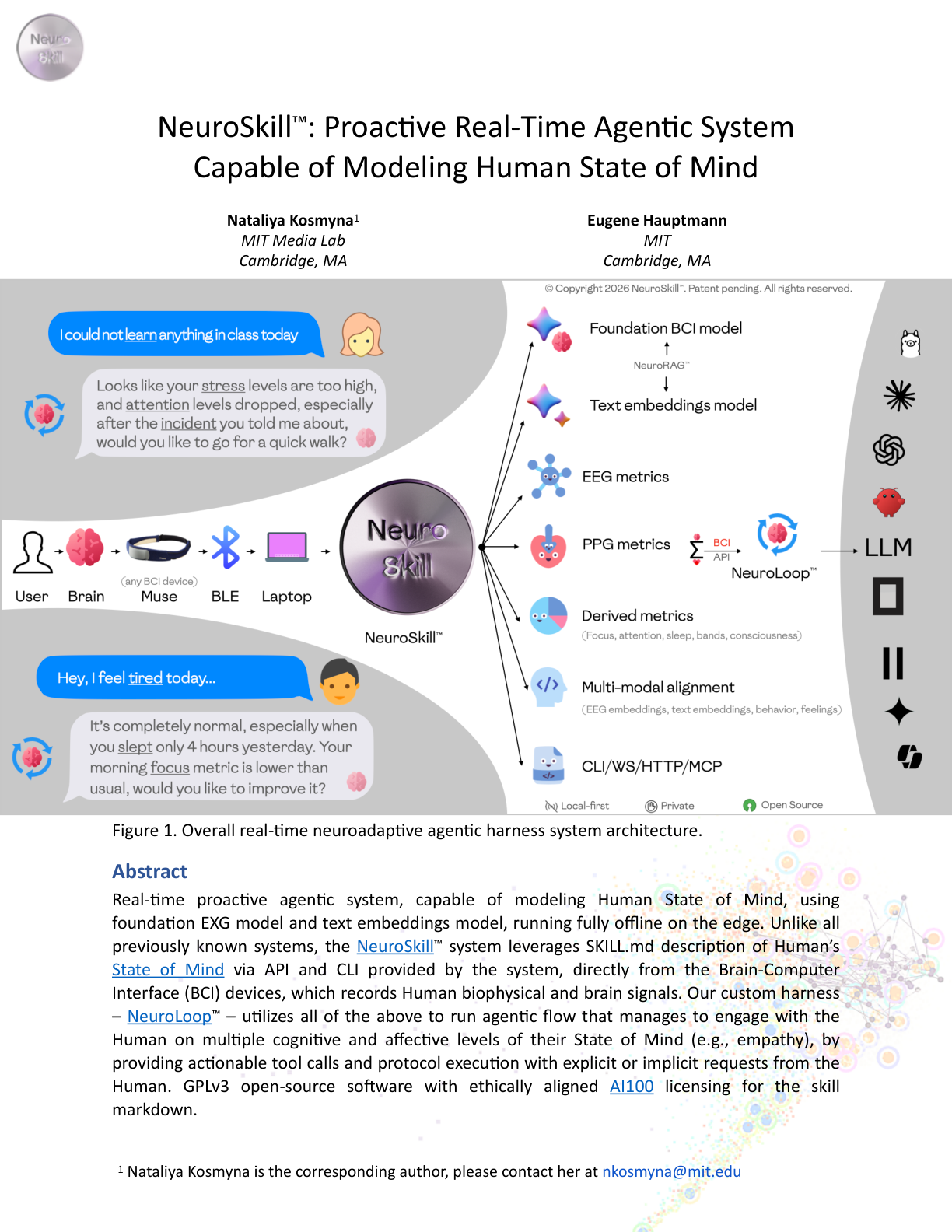
MIT researchers introduce NeuroSkill, a real-time proactive agentic system that models human cognitive and emotional state by integrating Brain-Computer Interface (BCI) signals with foundation EXG models and text embeddings. Unlike reactive agents that wait for explicit commands, NeuroSkill operates proactively, interpreting biophysical and neural signals to anticipate user needs.
Ask this paper
Custom agent harness - NeuroLoop: The system runs an agentic flow called NeuroLoop that engages with the user on multiple cognitive and affective levels, including empathy. It processes BCI signals through a foundation EXG model, converts them to state-of-mind descriptions, and uses those descriptions to drive actionable tool calls and protocol execution.
Fully offline edge deployment: The entire system runs locally on edge devices with no network dependency. This is a significant design choice for both privacy and latency, enabling real-time responsiveness to shifting cognitive states without cloud round-trips.
Proactive vs reactive interaction: NeuroSkill handles both explicit and implicit requests from the user. By continuously reading brain signals, it can detect confusion, cognitive overload, or emotional shifts and adjust its behavior before the user explicitly asks for help.
Open-source with ethical licensing: Released under GPLv3 with an ethically aligned AI100 licensing framework for the skill markdown, making the system reproducible and auditable while enforcing responsible use guardrails.