ParamMem
Self-reflection enables language agents to iteratively refine solutions, but models tend to generate repetitive reflections that add noise instead of useful signal. ParamMem introduces a parametric memory module that encodes cross-sample reflection patterns into model parameters, enabling diverse reflection generation through temperature-controlled sampling.
Ask this paper
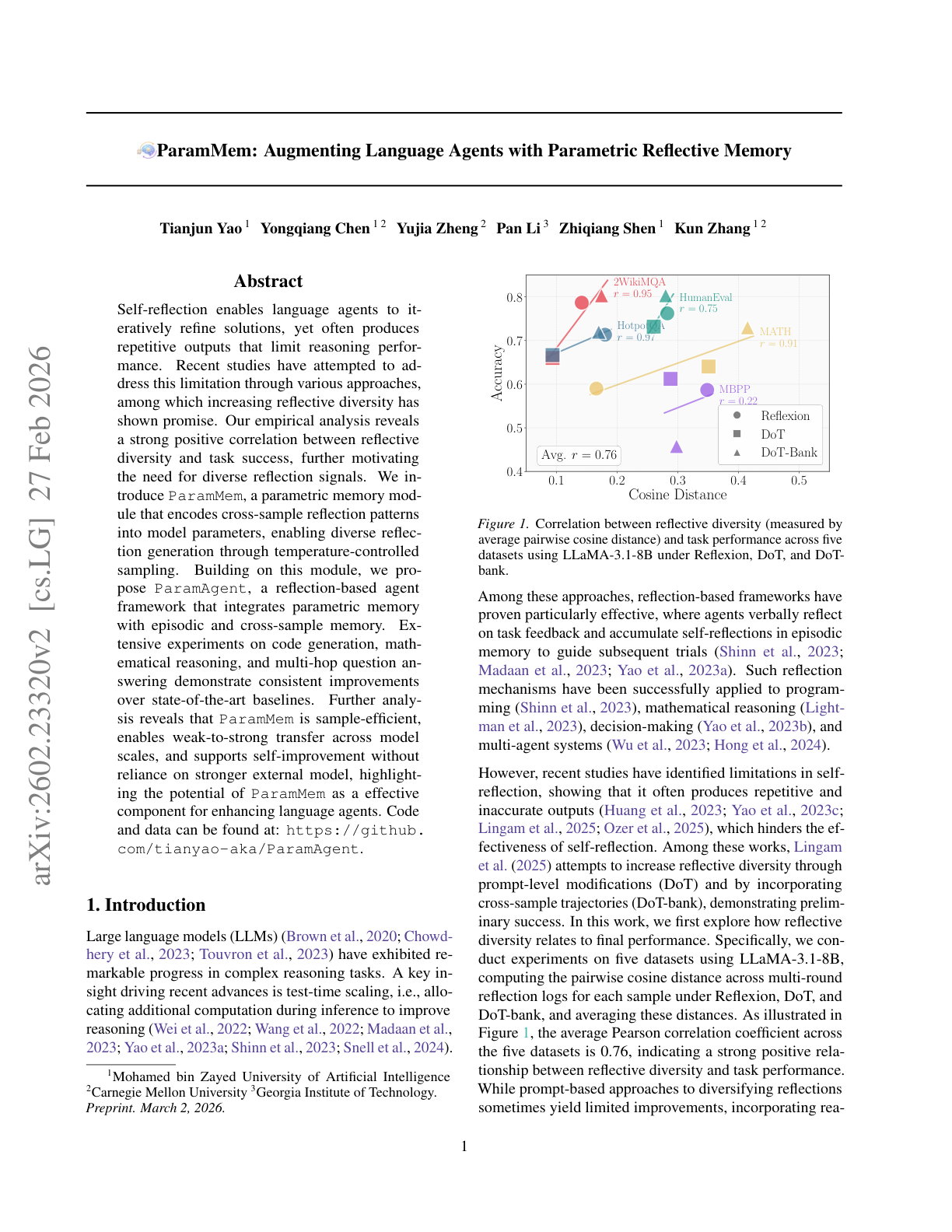
Diversity correlates with success: Empirical analysis reveals a strong positive correlation between reflective diversity and task success. The core problem is that standard self-reflection produces near-identical outputs across iterations, limiting the agent’s ability to explore alternative solution paths.
Three-tier memory architecture: ParamAgent integrates parametric memory (cross-sample patterns encoded in parameters), episodic memory (individual task instances), and cross-sample memory (broader learning patterns). This combination captures both local task context and global reflection strategies.
Weak-to-strong transfer: ParamMem is sample-efficient and supports transfer across model scales. Reflection patterns learned by smaller models can be applied to larger ones, enabling self-improvement without reliance on stronger external models.
Consistent benchmark gains: Evaluated on code generation, mathematical reasoning, and multi-hop question answering, ParamMem consistently outperforms state-of-the-art baselines across all three domains.