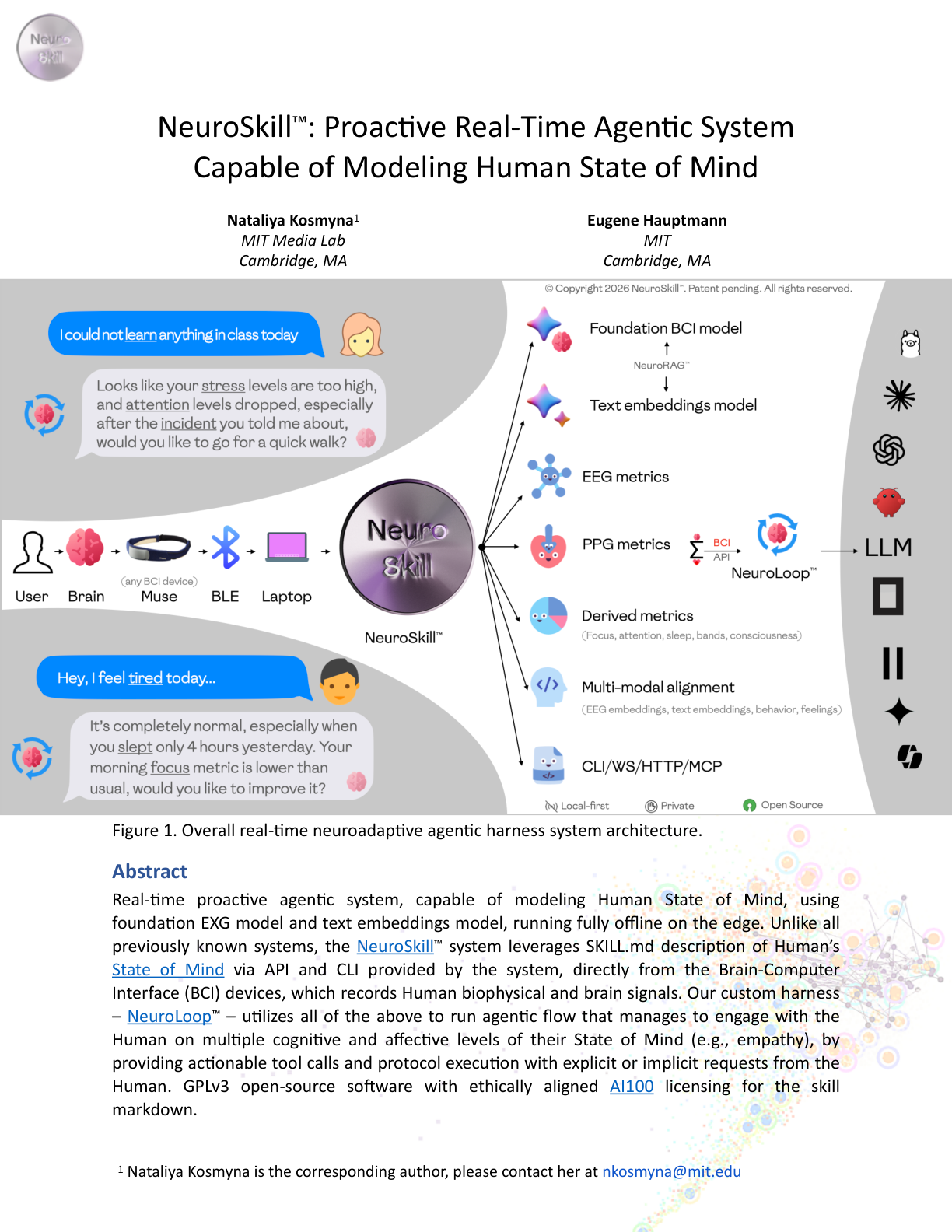
NeuroSkill
MIT researchers introduce NeuroSkill, a real-time proactive agentic system that models human cognitive and emotional state by integrating Brain-Computer Interface (BCI) signals with foundation EXG models and text embeddings. Unlike reactive agents that wait for explicit commands, NeuroSkill operates proactively, interpreting biophysical and neural signals to anticipate user needs.
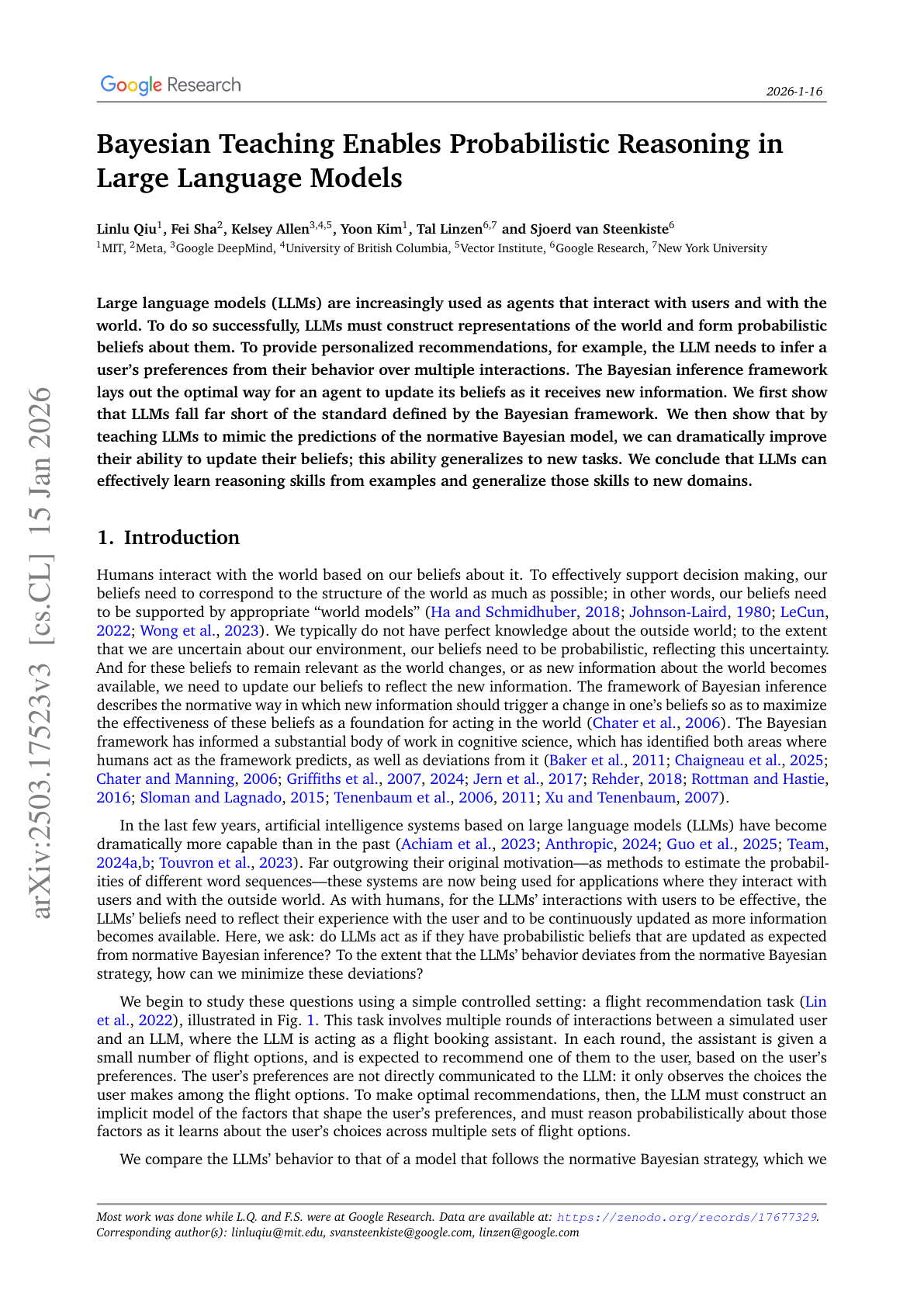
Bayesian Teaching for LLMs
Google researchers introduce a method to teach LLMs to reason like Bayesians by fine-tuning on interactions with a Bayesian Assistant that represents optimal probabilistic inference. LLMs normally fall far short of normative Bayesian reasoning, but this training approach dramatically improves their ability to update predictions based on new evidence.
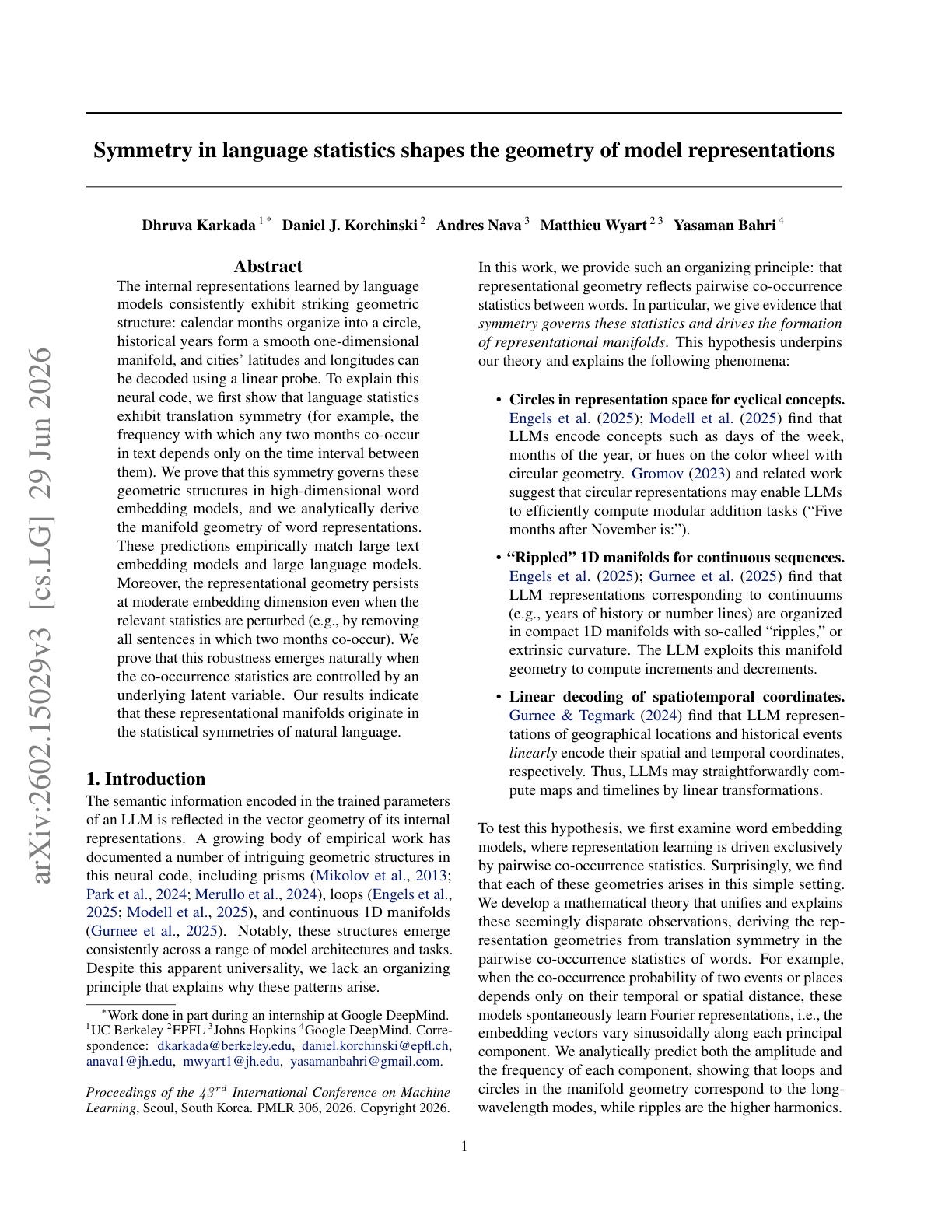
Why LLMs Form Geometric Representations
LLMs spontaneously form striking geometric structures in their internal representations: calendar months organize into circles, historical years form spirals, and spatial coordinates align to recoverable manifolds. This paper proves these patterns are not the product of deep learning dynamics but emerge directly from symmetries in natural language statistics.
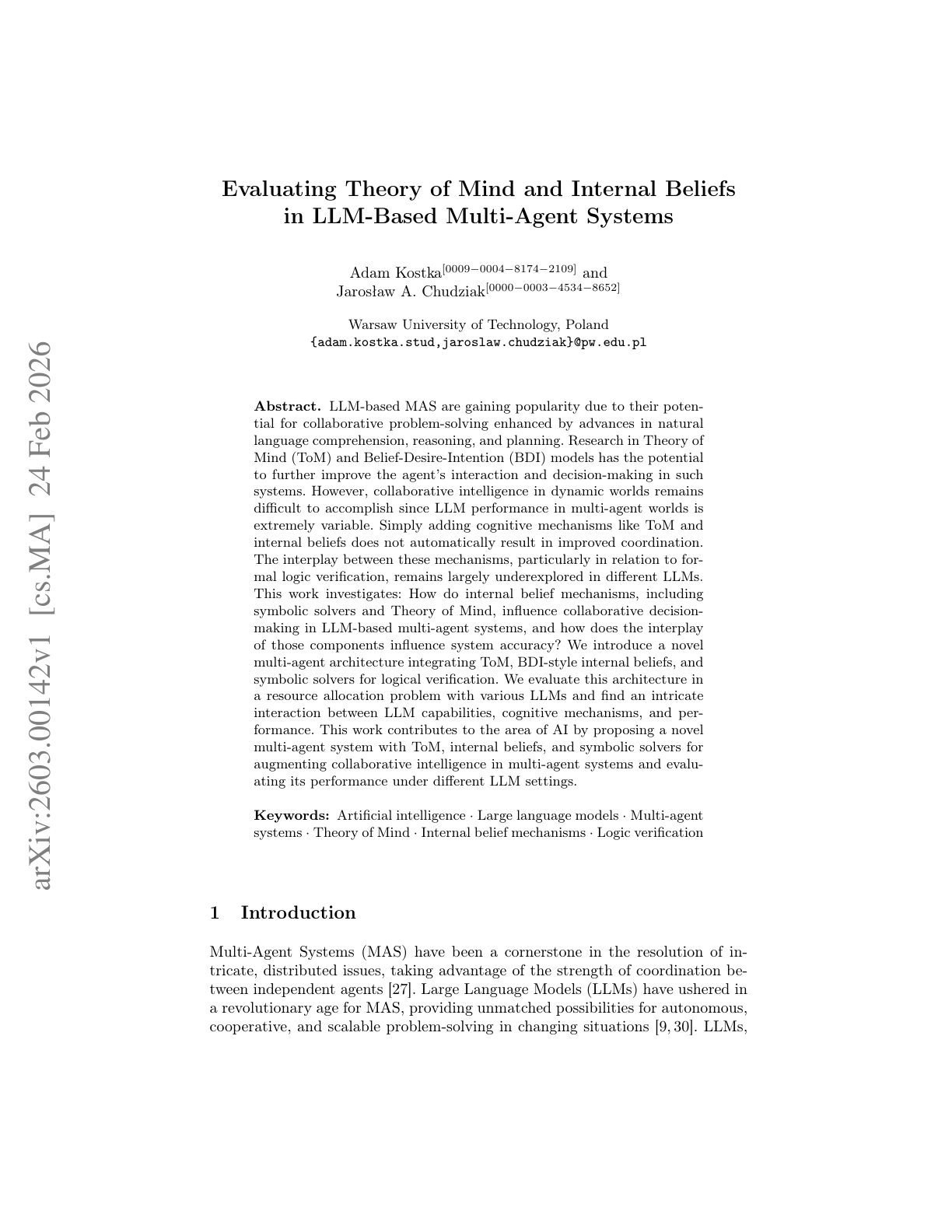
Theory of Mind in Multi-Agent LLMs
This work introduces a multi-agent architecture combining Theory of Mind (ToM), Belief-Desire-Intention (BDI) models, and symbolic solvers for logical verification, evaluating it on resource allocation problems across multiple LLMs. The central finding is counterintuitive: simply adding cognitive mechanisms does not automatically improve coordination.
Numina-Lean-Agent
Numina-Lean-Agent proposes a paradigm shift in automated theorem proving: instead of building complex, multi-component systems with heavy computational overhead, it directly uses a general coding agent as a formal math reasoner. Combining Claude Code with Numina-Lean-MCP, the system autonomously interacts with the Lean proof assistant while accessing theorem libraries and auxiliary reasoning tools.
ParamMem
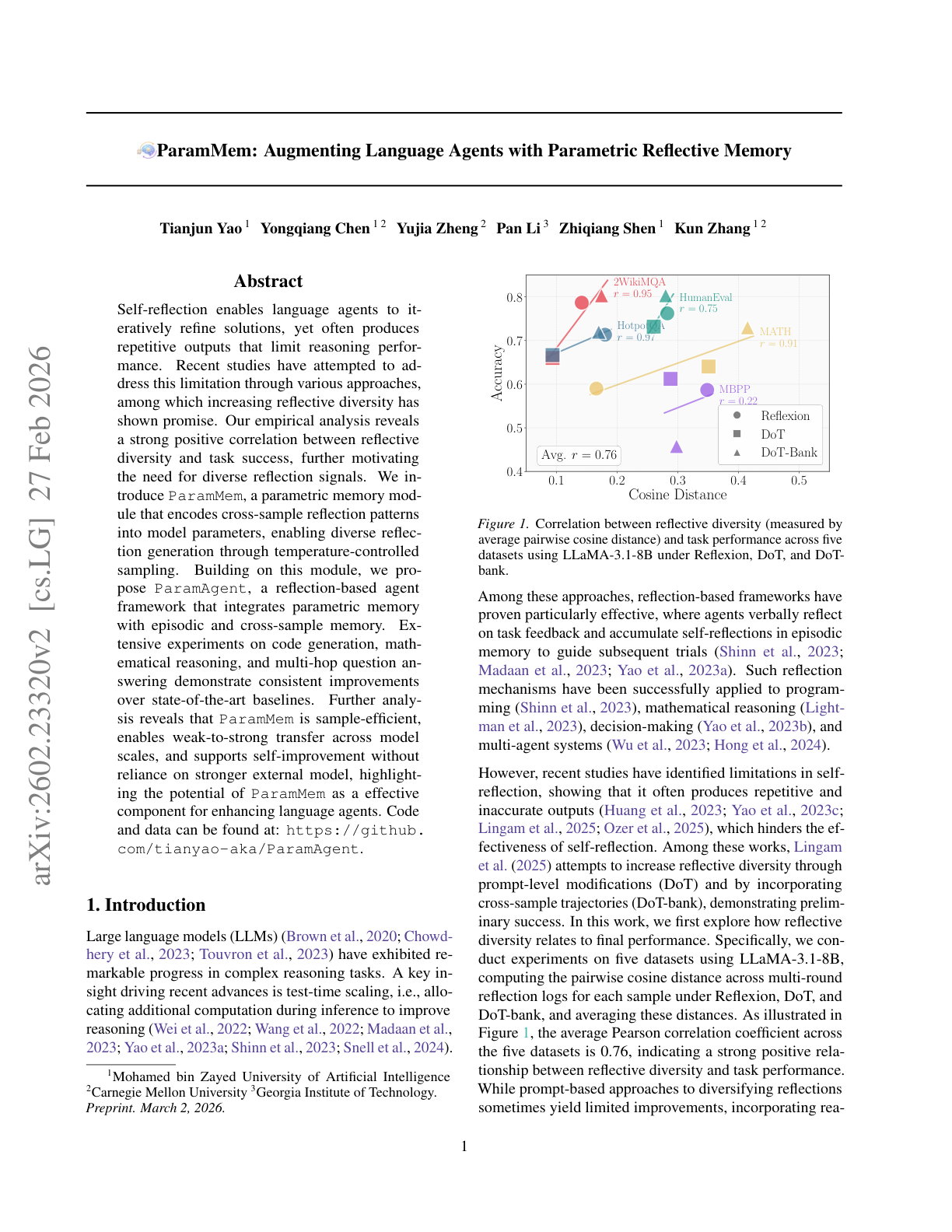
Self-reflection enables language agents to iteratively refine solutions, but models tend to generate repetitive reflections that add noise instead of useful signal. ParamMem introduces a parametric memory module that encodes cross-sample reflection patterns into model parameters, enabling diverse reflection generation through temperature-controlled sampling.
Auton Agentic AI Framework
Snap Research introduces the Auton framework, a declarative architecture for specification, governance, and runtime execution of autonomous agent systems. It addresses a fundamental mismatch: LLMs produce stochastic, unstructured outputs, while backend infrastructure requires deterministic, schema-conformant inputs.
Reaching Agreement Among LLM Agents
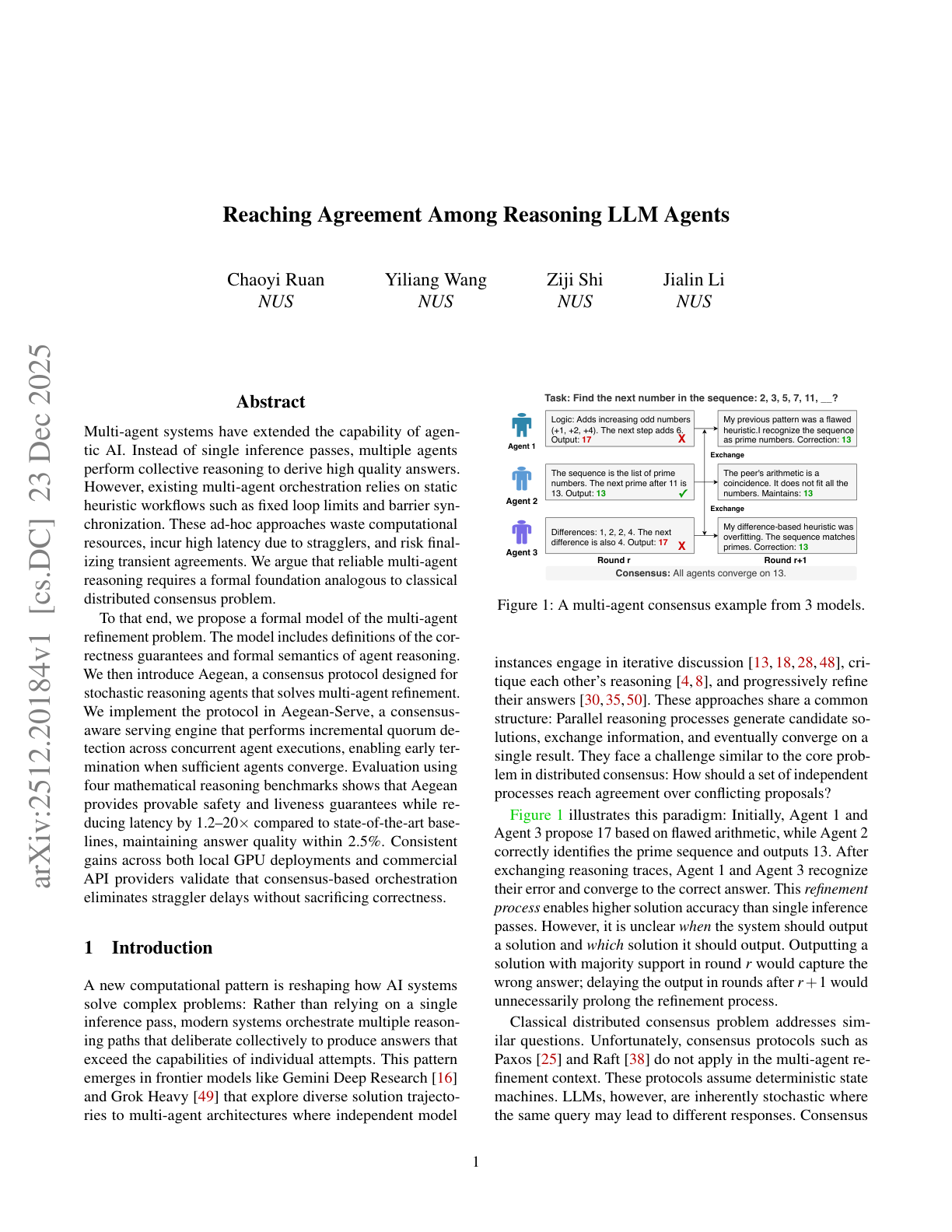
This paper introduces Aegean, a consensus protocol that frames multi-agent refinement as a distributed consensus problem. Rather than static heuristic workflows with fixed loop limits, Aegean enables early termination when sufficient agents converge, achieving 1.2-20x latency reduction across four mathematical reasoning benchmarks while maintaining answer quality within 2.5%. The consensus-aware serving engine performs incremental quorum detection across concurrent agent executions, cutting wasted compute on stragglers.
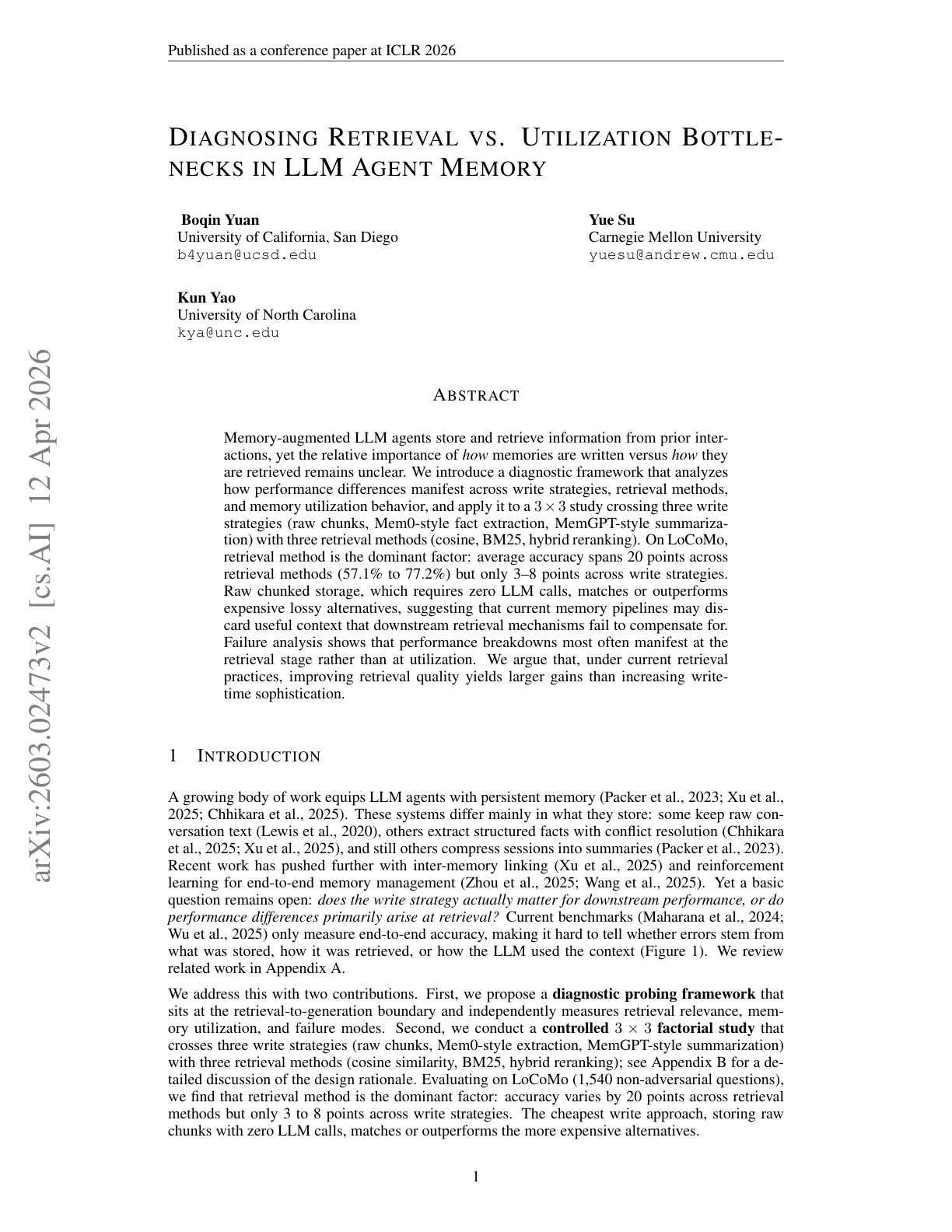
Diagnosing Agent Memory
This paper introduces a diagnostic framework that separates retrieval failures from utilization failures in LLM agent memory systems. Through a 3x3 factorial study crossing three write strategies with three retrieval methods, the authors find that retrieval is the dominant bottleneck, accounting for 11-46% of errors, while utilization failures remain stable at 4-8% regardless of configuration. Hybrid reranking cuts retrieval failures roughly in half, delivering larger gains than any write strategy optimization.
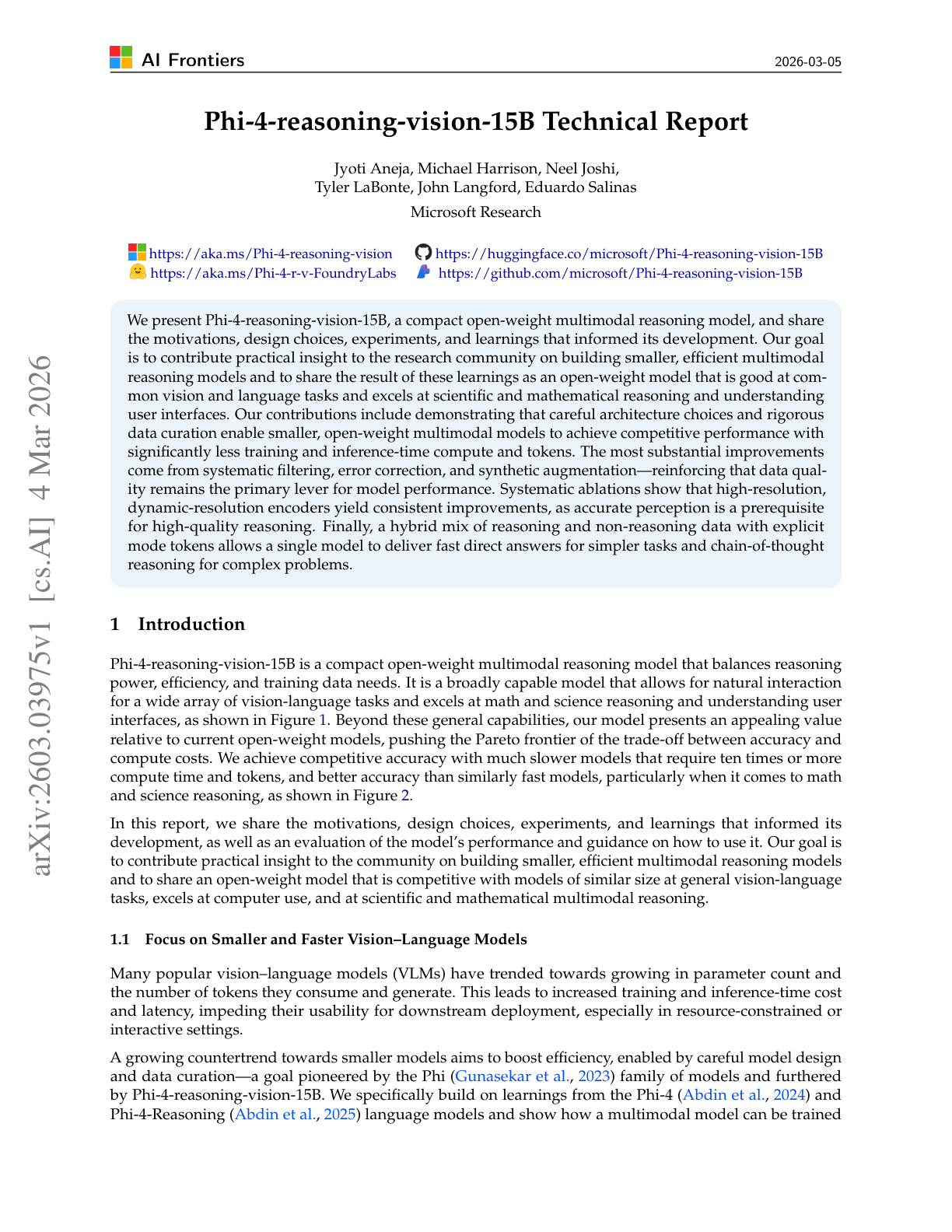
Phi-4-reasoning-vision-15B
Microsoft presents Phi-4-reasoning-vision-15B, a compact open-weight multimodal reasoning model that combines visual understanding with structured reasoning capabilities. Trained on just 200 billion tokens of multimodal data, the model excels at math and science reasoning and UI comprehension while requiring significantly less compute than comparable open-weight VLMs. The key insight is that systematic filtering, error correction, and synthetic augmentation remain the primary levers for model performance, pushing the Pareto frontier of the accuracy-compute tradeoff.