On the Overthinking of LLMs
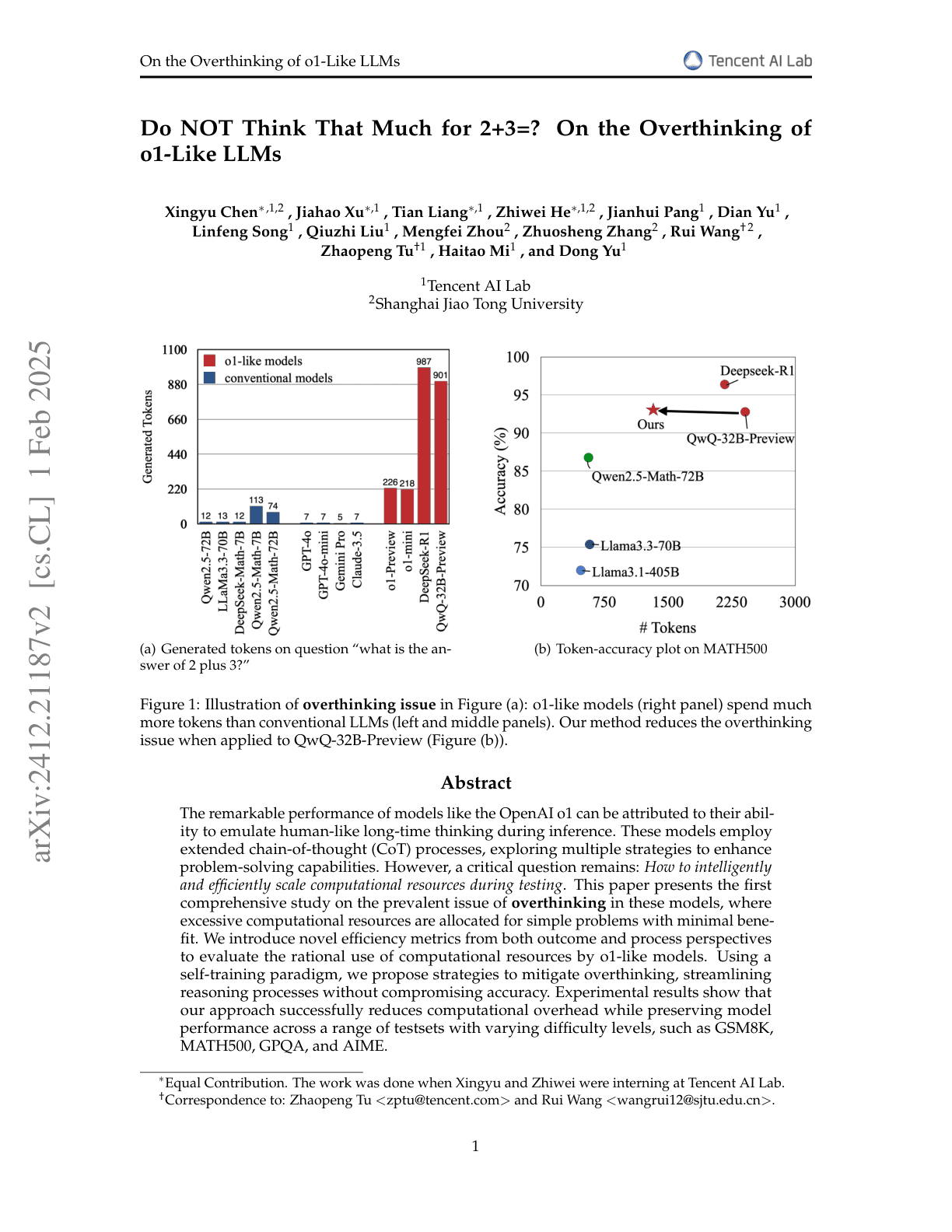
proposes a self-training strategy to mitigate overthinking in o1-like LLMs; it can reduce token output by 48.6% while maintaining accuracy on the widely-used MATH500 test set as applied to QwQ-32B-Preview.
Ask this paper
Abstract
The remarkable performance of models like the OpenAI o1 can be attributed to their ability to emulate human-like long-time thinking during inference. These models employ extended chain-of-thought (CoT) processes, exploring multiple strategies to enhance problem-solving capabilities. However, a critical question remains: How to intelligently and efficiently scale computational resources during testing. This paper presents the first comprehensive study on the prevalent issue of overthinking in these models, where excessive computational resources are allocated for simple problems with minimal benefit. We introduce novel efficiency metrics from both outcome and process perspectives to evaluate the rational use of computational resources by o1-like models. Using a self-training paradigm, we propose strategies to mitigate overthinking, streamlining reasoning processes without compromising accuracy. Experimental results show that our approach successfully reduces computational overhead while preserving model performance across a range of testsets with varying difficulty levels, such as GSM8K, MATH500, GPQA, and AIME.