Agents Are Not Enough
argues that while AI agents show promise, they alone cannot address the challenges in autonomous task execution; proposes a new ecosystem combining three key components: Agents (narrow, purpose-driven modules for specific tasks), Sims (digital representations of user preferences and behaviors), and Assistants (programs that coordinate between users, Sims, and Agents).
OLMo 2
introduces an enhanced architecture, training methods, and a specialized data mixture called Dolmino Mix 1124; the fully transparent model, released at 7B and 13B parameter scales with complete training data and code, matches or outperforms similar open-weight models like Llama 3.1 and Qwen 2.5 while using fewer computational resources, and its instruction-tuned version (OLMo 2-Instruct) remains competitive with comparable models.
Machine-Assisted Proof
examines how mathematicians have long used machines to assist with mathematics research and discusses recent AI tools that are transforming mathematical proof assistance.
Measuring Higher Level Mathematical Reasoning
introduces Putnam-AXIOM, a new math reasoning benchmark with 236 Putnam Competition problems and 52 variations; even the best model considered (OpenAI's o1-preview) achieves only 41.95% accuracy on original problems and performs significantly worse on variations.
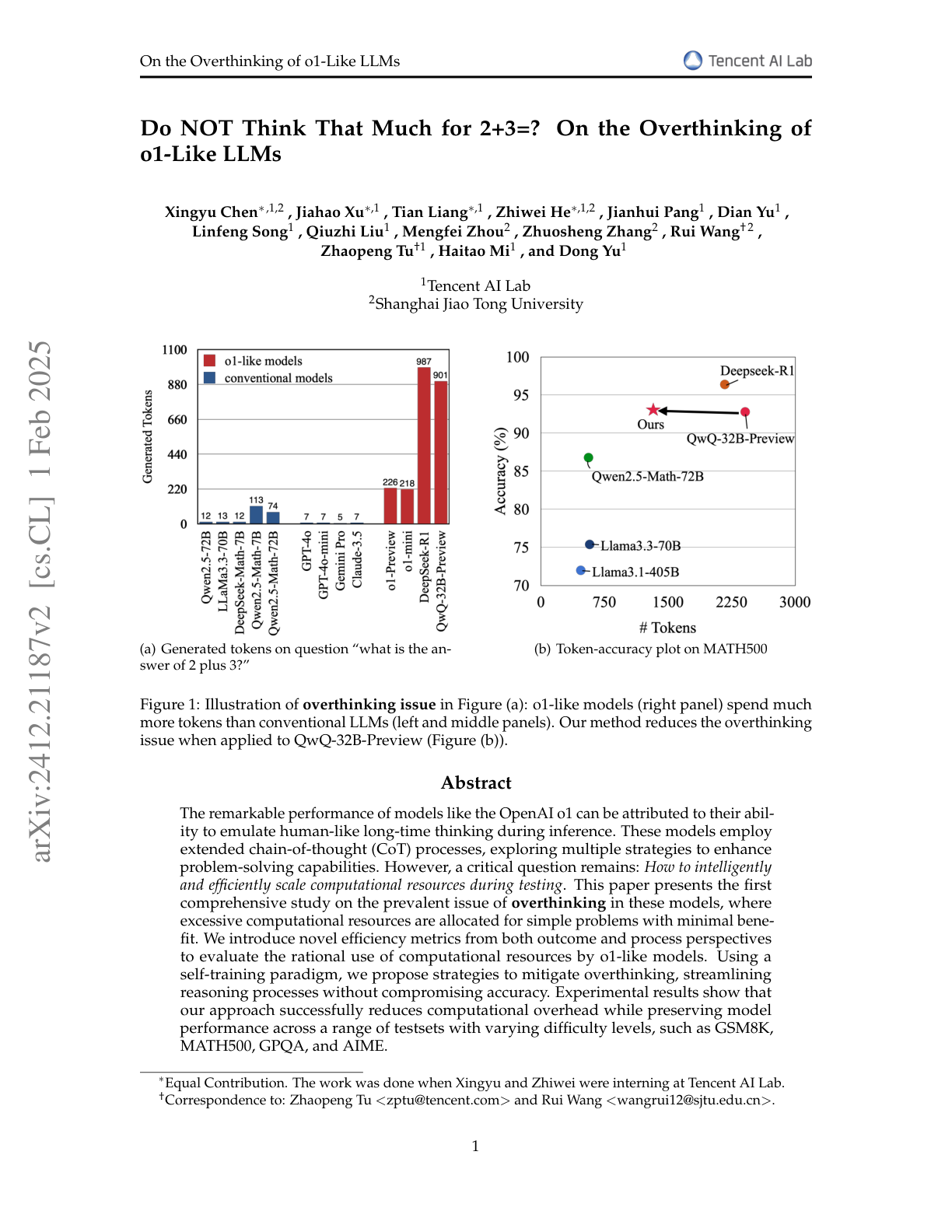
On the Overthinking of LLMs
proposes a self-training strategy to mitigate overthinking in o1-like LLMs; it can reduce token output by 48.6% while maintaining accuracy on the widely-used MATH500 test set as applied to QwQ-32B-Preview.
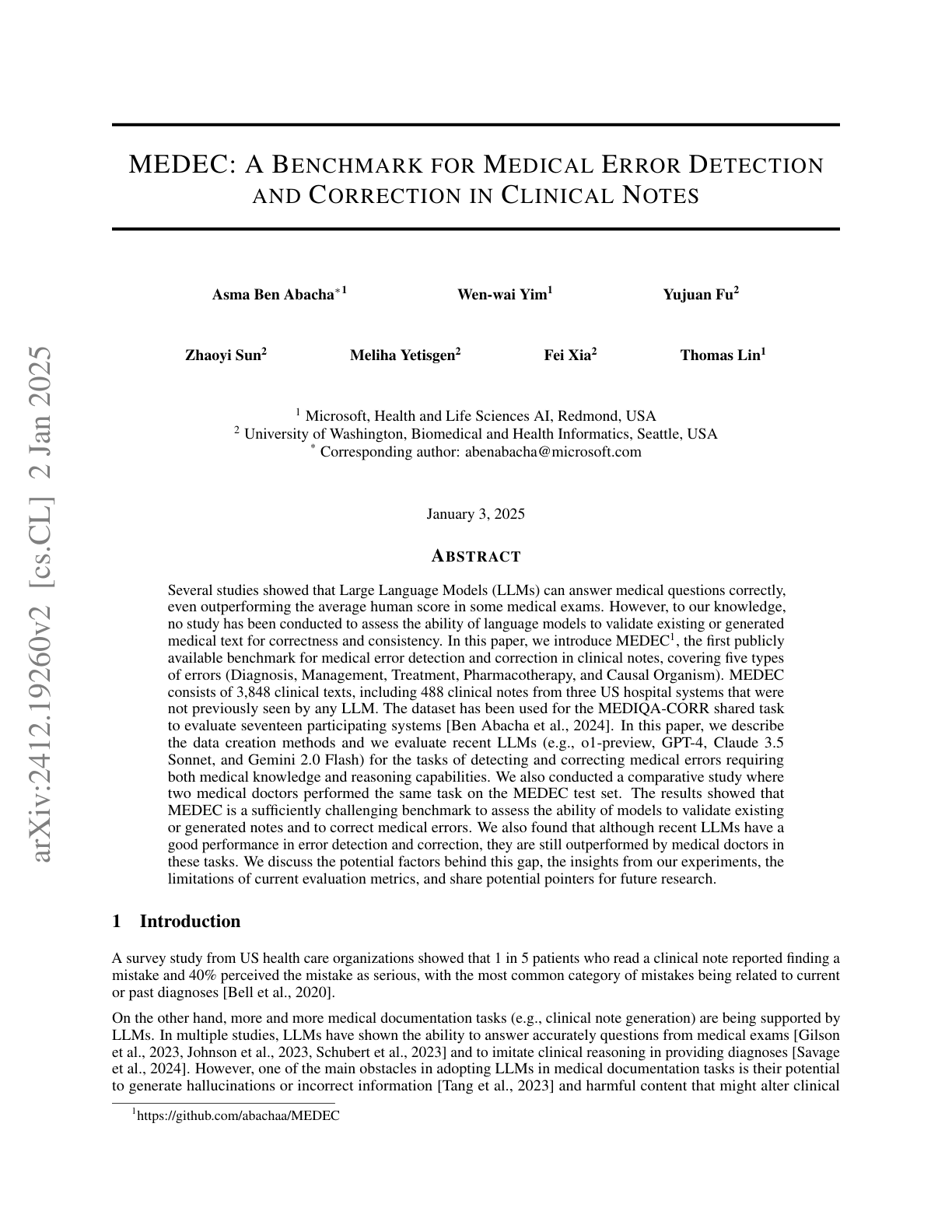
MEDEC
introduces MEDEC, a publicly available benchmark for medical error detection and correction in clinical notes, covering five types of errors (Diagnosis, Management, Treatment, Pharmacotherapy, and Causal Organism); it consists of 3,848 clinical texts, including 488 clinical notes from three US hospital systems; experimental results shows that Cluade 3.5 Sonnet performs better at detecting errors while o1-preview is better at correcting errors.

1.58-bit FLUX
presents the first successful approach to quantizing the state-of-the-art text-to-image generation model, FLUX.1-dev, using 1.58-bit weights (i.e., values in {-1, 0, +1}); the method relies on self-supervision from the FLUX.1-dev model and maintains comparable performance for generating 1024 x 1024 images as the original FLUX model.
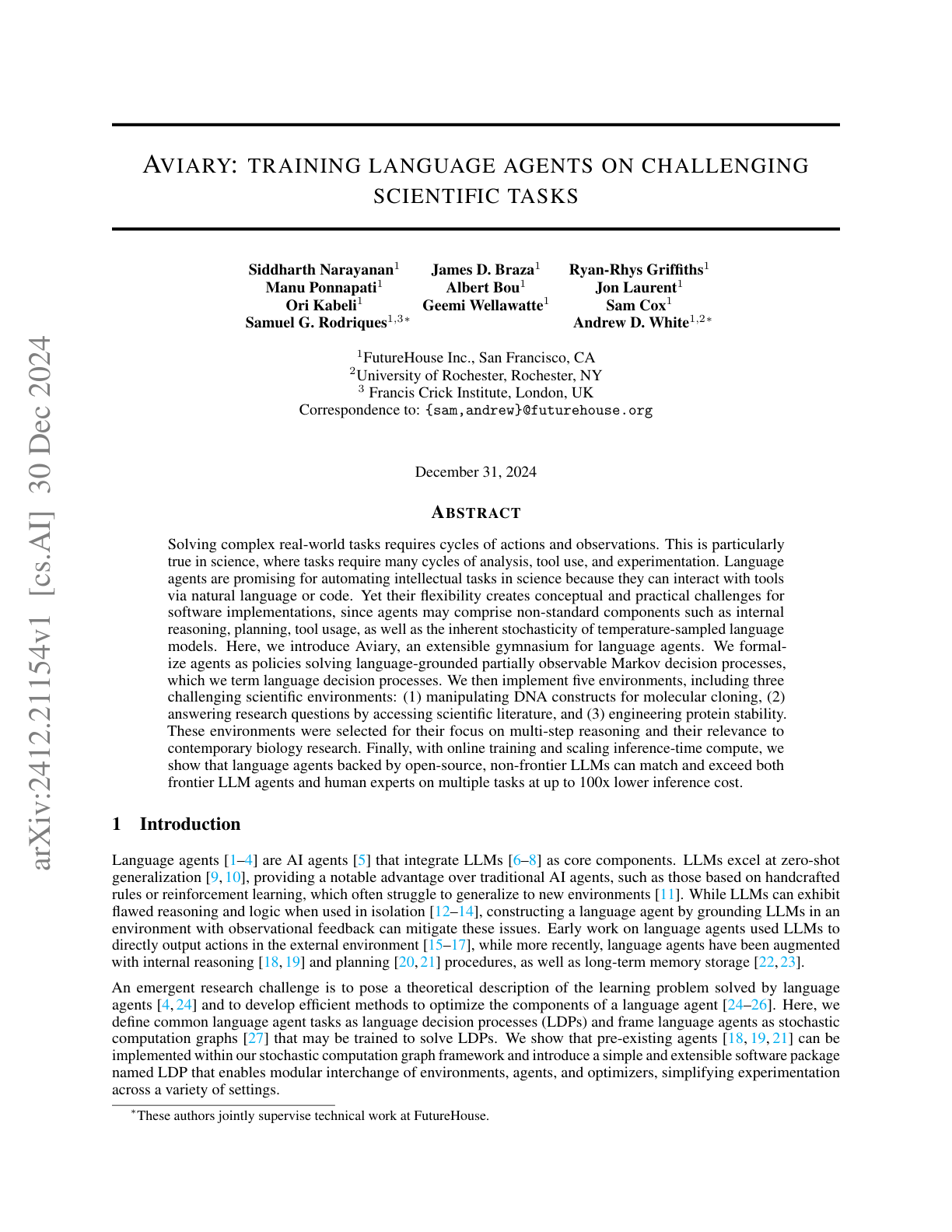
Aviary
an extensible open-source gymnasium that can help build language agents that exceed the performance of zero-shot frontier LLMs and even humans on several challenging scientific tasks.
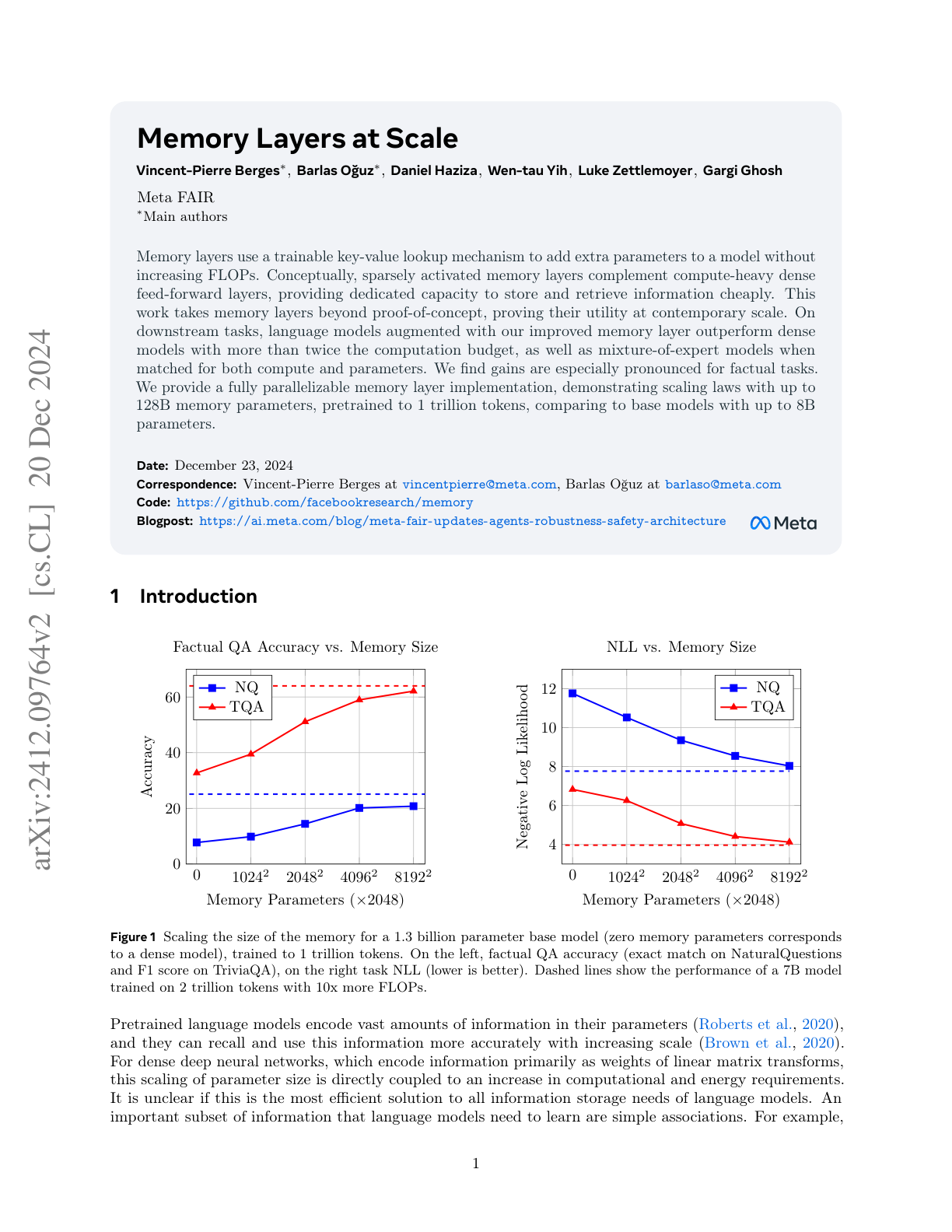
Memory Layers at Scale
demonstrates the effectiveness of memory layers at scale; shows that models with these memory layers outperform traditional dense models using half the computation, particularly in factual tasks; includes a parallelizable memory layer implementation that scales to 128B memory parameters and 1 trillion training tokens, tested against base models up to 8B parameters.
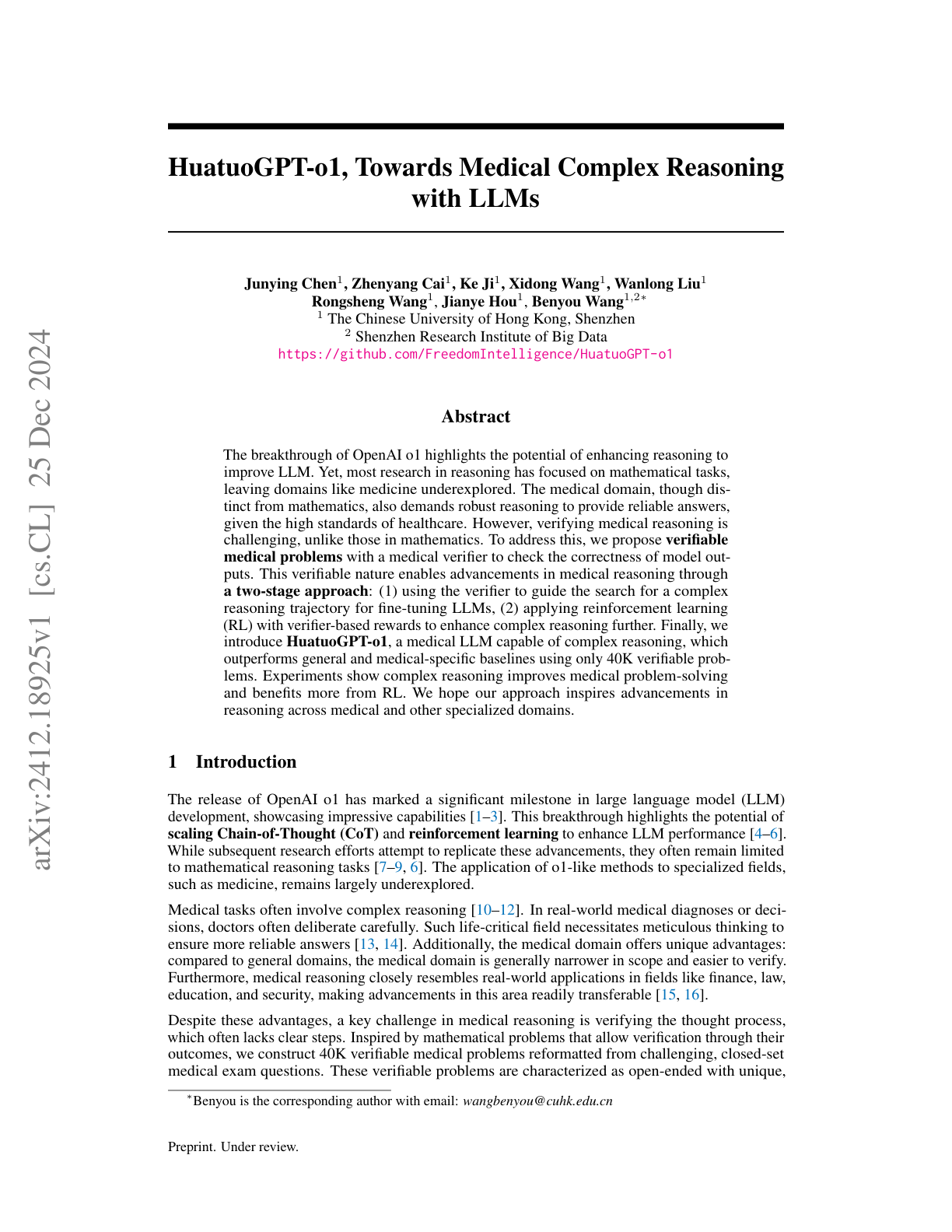
HuatuoGPT-o1
presents a novel approach to improving medical reasoning in language models by using a medical verifier to validate model outputs and guide the development of complex reasoning abilities; the system employs a two-stage approach combining fine-tuning and reinforcement learning with verifier-based rewards, achieving superior performance over existing models while using only 40,000 verifiable medical problems.